
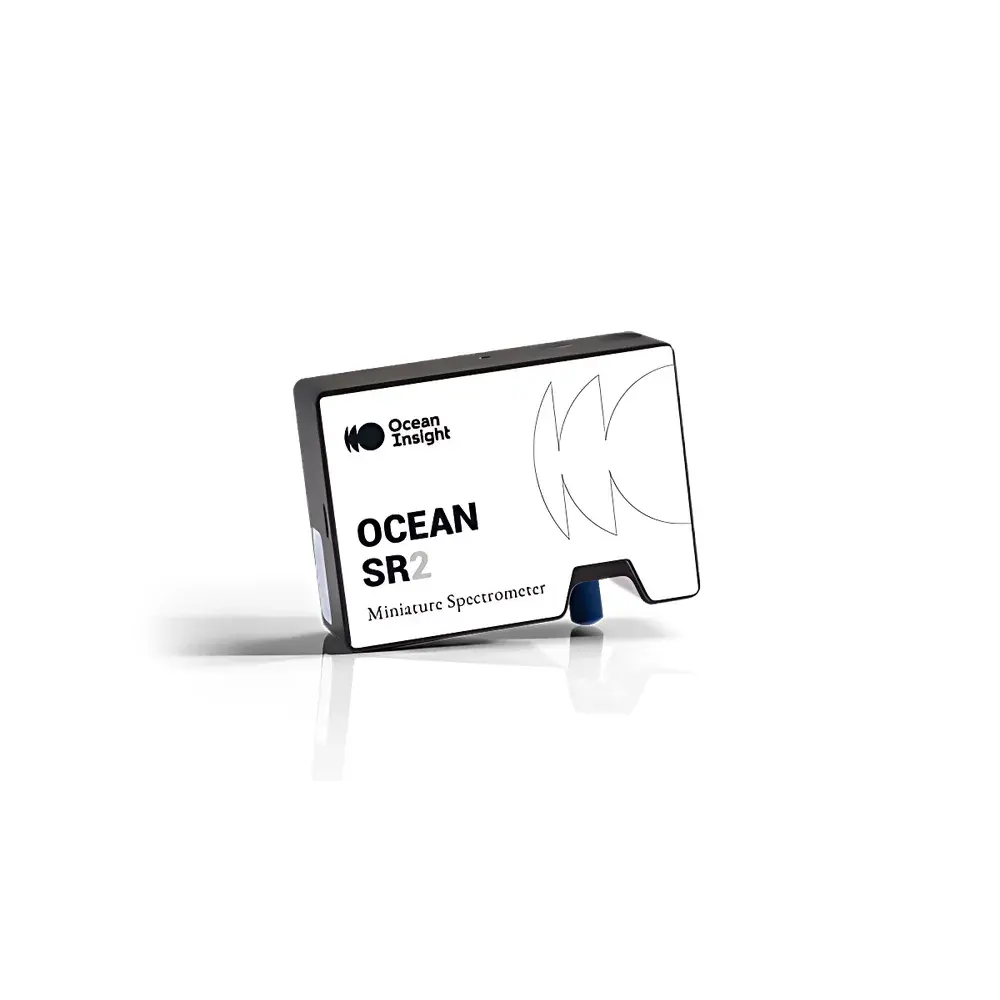
Ocean Optics SR2 Miniature Fiber Optic Spectrometer
| Brand | Ocean Optics |
|---|---|
| Origin | USA |
| Model | SR2 |
| Spectral Range | 185–1100 nm (configuration-dependent) |
| Detector Type | CCD |
| Optical Resolution (FWHM) | 0.56–1.71 nm |
| Signal-to-Noise Ratio | 380:1 (single acquisition) |
| Dynamic Range | 3400:1 (single acquisition) |
| Integration Time | as low as 10 µs |
| Slit Options | 5, 10, 25, 50, 100, or 200 µm |
| Thermal Stability | Engineered for low drift across operating temperatures |
| Inter-unit Consistency | Low unit-to-unit variation via automated precision manufacturing |
Overview
The Ocean Optics SR2 Miniature Fiber Optic Spectrometer is a high-performance, compact dispersive spectrometer engineered for demanding spectroscopic applications requiring both speed and signal fidelity. Based on Czerny-Turner optical architecture with a fixed grating and CCD detector array, the SR2 delivers calibrated spectral data across an extended UV-VIS-NIR range (185–1100 nm), configurable via optical bench selection and slit width. Its core innovation lies in the integration of ultrafast acquisition capability—down to 10 µs integration time—with a single-acquisition signal-to-noise ratio of 380:1 and dynamic range of 3400:1. This combination circumvents the traditional trade-off between speed and sensitivity, enabling reliable spectral capture in transient phenomena such as pulsed laser emission, plasma decay kinetics, and real-time absorbance monitoring in flow cells or reaction vessels.
Key Features
- Sub-10 µs minimum integration time for time-resolved spectroscopy and high-speed process monitoring
- Configurable spectral resolution (0.56–1.71 nm FWHM) achieved through interchangeable entrance slits (5–200 µm)
- Thermally stabilized optical bench design minimizing wavelength drift (<0.02 nm/°C typical) over ambient temperature ranges (15–35 °C)
- Low inter-unit variability ensured by automated alignment and calibration during manufacturing
- Compact footprint (120 × 80 × 35 mm) with SMA 905 fiber input and integrated USB 3.0 interface
- Built-in EEPROM storing calibration coefficients, slit configuration, and grating identification for plug-and-play operation
Sample Compatibility & Compliance
The SR2 interfaces seamlessly with standard 200–600 µm core silica optical fibers and supports common sampling accessories—including cuvette holders, integrating spheres, collimating lenses, and reflection probes—enabling direct coupling to liquid, solid, gas, and plasma samples. Its UV-enhanced optics support quantitative measurements from deep UV (185 nm) without ozone purge, complying with ASTM E275 and ISO 6245 for UV-Vis spectrophotometric performance validation. While not intrinsically certified for hazardous environments, the SR2 meets IEC 61326-1 (EMC for laboratory equipment) and RoHS 2011/65/EU. When deployed in regulated QC/QA workflows, its firmware and OceanDirect SDK support audit-trail-capable data logging aligned with GLP and FDA 21 CFR Part 11 requirements when used with validated host software and procedural controls.
Software & Data Management
Every SR2 ships with OceanDirect—a vendor-supported, cross-platform (Windows, macOS, Linux) software development kit providing low-level API access to all instrument parameters and raw spectral data streams. OceanDirect enables deterministic triggering (hardware TTL sync), multi-spectrometer synchronization, and real-time spectral averaging without proprietary runtime dependencies. It integrates natively with Python (via PyOcean), MATLAB, LabVIEW, and C/C++ environments. Spectral data are output in IEEE 754-compliant floating-point format with full metadata (wavelength array, integration time, dark reference, nonlinearity correction flags). Calibration files conform to the industry-standard Ocean Optics Spectral Calibration Format (OSCF v2.1), ensuring traceability and interoperability with third-party chemometric tools (e.g., Unscrambler, MATLAB PLS Toolbox).
Applications
- Laser characterization: Temporal profiling of Q-switched and mode-locked pulses; linewidth and centroid wavelength stability assessment under thermal load
- Plasma diagnostics: Real-time monitoring of atomic emission lines (e.g., Hα, O I, N II) in low-pressure RF plasmas and laser-induced breakdown spectroscopy (LIBS)
- UV-Vis absorbance quantification: High-dynamic-range transmission measurements in microfluidic reactors and photobioreactors with variable pathlength compensation
- LED and OLED spectral analysis: Binning by dominant wavelength, color rendering index (CRI), and spectral power distribution (SPD) per CIE 127:2007
- In-line process analytical technology (PAT): Integration into pharmaceutical wet granulation or chemical synthesis lines via fiber-coupled immersion probes
FAQ
What slit width should I select for optimal resolution versus throughput trade-off?
Selection depends on application priorities: 5 µm provides highest resolution (~0.56 nm FWHM) at reduced light throughput; 100–200 µm maximizes signal for low-light applications (e.g., fluorescence) with resolution ~1.4–1.7 nm.
Is the SR2 suitable for quantitative absorbance measurements per USP <857>?
Yes—when paired with NIST-traceable calibration standards and validated optical path components, the SR2 meets linearity, repeatability, and stray light requirements specified in USP <857> for UV-Vis spectrophotometers.
Can multiple SR2 units be synchronized for spatially resolved spectroscopy?
Yes—using external TTL trigger signals and OceanDirect’s precise timestamping (±1 µs jitter), up to 16 SR2 spectrometers can be hardware-synchronized for hyperspectral line-scan or multi-point monitoring.
Does the SR2 require periodic recalibration?
Factory calibration remains stable for ≥12 months under normal lab conditions; annual verification using a mercury-argon lamp or NIST SRM 2035 is recommended for GxP environments.
How does thermal drift compare to previous-generation Ocean spectrometers?
The SR2’s monolithic aluminum optical bench and thermally anchored grating reduce wavelength shift to <0.02 nm/°C—approximately 3× better than the legacy QE65000 platform under identical thermal gradients.
Related Products





