
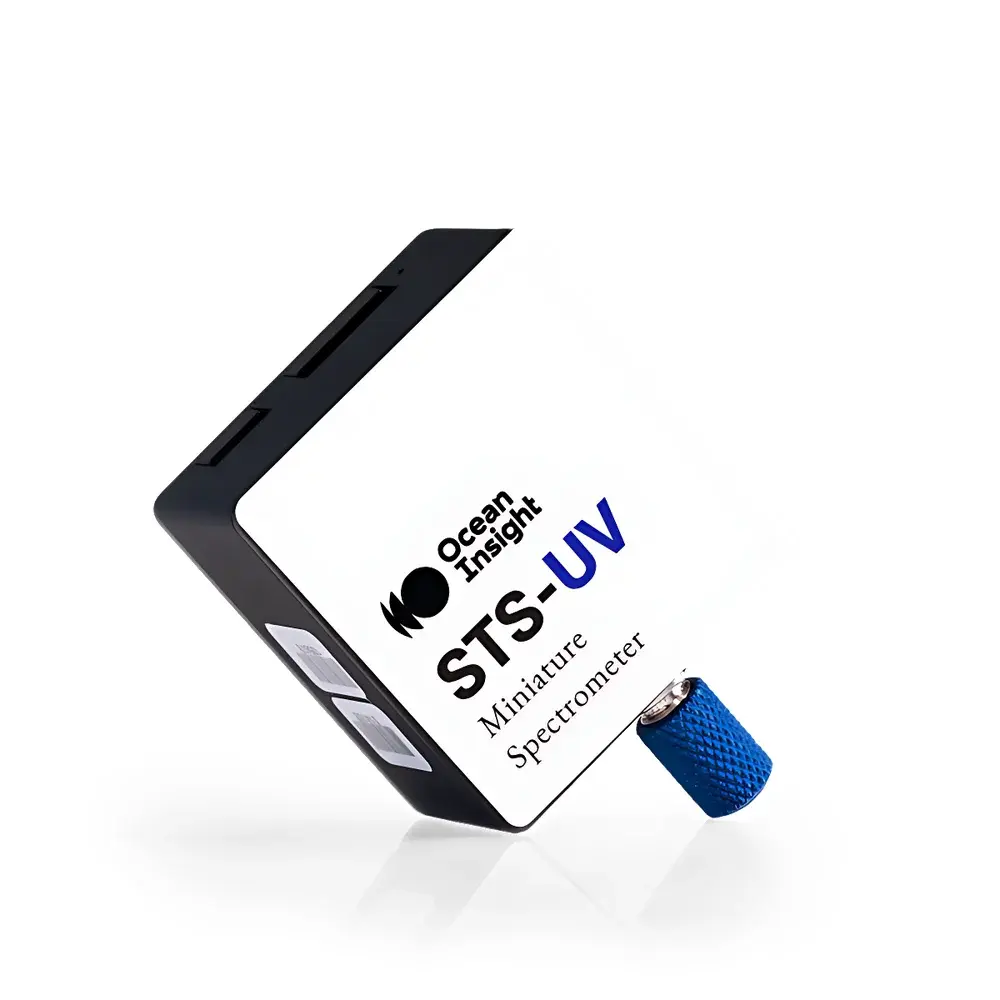
Ocean Optics STS Miniature Fiber Optic Spectrometer
| Brand | Ocean Optics |
|---|---|
| Origin | USA |
| Model | STS Miniature Fiber Optic Spectrometer |
| Spectral Range | 200–1100 nm |
| Detector Type | CMOS |
| Optical Resolution (FWHM) | 1.0–12.0 nm (configurable via slit width) |
| Signal-to-Noise Ratio | >1500:1 (at maximum signal) |
| Dynamic Range | 5×10⁹ (system, 10 s integration) |
| Stray Light | ≤0.25% at 450 nm |
| Dimensions | 40 × 42 × 24 mm |
| Weight | 68 g |
| Integration Time | 10 µs – 10 s |
| Dark Noise | ≤3 counts RMS |
| Grating | 600 lines/mm |
| Input Connector | SMA 905 |
Overview
The Ocean Optics STS Miniature Fiber Optic Spectrometer is a compact, high-performance OEM-grade spectroscopic engine engineered for embedded and portable applications requiring reliable spectral acquisition in constrained physical footprints. Based on a monolithic CMOS linear array detector and optimized Czerny-Turner optical bench architecture, the STS delivers laboratory-grade spectral fidelity—without the bulk or cost of traditional benchtop instruments. Its core measurement principle relies on dispersive spectroscopy: incoming light, coupled via SMA 905 fiber, is collimated, diffracted by a ruled 600 lines/mm grating, and focused onto the CMOS sensor, where wavelength-resolved intensity data is digitized with 16-bit precision. With a total volume under 41 cm³ and mass of only 68 g, the STS is purpose-built for integration into analytical instrumentation, process monitoring systems, handheld sensors, and field-deployable environmental monitors—where thermal stability, mechanical robustness, and electrical interoperability are non-negotiable.
Key Features
- Ultra-compact form factor: 40 × 42 × 24 mm footprint enables seamless integration into space-constrained enclosures and portable devices without compromising optical path integrity.
- High system-level dynamic range: Achieves 5×10⁹ (10 s integration) and ~4600:1 single-scan dynamic range—critical for quantifying both weak and saturated spectral features within the same acquisition.
- Thermally stable spectral response: Optical alignment and detector gain characteristics remain consistent across ambient temperatures from −10 °C to +50 °C, minimizing calibration drift during uncontrolled deployments.
- Configurable resolution & sensitivity: Interchangeable slit widths (10–200 µm) allow users to trade off optical resolution (1.0–12.0 nm FWHM) and throughput per application requirements—e.g., 10 µm for high-resolution UV-Vis identification, 50 µm for NIR reflectance in low-light conditions.
- Low stray light performance: Optimized internal baffling and grating design yield ≤0.25% stray light at 450 nm and ≤0.1% at 750 nm—essential for accurate absorbance measurements and fluorescence background rejection.
- OEM-ready interface: USB 2.0 communication, TTL-compatible trigger input, and programmable GPIO support deterministic synchronization with external light sources, shutters, or motion stages.
Sample Compatibility & Compliance
The STS spectrometer supports direct coupling to standard 200–600 µm core silica optical fibers (NA 0.22), enabling flexible sampling configurations—including reflection probes, immersion probes, flow cells, and integrating spheres. It is compatible with common spectroscopic accessories such as cuvette holders, collimating lenses, and bandpass filters (custom filter integration available upon request). While not certified as a medical device or safety-critical instrument, the STS conforms to IEC 61326-1 (EMC for laboratory equipment) and RoHS 2011/65/EU directives. Its stable baseline and reproducible pixel-to-wavelength mapping make it suitable for applications governed by ISO/IEC 17025 quality management systems, particularly when used in conjunction with traceable NIST-calibrated light sources for routine performance verification.
Software & Data Management
The STS is fully supported by Ocean Insight’s OceanView™ spectroscopy software (Windows/macOS/Linux), providing real-time spectral visualization, mathematical operations (e.g., baseline correction, peak integration, ratioing), and batch processing workflows. For OEM integration, the Ocean HDX SDK delivers comprehensive C/C++, Python, MATLAB, and LabVIEW APIs—including low-level register access, asynchronous acquisition control, and hardware-timed triggering. All firmware and driver packages comply with FDA 21 CFR Part 11 requirements for electronic records and signatures when deployed in regulated environments (e.g., pharmaceutical QC labs), provided audit trails, user authentication, and data integrity safeguards are implemented at the system level. Raw spectral data is exported in industry-standard formats (CSV, ASCII, HDF5) and retains full metadata (integration time, temperature, slit configuration, calibration coefficients).
Applications
- LED and laser diode spectral characterization (peak wavelength, FWHM, CCT, CRI)
- In-line colorimetry and reflectance monitoring in printing, paint, and textile manufacturing
- UV-Vis absorbance and transmittance analysis in microfluidic lab-on-chip platforms
- NIR-based moisture and organic content assessment in agricultural and food processing lines
- Environmental water quality sensing (e.g., nitrate, chlorophyll-a, CDOM via absorption or fluorescence excitation-emission matrices)
- Educational and research-grade spectroscopy modules in undergraduate physics and chemistry labs
- Portable Raman spectrometer excitation source monitoring and laser line stabilization
FAQ
Is the STS spectrometer calibrated at the factory?
Yes—each unit ships with a NIST-traceable irradiance and wavelength calibration certificate. Users may perform optional recalibration using Ocean Insight’s calibration kits (e.g., HG-1 Mercury-Argon lamp, LS-1 halogen tungsten source).
Can the STS operate in continuous acquisition mode?
Yes—it supports streaming acquisition at up to 1,000 spectra per second (depending on integration time and USB bandwidth), with hardware buffering to prevent frame loss during sustained operation.
What is the recommended fiber core size for optimal coupling efficiency?
A 400 µm core, 0.22 NA multimode fiber provides optimal balance between throughput and resolution across the full 200–1100 nm range; smaller cores improve resolution but reduce signal-to-noise in low-light applications.
Does the STS support temperature compensation during long-term measurements?
The onboard thermistor enables software-based wavelength correction algorithms; OceanView and the HDX SDK include built-in temperature compensation routines that adjust pixel-to-wavelength mapping based on real-time sensor readings.
Are custom firmware modifications available for OEM customers?
Yes—Ocean Insight offers tailored firmware development services, including custom boot sequences, proprietary command sets, and embedded spectral preprocessing (e.g., dark subtraction, smoothing, or peak detection) executed on-device.
Related Products





