
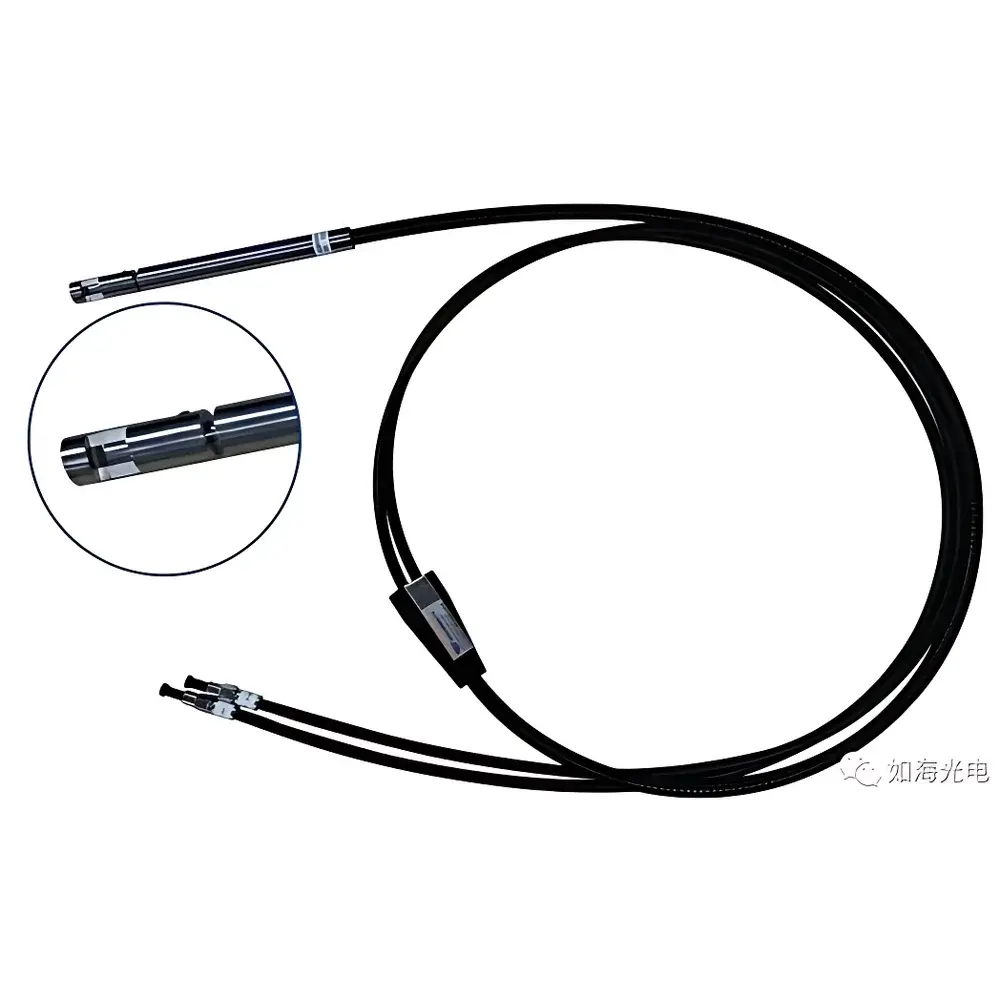
Oceanhood Dr Variable-Pathlength Immersion Transmission Probe
| Brand | Oceanhood |
|---|---|
| Origin | Shanghai, China |
| Manufacturer Type | Manufacturer |
| Origin Category | Domestic (China) |
| Model | Dr |
| Price Range | USD 0.15–1499 |
| Probe Rod Length | 160 mm (customizable) |
| Probe Rod Diameter | 12 mm (customizable) |
| Fiber Core Diameter | 600 µm |
| Wavelength Range | 350–2500 nm |
| Adjustable Gap | 0.5–10 mm |
| Adjustable Optical Pathlength | 1–20 mm |
| Spectrometer Interface | SMA905 |
| Optional Flanges | DN15 / DN25 / DN32 |
| Max Operating Pressure (Tip) | 10 bar @ 25 °C |
| Operating Temperature | –20 °C to +80 °C (body), up to +200 °C (immersed tip) |
Overview
The Oceanhood Dr Variable-Pathlength Immersion Transmission Probe is an engineered optical interface designed for in situ and real-time absorbance or transmittance measurement of liquid-phase samples in process environments. Unlike conventional cuvette-based spectrophotometric systems—where sampling, transfer, and containment introduce delays, contamination risks, and representativeness errors—the Dr probe enables direct immersion into the process stream. Light propagates through the sample via a collimated path defined by two precisely aligned optical windows at the probe tip; the sample flows freely through the adjustable gap between them. This configuration leverages Beer–Lambert law-compliant transmission geometry while eliminating the need for sample extraction or flow-cell integration. The probe operates across a broad spectral range (350–2500 nm), supporting UV-Vis, NIR, and short-wave IR spectroscopic modalities. Its modular mechanical design accommodates diverse industrial vessels, bioreactors, pipelines, and wastewater channels—making it suitable for continuous monitoring where regulatory compliance, process reproducibility, and measurement traceability are critical.
Key Features
- Continuously adjustable optical pathlength (1–20 mm) and fluid gap (0.5–10 mm), enabling dynamic optimization for varying analyte concentrations without hardware replacement
- High-temperature capability: immersed tip rated to +200 °C, allowing deployment in sterilization-in-place (SIP) and high-temperature reaction monitoring applications
- Pressure-rated construction: probe tip withstands up to 10 bar at 25 °C, validated per ISO 15848-1 for fugitive emission control in sealed systems
- 600 µm core multimode fiber with SMA905 termination ensures efficient coupling to benchtop, portable, and OEM spectrometers—including Ocean Insight, Avantes, Hamamatsu, and StellarNet platforms
- Customizable flange interfaces (DN15, DN25, DN32) compliant with DIN EN 1092-1 and ASME B16.5 standards for sanitary and industrial process integration
- Stainless steel 316L body with fused-silica optical windows provides chemical resistance to acids, bases, solvents, and biological media under GMP-relevant conditions
Sample Compatibility & Compliance
The Dr probe is compatible with homogeneous liquids, suspensions with particle sizes <5 µm, and low-viscosity Newtonian fluids (µ < 50 cP). It is not recommended for highly scattering colloids, viscous polymer melts, or abrasive slurries without upstream filtration. The probe meets material compatibility requirements outlined in USP <1058> Analytical Instrument Qualification and supports IQ/OQ/PQ documentation protocols. Its pressure and temperature ratings align with IEC 61511 functional safety guidelines for SIL-2 capable installations. For pharmaceutical manufacturing, the design supports alignment with FDA 21 CFR Part 11 data integrity expectations when paired with audit-trail-enabled spectrometer software.
Software & Data Management
While the probe itself is hardware-only, it integrates seamlessly with third-party spectroscopy platforms offering real-time chemometric modeling (e.g., PLS, PCR, PCA). When used with Oceanhood’s OCEAN-SPECTRA™ software suite or open-source tools like Python-based PySpectra, users can implement automated pathlength compensation algorithms that dynamically correct absorbance values based on physical gap calibration. Raw intensity data (I0, I) is timestamped and exported in ASTM E131-compliant .jdx or HDF5 formats. All configuration parameters—including gap setting, calibration wavelength, and temperature offset—are stored in metadata headers to satisfy GLP audit requirements.
Applications
- Pharmaceutical process analytical technology (PAT): real-time monitoring of API concentration, solvent composition, and reaction endpoint in jacketed reactors and crystallizers
- Wastewater treatment: online quantification of nitrate, nitrite, and organic carbon via UV-254 absorbance with auto-compensated pathlength for variable turbidity
- Bioprocess monitoring: non-invasive tracking of glucose, lactate, and viable cell density in mammalian and microbial fermenters using NIR spectral fingerprints
- Chemical manufacturing: closed-loop control of dye concentration, catalyst activity, and polymerization degree in continuous stirred-tank reactors (CSTRs)
- Food & beverage QA: inline verification of color stability, ethanol content, and adulterant detection during blending and pasteurization
FAQ
Can the Dr probe be used in explosive atmospheres?
No—standard models lack ATEX or IECEx certification. Intrinsically safe variants require custom housing and fiber-optic isolation; contact Oceanhood Engineering for hazardous-area qualification pathways.
Is pathlength calibration traceable to NIST standards?
Yes—calibration kits include certified gauge blocks (NIST-traceable, ±0.5 µm uncertainty) and spectral reference standards (SRM 2036, SRM 2068) for end-to-end metrological validation.
Does the probe support bidirectional light propagation (e.g., for reflectance mode)?
No—it is optimized exclusively for collinear transmission geometry. For combined transmission/reflection measurements, Oceanhood recommends the dual-probe DR-TR series with synchronized trigger synchronization.
What maintenance is required for long-term operation?
Routine inspection of window clarity and gap clearance every 500 operating hours; cleaning with IPA and lint-free wipes. No lubrication or recalibration is needed under specified pressure/temperature limits.
Can I integrate this probe with my existing LabVIEW or MATLAB control system?
Yes—SMA905 interface allows direct connection to any spectrometer with SDK support. Oceanhood provides documented DLLs and MATLAB Live Script examples for pathlength-aware spectral acquisition and baseline correction.
Related Products




