
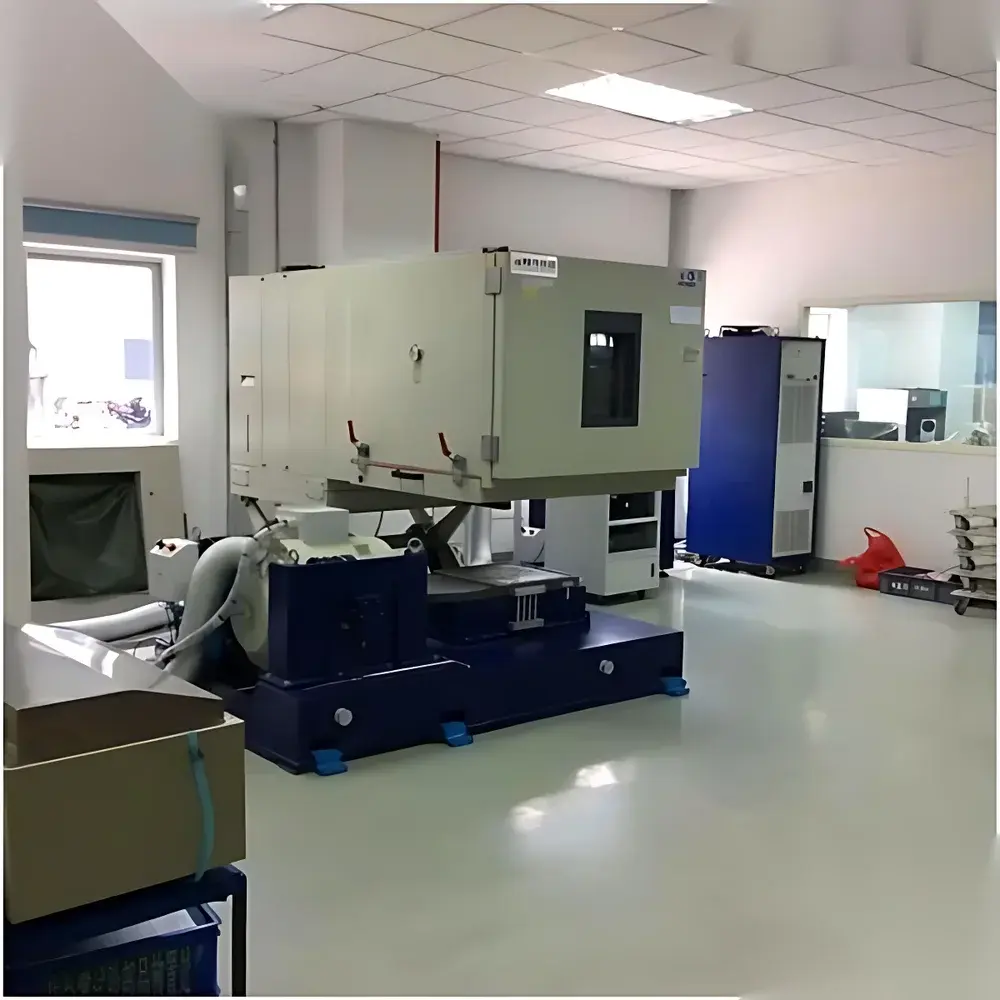
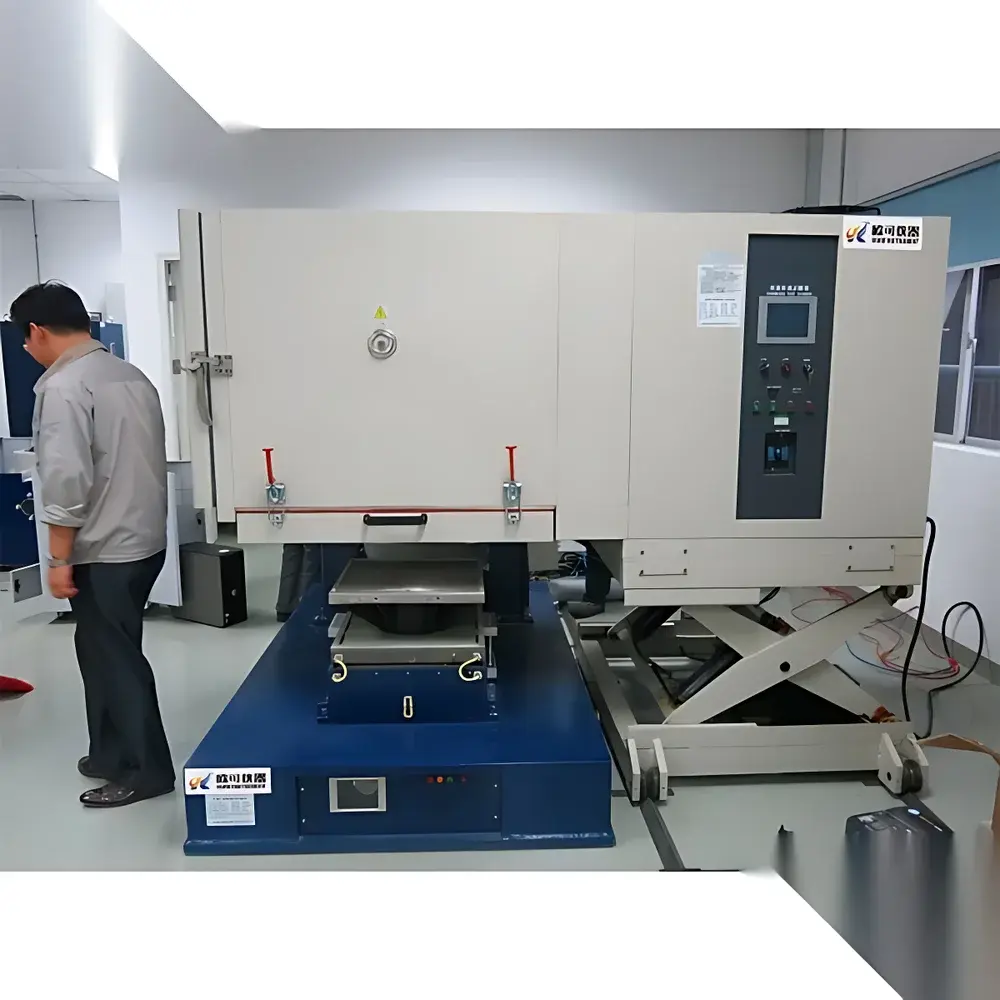
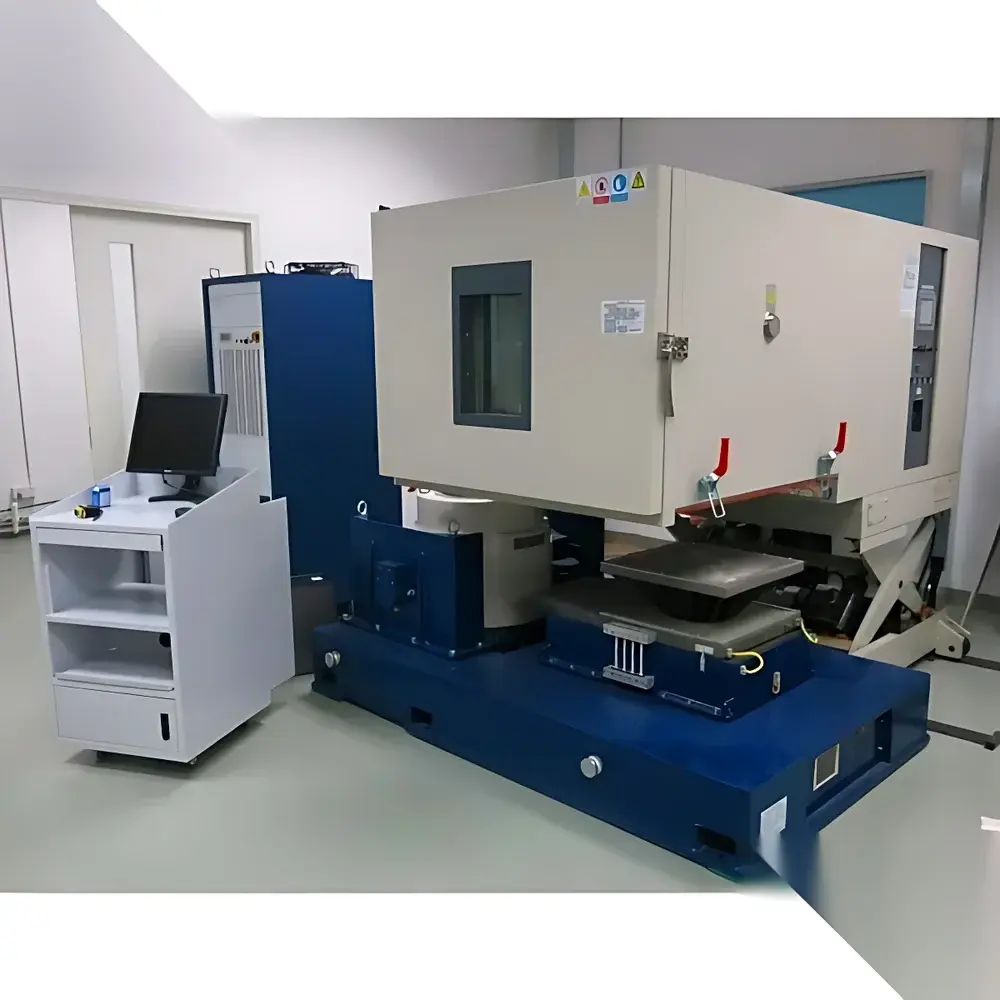
OEKO Combined Temperature-Humidity-Vibration Test Chamber for Automotive Applications
| [Brand | Other Brands |
|---|---|
| Origin | Imported |
| Manufacturer Type | Authorized Distributor |
| Temperature Range | -20°C to 150°C / -40°C to 150°C / -60°C to 150°C |
| Temp. Uniformity | ≤ ±2°C |
| Temp. Stability | ±0.5°C |
| Temp. Deviation | ≤ ±2°C |
| Ramp Rate | 0.7–1.0°C/min |
| Time Setting Range | 0–9999 h |
| Sinusoidal Force Capacity | 2.94 kN (300 kgf) |
| Frequency Range | 5–500 Hz |
| Max. Acceleration | 980 m/s² (100 g) |
| Max. Velocity | 1.1 m/s |
| Max. Displacement | 25 mm p-p |
| Moving Mass | 2.7 kg |
| Payload Capacity | 120 kg |
| Table Size | 150 mm × 150 mm |
| Vibration Axis | Vertical (Z-axis only) |
| Power Supply | AC 380 V ±10%, 50 Hz, 3-phase 5-wire |
| Refrigeration | Twin-stage or single-stage cascade system with Tecumseh (France) hermetic compressors, Parker (USA) dry filters, GY (Taiwan) oil separators, CASTEL (Italy) solenoid valves] |
Overview
The OEKO Combined Temperature-Humidity-Vibration Test Chamber is an engineered environmental simulation platform designed specifically for automotive component validation under simultaneous thermo-mechanical stress conditions. It integrates three independent yet synchronized test domains—temperature, humidity, and electrodynamic vibration—within a single chamber architecture, enabling realistic replication of real-world operational environments encountered by automotive ECUs, sensors, infotainment modules, battery management systems, and structural assemblies. The system operates on the principle of coupled environmental stress screening (ESS), where thermal cycling and mechanical excitation are applied concurrently to accelerate latent defects, reveal interface fatigue, and verify long-term reliability per ISO 16750-4, SAE J2380, and GMW 3172 requirements. Its modular design allows vibration actuator retraction via precision linear rails when static thermal-humidity testing is required—eliminating cross-domain interference and preserving calibration integrity across test modes.
Key Features
- Modular vibration subsystem with retractable electromagnetic shaker mounted on heavy-duty linear guide rails—enabling seamless transition between combined and isolated environmental testing.
- Multi-layer sealing interface between the vibration table and chamber base: alternating layers of high-temperature epoxy resin and silicone rubber ensure hermetic integrity at temperatures up to 150°C while maintaining dynamic compliance during 100 g acceleration events.
- Dual-independent control architecture: temperature/humidity and vibration subsystems operate via separate PID controllers and feedback loops—preventing signal crosstalk and ensuring traceable, repeatable parameter execution per IEC 60068-2-64 and MIL-STD-810H Annex G.
- Chamber construction: A3 carbon steel outer shell with electrostatic powder coating; SUS304 stainless steel mirror-finish inner liner; high-density ultra-fine glass wool insulation (thermal conductivity ≤ 0.035 W/m·K).
- Climate control system: Top-mounted low-noise Xiangming centrifugal blower with multi-wing impeller; bottom return air ducting; uniform airflow distribution achieving ≤ ±2°C spatial uniformity across full working volume.
- Observation window: Triple-layer laminated tempered glass with embedded conductive ITO film—providing unobstructed visual monitoring while maintaining EMI shielding and anti-fog performance during condensing humidity cycles.
- Standard 50 mm diameter cable port (left-side mounted) with silicone gasket seal—compatible with external power supplies, thermocouple feeds, and analog/digital I/O lines under continuous operation.
Sample Compatibility & Compliance
The chamber accommodates automotive-grade DUTs up to 120 kg mass and 150 mm × 150 mm footprint, including engine control units, ADAS radar housings, HVAC actuators, and lightweight composite brackets. Its vertical-only (Z-axis) vibration configuration meets the directional emphasis specified in ISO 16750-3 for road-induced excitations. Humidity control spans 20–98% RH with rapid dew-point recovery, supporting condensation, damp heat, and freeze-thaw protocols aligned with ISO 60068-2-30 and VW PV1210. All electrical safety circuits comply with IEC 61000-4 series EMC standards, and refrigeration components—including Tecumseh compressors and CASTEL solenoid valves—carry CE, UL recognition, and RoHS certification. Full system documentation supports GLP/GMP audit readiness, including calibration traceability to NIST standards and configurable test log metadata (operator ID, timestamp, setpoint history).
Software & Data Management
The integrated controller features a 10.1-inch capacitive touchscreen HMI running embedded Linux with real-time OS kernel. Test profiles are programmable via intuitive drag-and-drop sequencing, supporting ramp-soak-dwell cycles, random vibration spectra (PSD), and sine-sweep functions—all exportable as XML or CSV for third-party analysis. Data logging records temperature, humidity, acceleration, velocity, displacement, and chamber pressure at user-defined intervals (minimum 100 ms). Audit trails include operator login/logout timestamps, parameter modification logs, and alarm event histories—fully compliant with FDA 21 CFR Part 11 requirements for electronic records and signatures. Optional Ethernet/IP and Modbus TCP interfaces enable integration into enterprise MES platforms such as Siemens Opcenter or Rockwell FactoryTalk.
Applications
- Accelerated life testing of EV battery enclosures under thermal shock + road vibration loading.
- Validation of infotainment display adhesion strength during cyclic humidity exposure and resonant frequency sweeps.
- Reliability screening of ABS hydraulic modulators subjected to combined -40°C cold soak and 50 Hz sinusoidal excitation.
- Qualification of camera lens mounts per ISO 16750-4 for micro-crack initiation under simultaneous 85°C/85% RH and broadband random vibration (20–2000 Hz).
- Thermal-mechanical fatigue assessment of aluminum die-cast chassis brackets using step-stress profiles defined in SAE J2244.
FAQ
What standards does this chamber support for automotive qualification?
It enables full compliance with ISO 16750-3 (mechanical loads), ISO 16750-4 (climatic loads), SAE J2380 (vibration durability), GMW 3172 (combined environment), and Ford CETP 00.00-L-467.
Can the vibration system be used independently without temperature/humidity control?
Yes—the shaker module is fully decoupled and can operate standalone at full rated performance (up to 100 g, 5–500 Hz) while the chamber remains at ambient conditions.
Is remote monitoring and control supported?
Standard Ethernet connectivity allows secure web-based access to real-time data, alarm status, and profile management via HTTPS with TLS 1.2 encryption.
What maintenance intervals are recommended for the refrigeration system?
Compressor oil and filter replacement every 12 months or 3000 operating hours; annual calibration of PT100 temperature sensors and capacitive humidity probes against NIST-traceable references.
How is data integrity ensured during extended 9999-hour tests?
Non-volatile internal storage retains all logged parameters even during power interruption; automatic resume functionality restores test execution from last valid checkpoint upon power recovery.



