
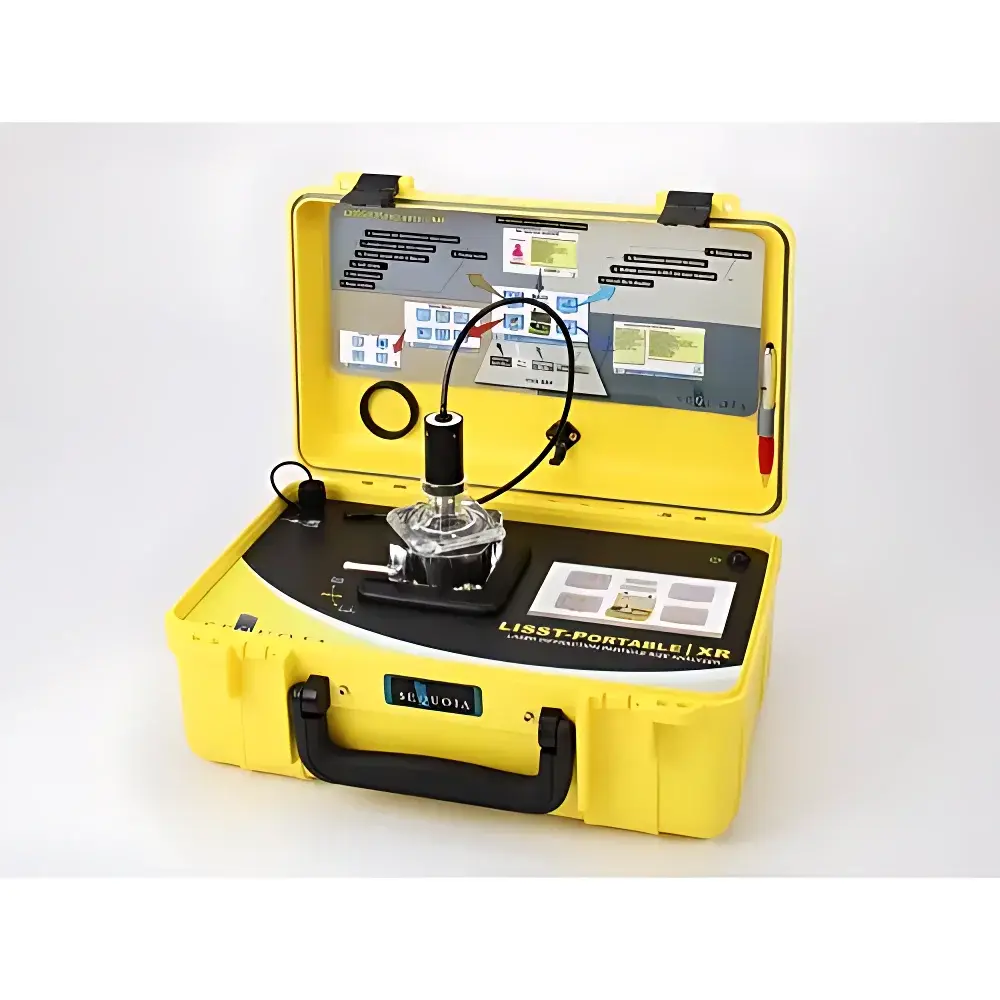
OFITE 365-10 Portable Laser Diffraction Particle Size Analyzer
| Brand | OFITE |
|---|---|
| Origin | USA |
| Manufacturer Status | Authorized Distributor |
| Origin Category | Imported |
| Model | 365-10 |
| Dispersion Method | Wet Dispersion |
| Measurement Range | 0.34–500 µm |
| Data Storage | 128 MB Flash Memory (≥40,000 samples) |
| Battery Life | Up to 6 hours |
| Dimensions (H×D×W) | 17.7 × 29 × 44.3 cm |
| Weight | 7.5 kg |
| Ultrasonic Probe | 25 W, 40 kHz |
| Compliance | ISO 13320-1 |
Overview
The OFITE 365-10 Portable Laser Diffraction Particle Size Analyzer is the world’s only battery-powered, field-deployable instrument engineered for real-time, in-situ particle size distribution (PSD) and volumetric concentration analysis via laser diffraction. Unlike benchtop systems requiring AC power, dedicated lab infrastructure, or external computing, the 365-10 integrates a stabilized He-Ne laser source, precision optical train, and embedded Mie/Fraunhofer scattering algorithms into a ruggedized, self-contained platform. Its core measurement principle adheres strictly to ISO 13320-1:2020, ensuring traceable, standardized quantification of particle size across 44 logarithmically spaced channels spanning 0.34–500 µm. Designed for both field deployment and controlled laboratory use, it enables wet-dispersion analysis of suspensions without sample transfer delays—critical for applications where particle agglomeration, hydration state, or time-sensitive rheological behavior must be preserved.
Key Features
- Integrated wet dispersion system with recirculating peristaltic pump and mixing chamber—optimized to maintain suspension stability of dense, coarse, or high-density particles (e.g., sand, catalysts, drilling cuttings)
- Self-contained operation: rechargeable lithium-ion battery (6-hour runtime), onboard ARM-based processor, 7-inch capacitive touchscreen interface, and internal 128 MB flash memory supporting ≥40,000 full-sample records
- Ruggedized optical path with shock-absorbing mounts and sealed optics—certified for transport and operation in industrial field environments (IP54-rated enclosure)
- Built-in 25 W, 40 kHz ultrasonic probe with programmable duty cycle and amplitude control—enabling reproducible de-agglomeration directly within the measurement cell
- On-device SOP execution: touch-driven method setup, automated measurement sequence, real-time data visualization, and ASCII-formatted result export (no PC dependency)
- Dual optical models selectable via GUI: Mie theory (with user-defined refractive index and absorption coefficient) and Fraunhofer approximation—supporting method flexibility across diverse material classes
Sample Compatibility & Compliance
The 365-10 is validated for aqueous and non-aqueous suspensions with solid concentrations ranging from 30–1,900 mg/L, depending on particle morphology and optical properties (e.g., ISO Fine: 30 mg/L at 95% transmission; ISO Coarse: 95 mg/L at 95% transmission). It accommodates particles with D10 as low as 1.5 µm and D90 up to 175 µm—covering fine clays, ground glass standards, silica fumes, and coarse sands. All measurements comply with ISO 13320-1 for laser diffraction methodology, including beam alignment verification, detector calibration, and background subtraction protocols. While not FDA-registered, its data structure supports GLP/GMP-aligned workflows: each stored record includes timestamp, operator ID (user-input field), battery voltage, transmission %, raw scattering pattern, and full statistical output—enabling audit-ready traceability.
Software & Data Management
The embedded firmware provides complete standalone operation: no host PC, drivers, or proprietary software installation required. The touchscreen interface supports multilingual labels (English default), customizable report templates, and direct export of ASCII (.txt) files containing all computed parameters—including D5, D10, D16, D25, D50 (median), D60, D75, D84, D90, D95, span (D90–D10)/D50, Hazen uniformity coefficient (D60/D10), specific surface area (calculated), powder volume fraction, volumetric concentration, and optical transmission. Files are retrievable via USB 2.0 port or SD card slot. No cloud connectivity or remote telemetry is implemented—ensuring data sovereignty and compliance with air-gapped operational requirements common in oilfield, environmental, and defense sectors.
Applications
- Drilling fluid solids analysis: real-time monitoring of barite, bentonite, and drilled solids in mud streams during ROP optimization and solids control validation
- Environmental sediment characterization: on-site grain-size distribution of riverbed, estuarine, or dredged materials per ASTM D422 and ISO 14688
- Pharmaceutical excipient QC: rapid assessment of lactose, microcrystalline cellulose, or API suspensions in wet granulation development
- Industrial mineral processing: inline slurry analysis for grinding circuit optimization and cyclone overflow verification
- Research-grade field studies: aerosol precursor suspension analysis, volcanic ash dispersion modeling, and soil erosion benchmarking
FAQ
Does the 365-10 require external calibration standards?
No. Factory calibration is performed using NIST-traceable polystyrene latex (PSL) standards and verified against ISO 13320-1 reference materials. Field recalibration is not supported; optical integrity is monitored continuously via built-in laser power and detector baseline diagnostics.
Can the instrument measure dry powders?
No. The 365-10 is designed exclusively for wet dispersion analysis. Dry powder measurement requires optional accessory modules not included with the base 365-10 configuration.
What is the minimum sample volume required per analysis?
The recirculation cell holds 120 mL total volume; typical analysis uses 80–100 mL of suspension. Sample volume is adjustable via pump flow rate and measurement duration settings.
Is the ultrasonic probe intensity adjustable?
Yes. Amplitude (10–100%) and duration (1–120 s) are programmable per SOP, enabling method-specific dispersion energy delivery without manual intervention.
How is data security and integrity maintained?
All data are written directly to non-volatile flash memory with timestamped file naming. No overwriting occurs—each measurement generates a unique record. Firmware enforces write-protection after power loss and includes CRC-32 checksum validation for every stored dataset.



