
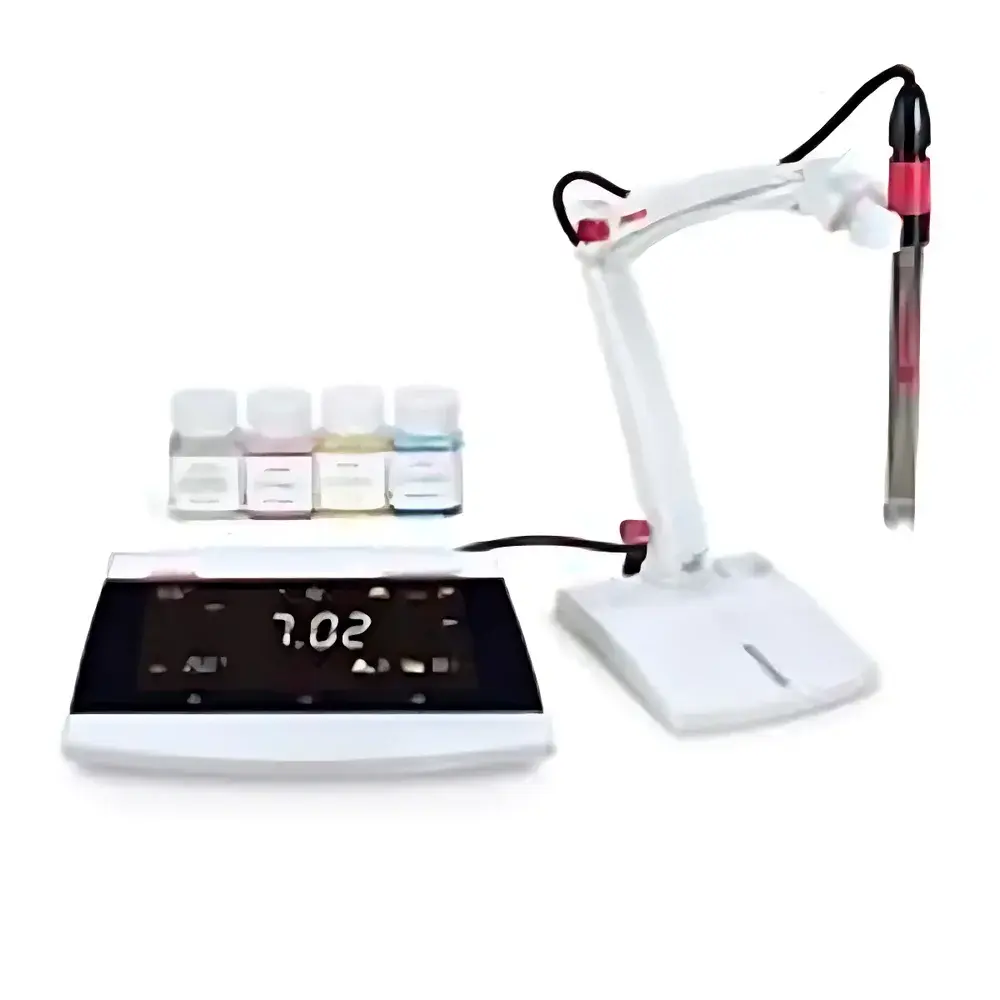
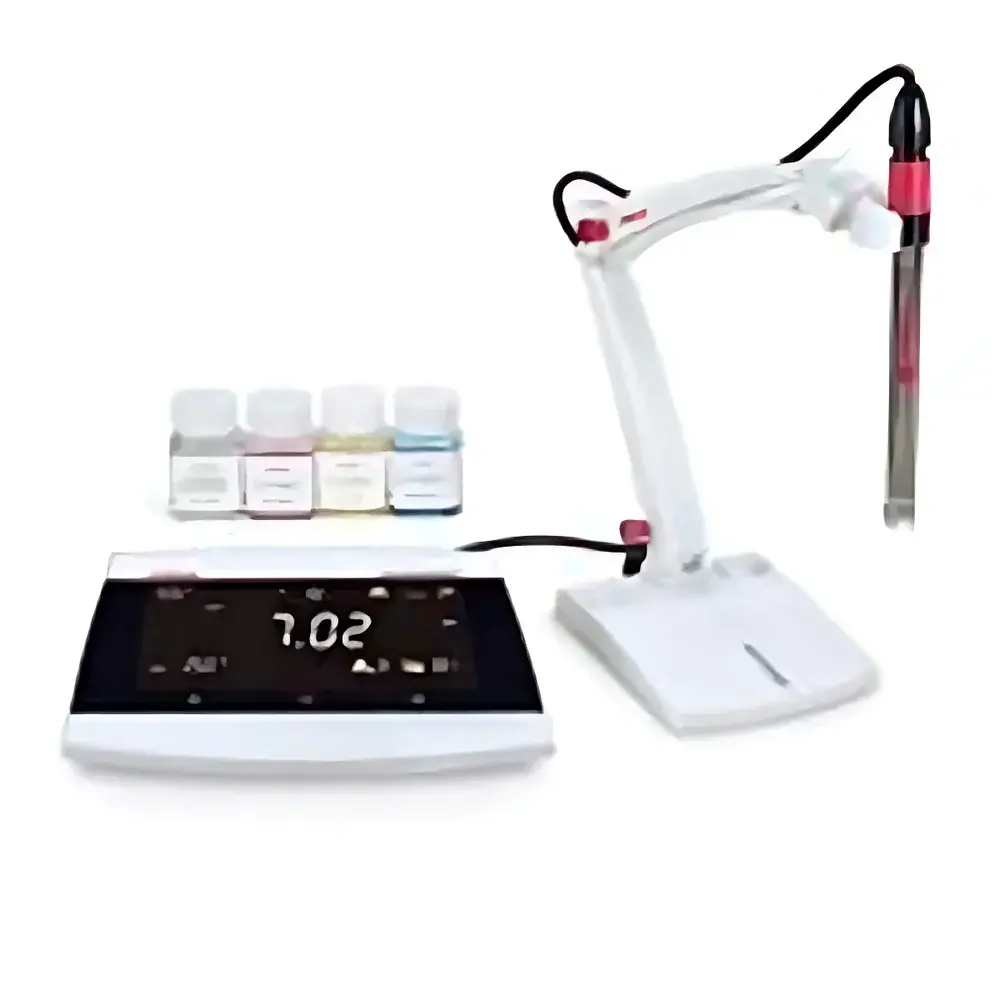
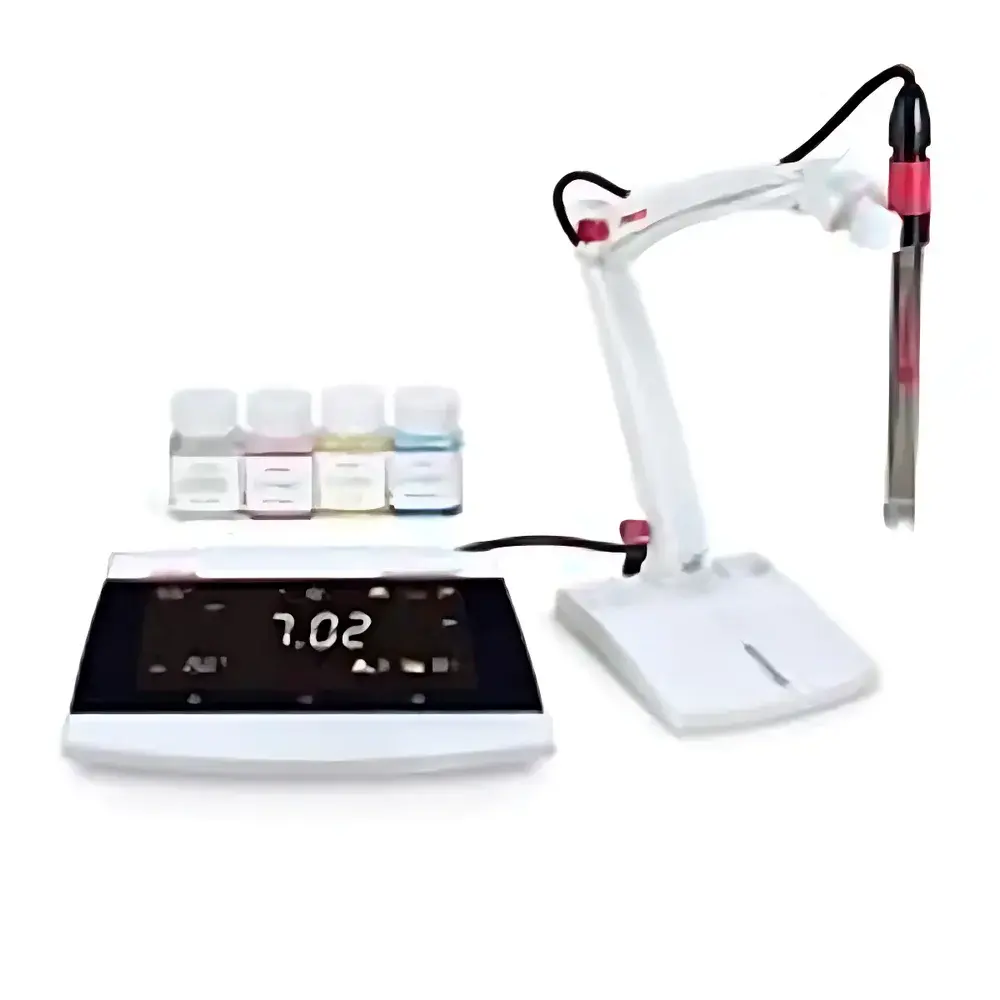
OHAUS AB33PH Benchtop pH Meter
| Brand | OHAUS |
|---|---|
| Origin | Shanghai, China |
| Model | AB33PH |
| Instrument Type | Benchtop |
| Parameter Type | Single-Parameter (pH/mV/ORP/Temperature) |
| Measurement Range | 0.00–14.00 pH, −1999–+1999 mV, 0–100 °C |
| Resolution | 0.01 pH / 1 mV / 0.1 °C |
| Accuracy | ±0.01 pH / ±1 mV / ±0.5 °C |
| Calibration Solutions | China-compliant buffer set (pH 4.01, 7.00, 10.01) |
| Display | 6.5-inch backlit segmented & dot-matrix LCD with capacitive touch keys |
| Data Storage | 1,000 measurement records with timestamp |
| Connectivity | RS232 and USB |
| Power Supply | AC adapter |
| Dimensions (H×L×W) | 51 × 210 × 142 mm |
| Net Weight | 0.5 kg |
| Enclosure Material | ABS housing with integrated electrode stand |
| Compliance | Designed for GLP-compliant laboratory workflows |
Overview
The OHAUS AB33PH Benchtop pH Meter is a precision electrochemical instrument engineered for routine pH, redox potential (ORP), and temperature measurements in academic, quality control, and industrial R&D laboratories. Built upon the STARTER platform’s legacy of reliability, the AB33PH implements potentiometric measurement principles—comparing the potential difference between a pH-sensitive glass electrode and a stable reference electrode against standardized buffer solutions—to deliver traceable, reproducible results. Its architecture integrates i-Steward intelligent calibration management, which actively monitors electrode performance, tracks calibration history, and issues configurable warnings when calibration validity expires—ensuring data integrity across shifts and operators. The meter operates within ISO/IEC 17025-aligned workflows and supports documentation practices required under GLP and GMP environments, including time-stamped event logs and user-accessible calibration reports.
Key Features
- 6.5-inch capacitive touch-enabled LCD display with dual-mode backlighting (segmented for numeric clarity + dot-matrix for contextual icons and prompts)
- i-Steward calibration intelligence: automatic slope/offset validation, drift detection, and visual alert for overdue calibrations
- Full parameter support: pH (0.00–14.00), ORP (−1999 to +1999 mV), and temperature (0–100 °C) with simultaneous display
- 1,000-point internal memory with auto-timestamped storage, exportable via RS232 or USB to LIMS or spreadsheet applications
- Dedicated ABS housing with integrated electrode stand and cable management grooves for clutter-free bench operation
- Compliance-ready features: password-protected method settings, user-defined calibration protocols, and editable operator ID fields
Sample Compatibility & Compliance
The AB33PH is optimized for aqueous and low-ionic-strength samples typical in pharmaceutical dissolution testing, water quality analysis, food & beverage titration prep, and educational labs. It accepts standard BNC-input pH electrodes—including the included ST310 combination electrode—and supports both single- and multi-point calibration using NIST-traceable buffers. While calibrated per Chinese national standards (JJG 119–2018), its measurement algorithm adheres to IUPAC-recommended pH scale definitions and meets ASTM E70 and ISO 3696 Class 3 water specifications for supporting reagent preparation. The device does not require regulatory certification for standalone use but generates audit trails compatible with FDA 21 CFR Part 11–aligned systems when paired with validated data capture software.
Software & Data Management
No proprietary software installation is required for basic operation; however, the AB33PH exports ASCII-formatted data files (.csv or .txt) via USB mass storage mode or RS232 serial streaming. Timestamps include date, time, and operator ID (if entered), enabling direct import into Excel, LabArchives, or electronic lab notebooks. Calibration logs retain slope (%), offset (mV), buffer IDs, and ambient temperature at time of calibration—critical for retrospective review during internal audits or regulatory inspections. All configuration changes are logged with timestamps, satisfying minimum ALCOA+ (Attributable, Legible, Contemporaneous, Original, Accurate) data integrity requirements.
Applications
- Pharmaceutical QC: Monitoring pH of buffer solutions prior to HPLC mobile phase preparation and dissolution media
- Environmental labs: Field-deployable verification of wastewater effluent pH against EPA Method 150.1
- Food safety testing: Verification of acidified food product pH for thermal process lethality calculations (e.g., FDA Acidified Foods Regulation 21 CFR 114)
- Academic teaching: Real-time visualization of titration curves and Henderson–Hasselbalch behavior in undergraduate analytical chemistry labs
- Biotechnology: Routine monitoring of cell culture media and fermentation broth pH stability
FAQ
Does the AB33PH support automatic temperature compensation (ATC)?
Yes—it accepts input from the built-in temperature sensor of the ST310 electrode or an optional external Pt100 probe, applying Nernstian correction in real time.
Can calibration data be exported separately from measurement records?
Yes—calibration events are stored as discrete entries with full metadata and can be filtered and exported independently via USB.
Is the device compatible with non-OHAUS electrodes?
Any BNC-output pH or ORP electrode meeting ANSI/ISA S84.01 electrical specifications may be used, though accuracy claims apply only with the supplied ST310.
What happens if the calibration due date is exceeded?
The i-Steward system displays a persistent warning icon and disables measurement confirmation until recalibration is performed and validated.
How is user access controlled for GLP compliance?
The AB33PH supports up to 10 customizable user profiles with individual passwords; all critical actions (calibration, method change, data deletion) require authenticated entry.



