
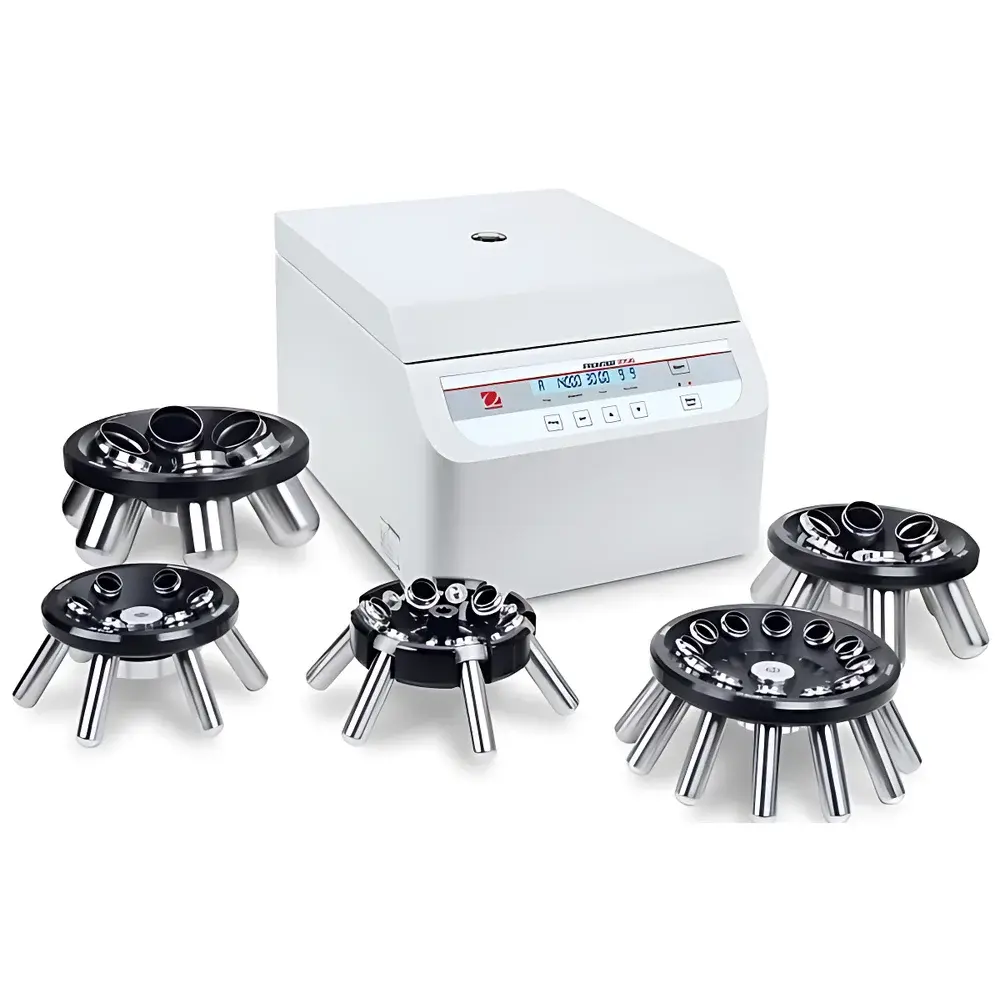
OHAUS FRONTIER™ 2706 Benchtop Multipurpose Low-Speed Centrifuge
| Brand | OHAUS |
|---|---|
| Origin | Jiangsu, China |
| Manufacturer Type | Original Equipment Manufacturer (OEM) |
| Product Category | Domestic |
| Model | FRONTIER™ 2706 |
| Instrument Type | Benchtop Centrifuge |
| Speed Range | Up to 6,000 rpm |
| Maximum RCF | 3,660 × g |
| Maximum Capacity | 100 mL per rotor |
| Rotor Compatibility | 5 interchangeable fixed-angle rotors |
| Sample Tube Compatibility | Conical-bottom and round-bottom centrifuge tubes (10–100 mL) |
| Dimensions (W × D × H) | 250 × 320 × 450 mm |
| Application Class | Biological macromolecule pre-purification, food matrix clarification, wastewater solid-liquid separation, and routine lab sample preparation |
| Safety Certification | IEC 61010-1 compliant, integrated lid interlock, imbalance detection, automatic rotor recognition (model-dependent), and brushless DC motor with thermal protection |
Overview
The OHAUS FRONTIER™ 2706 is a benchtop multipurpose low-speed centrifuge engineered for reliability, operational safety, and broad compatibility across routine laboratory workflows. Designed around the principles of sedimentation-based separation—leveraging centrifugal force to accelerate phase partitioning in heterogeneous mixtures—the instrument operates within a defined mechanical envelope optimized for gentle yet effective pelleting of cells, precipitates, and suspended particulates. Its maximum rotational speed of 6,000 rpm and corresponding relative centrifugal force (RCF) of 3,660 × g position it precisely within the low-speed centrifugation range (typically <10,000 rpm), making it suitable for applications where high g-forces may compromise structural integrity—such as initial clarification of food homogenates, stabilization of wastewater samples prior to filtration or spectroscopic analysis, and crude fractionation of biological matrices before downstream purification (e.g., nucleic acid or protein isolation). The unit features a brushless DC motor for consistent torque delivery, reduced maintenance, and extended service life—critical for laboratories requiring daily reproducibility under variable load conditions.
Key Features
- Robust all-metal chassis with vibration-dampening base design ensures stable operation at full speed, even with partially loaded rotors.
- Integrated safety architecture includes automatic lid interlock, real-time imbalance detection, and overtemperature shutdown—fully compliant with IEC 61010-1 for electrical safety in laboratory environments.
- Five interchangeable fixed-angle rotors support standardized tube formats from 10 mL conical tubes to 100 mL round-bottom centrifuge bottles—enabling seamless transition between sample volume tiers without hardware reconfiguration.
- Digital control interface with intuitive rotary encoder and backlit LCD display provides precise setting of time (1 s–99 min 59 s), speed (100–6,000 rpm in 10 rpm increments), and acceleration/deceleration profiles (soft stop option available).
- Brushless DC motor eliminates carbon brush wear, reduces electromagnetic interference, and supports GLP-compliant audit trails when paired with optional data logging software.
Sample Compatibility & Compliance
The FRONTIER™ 2706 accommodates standard polypropylene and polycarbonate centrifuge tubes (10–100 mL), including both conical-bottom (e.g., 15 mL and 50 mL Falcon®-style tubes) and round-bottom configurations commonly used in environmental, food, and basic life science labs. It is routinely deployed in protocols aligned with ASTM D5907 (suspended solids in wastewater), AOAC 984.27 (fat extraction in dairy products), and ISO 7218 (microbiological examination—pre-enrichment centrifugation). While not intended for sterile or BSL-2 containment, its sealed rotor chamber and smooth internal surfaces facilitate decontamination using ethanol or 10% sodium hypochlorite solutions—supporting adherence to institutional biosafety and hygiene SOPs.
Software & Data Management
The centrifuge operates as a standalone instrument but integrates with OHAUS’ optional FrontierConnect™ PC software suite for protocol archiving, run history export (CSV), and electronic signature-enabled method validation. When configured with audit trail functionality, the system complies with FDA 21 CFR Part 11 requirements—including user authentication, immutable event logs, and timestamped parameter changes—making it suitable for regulated QC/QA environments in contract testing labs and food safety accreditation programs (e.g., ISO/IEC 17025).
Applications
- Preliminary clarification of fruit juice, milk, or fermentation broths prior to HPLC or enzymatic assay.
- Sedimentation of suspended solids in municipal or industrial wastewater samples for turbidity or heavy metal analysis.
- Cell pelleting from bacterial or yeast cultures during plasmid prep or enzyme expression workflows.
- Phase separation in lipid extraction protocols (e.g., Folch or Bligh-Dyer methods) where excessive shear must be avoided.
- Routine blood fractionation (serum/plasma separation) in veterinary or field-deployable diagnostic settings.
FAQ
What is the maximum rotor capacity supported by the FRONTIER™ 2706?
The instrument accommodates up to 100 mL total volume per run when using the optional 4 × 24 mL or 6 × 15 mL fixed-angle rotors—subject to symmetrical loading per manufacturer guidelines.
Does the centrifuge support refrigerated operation?
No. The FRONTIER™ 2706 is a non-refrigerated model; ambient temperature operation is recommended for stability-critical applications requiring thermal control.
Can rotor calibration data be stored onboard?
Rotor identification is manual; however, FrontierConnect™ software enables persistent storage of rotor-specific parameters—including max speed, RCF curves, and historical usage logs—for traceability and preventive maintenance scheduling.
Is the unit compatible with third-party rotors?
OHAUS recommends exclusive use of certified FRONTIER™ series rotors to ensure mechanical integrity, safety compliance, and warranty validity.
What maintenance intervals are recommended?
Brushless motor design eliminates routine brush replacement; annual inspection of rotor threads, lid latch mechanism, and imbalance sensor calibration is advised per OHAUS Technical Bulletin TB-2706-01.



