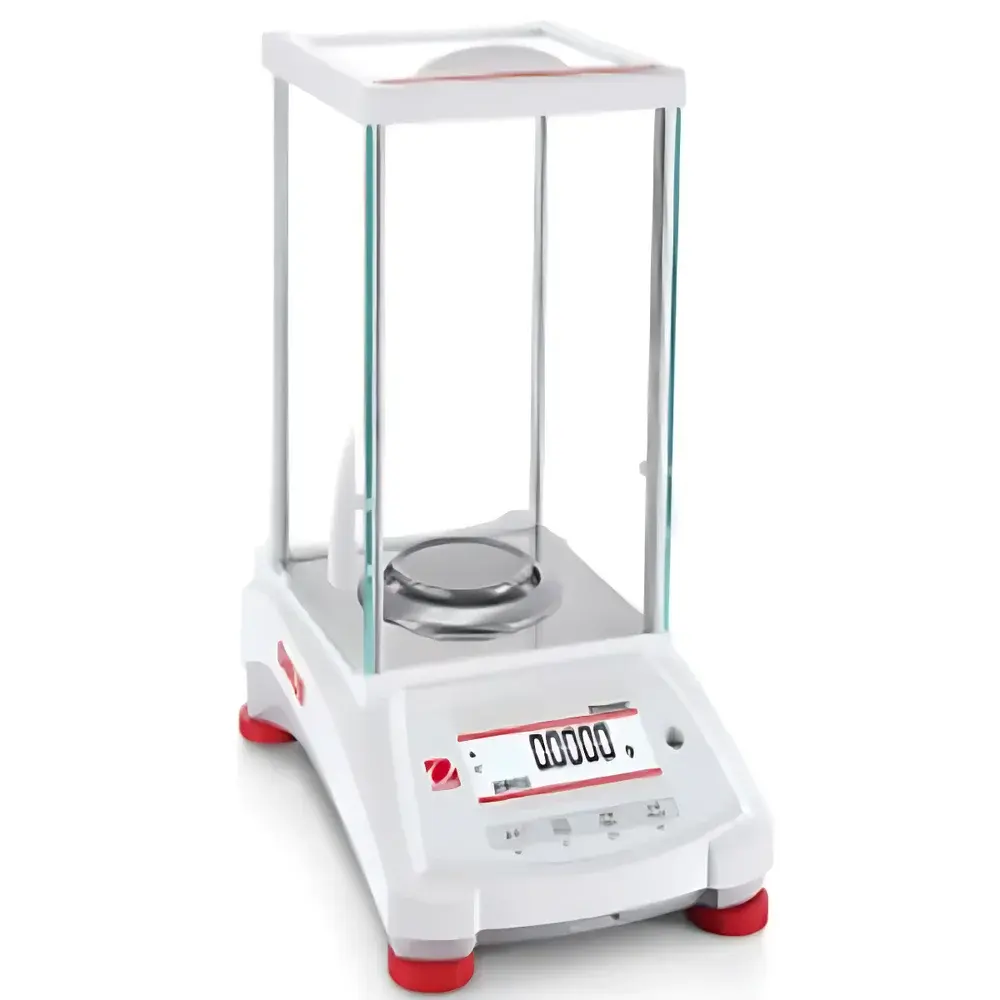
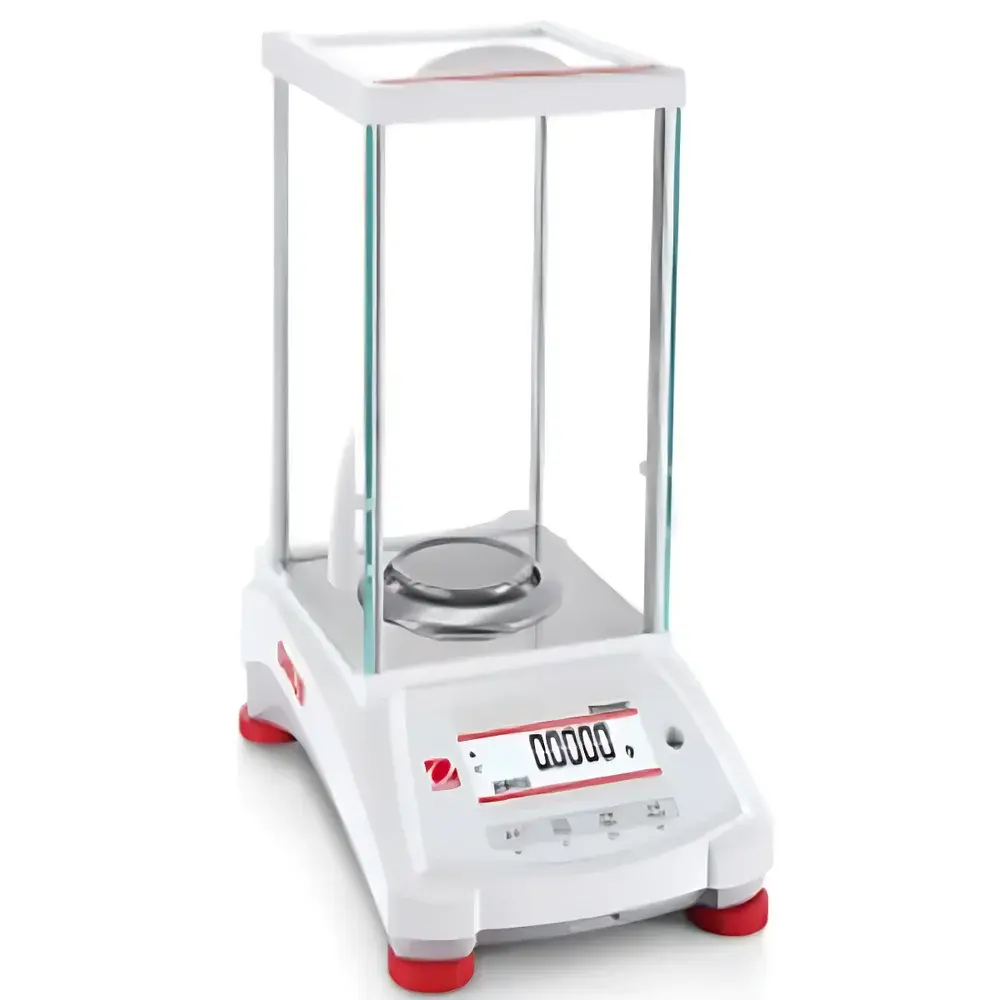
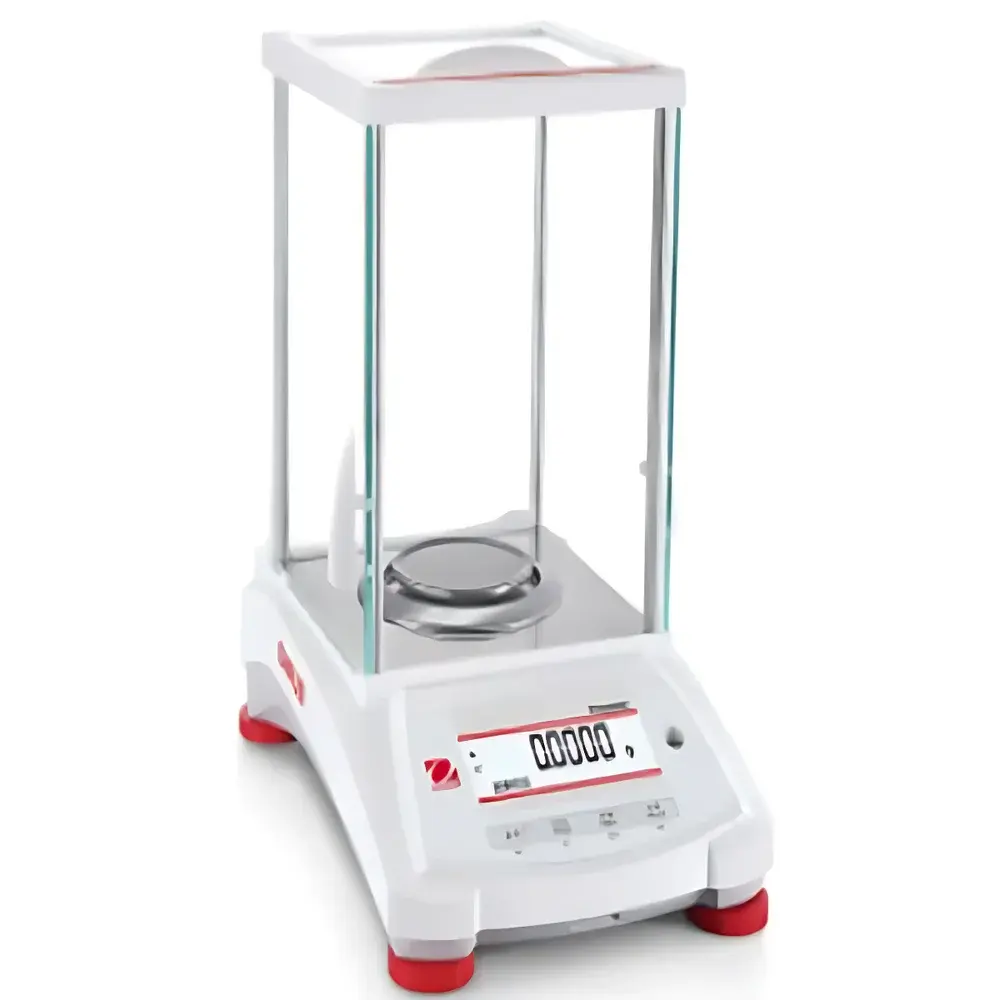
OHAUS PX85ZH Precision Analytical Balance
| Brand | OHAUS |
|---|---|
| Origin | USA |
| Model | PX85ZH |
| Instrument Type | Analytical Balance |
| Maximum Capacity | 82 g |
| Readability | 0.01 mg |
| Calibration | Internal Calibration |
| Minimum Weight (USP <0.1% typical) | 20 mg |
| Stabilization Time | 10 s |
| Pan Size | 80 mm |
| Display | Backlit Dual-Line LCD |
| Communication Interfaces | RS232, USB |
| Construction | Die-cast aluminum base, stainless steel pan, glass draft shield, underhook, removable dust cover, anti-theft lock |
| Operating Environment | 10–30 °C, ≤80% RH non-condensing |
| Net Weight | 4.5 kg |
| Dimensions (H×L×W) | 309 × 321 × 209 mm |
| Power Supply | Included AC adapter |
| Weighing Units | g, mg, kg, oz, oz t, lb, ct, N, momme, mesghal, tical, tola, grain, liang (HK/TW/SG), baniwit, taels |
Overview
The OHAUS PX85ZH Precision Analytical Balance is an ISO/IEC 17025-aligned analytical weighing instrument engineered for laboratories requiring high reproducibility in low-mass measurements. Utilizing electromagnetic force restoration (EMFR) transduction technology, the PX85ZH delivers traceable mass determinations with a readability of 0.01 mg across its 82 g maximum capacity. Its design conforms to fundamental metrological principles defined in OIML R 76 and ASTM E898, ensuring compliance with regulatory expectations for quantitative analysis in QC, R&D, and GLP environments. The balance operates within a controlled environmental envelope—10–30 °C ambient temperature and ≤80% relative humidity (non-condensing)—to maintain thermal equilibrium of internal components and minimize drift-induced uncertainty. Integrated draft shielding, thermally stable die-cast aluminum base, and precision-machined stainless steel pan collectively mitigate mechanical and thermal noise, supporting consistent repeatability at or below 0.02 mg (2σ, n=10).
Key Features
- Internal calibration system with automatic drift compensation triggered by time or temperature thresholds, eliminating manual recalibration during routine operation
- Dual-line backlit LCD display providing real-time gross/net/tare values alongside contextual prompts—including stability indicator, overload/underload warning, and user-defined unit labels
- Configurable environmental compensation: adjustable air density, temperature, and gravity correction parameters for density determination and buoyancy-corrected mass reporting
- Four-language interface support (English, Spanish, French, Chinese) with customizable user ID and project naming for audit-ready workflow documentation
- Hardware-level security features including menu lockout, password-protected configuration reset, and physical anti-theft lock compatible with standard lab anchoring systems
- GLP/GMP-compliant real-time clock with timestamped data output via RS232 or USB; supports 21 CFR Part 11–compatible software integration when paired with OHAUS Acquire or third-party LIMS platforms
Sample Compatibility & Compliance
The PX85ZH accommodates diverse sample geometries through its 80 mm stainless steel pan and optional underhook assembly for suspended density measurements. Its glass draft shield meets ISO 9001 and ISO/IEC 17025 requirements for environmental isolation during microgram-level weighing. The minimum weight of 20 mg (USP <0.1% criterion, typical) is validated per USP Chapter 41 and EU GMP Annex 18 guidelines, enabling reliable use in pharmaceutical assay preparation, reference standard dilution, and catalyst mass dosing. All firmware and calibration records are stored internally with immutable timestamps, satisfying traceability mandates under FDA 21 CFR Part 11 and ISO/IEC 17025 Clause 7.7.
Software & Data Management
Data export follows ASCII-based protocols over RS232 and USB virtual COM port interfaces, generating comma- or tab-delimited outputs compatible with Excel, LabArchives, and electronic lab notebooks (ELNs). The balance supports configurable print formatting—including header metadata (user ID, date/time, project name), unit selection, and statistical summary (mean, SD, CV%)—via connected serial printers or host PC applications. Firmware updates are performed via USB mass storage mode without external programming tools. Audit trail functionality logs all parameter changes, calibration events, and error conditions with operator ID and timestamp, meeting ALCOA+ data integrity principles.
Applications
- Quantitative preparation of reference standards and working solutions in pharmaceutical QC labs (per USP )
- Density determination of solids and powders using Archimedes’ principle with integrated underhook and sinker accessories
- Counting small components (e.g., tablets, microelectronics, seeds) with statistical validation of count accuracy
- Gravimetric titration endpoint verification and moisture content analysis via loss-on-drying protocols
- Research-scale synthesis where reagent mass must be documented to ≤0.01 mg resolution under GLP conditions
- Calibration of pipettes and volumetric glassware using gravimetric water delivery verification (ISO 8655)
FAQ
What is the minimum weight requirement for compliant pharmaceutical weighing per USP?
The PX85ZH satisfies USP Chapter 41 with a verified minimum weight of 20 mg at the 0.1% tolerance level under standard laboratory conditions.
Does the PX85ZH support 21 CFR Part 11 compliance?
Yes—when used with validated software (e.g., OHAUS Acquire v5.0+) and configured with user authentication, electronic signatures, and audit trail logging, it fulfills predicate rules for electronic records and signatures.
Can the balance perform density measurements without external accessories?
Density determination requires optional sinker kits and liquid immersion fixtures; the underhook and built-in tare memory enable full implementation of ISO 1183-1 protocols.
Is external vibration isolation required?
While not mandatory, placement on a granite slab or active damping table is recommended when operating near HVAC vents, centrifuges, or foot traffic zones to maintain optimal repeatability.
How frequently should internal calibration be performed?
OHAUS recommends initiating internal calibration after power-up, following significant ambient temperature shifts (>2 °C), and at user-defined intervals (e.g., every 2 hours) via programmable auto-calibration scheduling.