
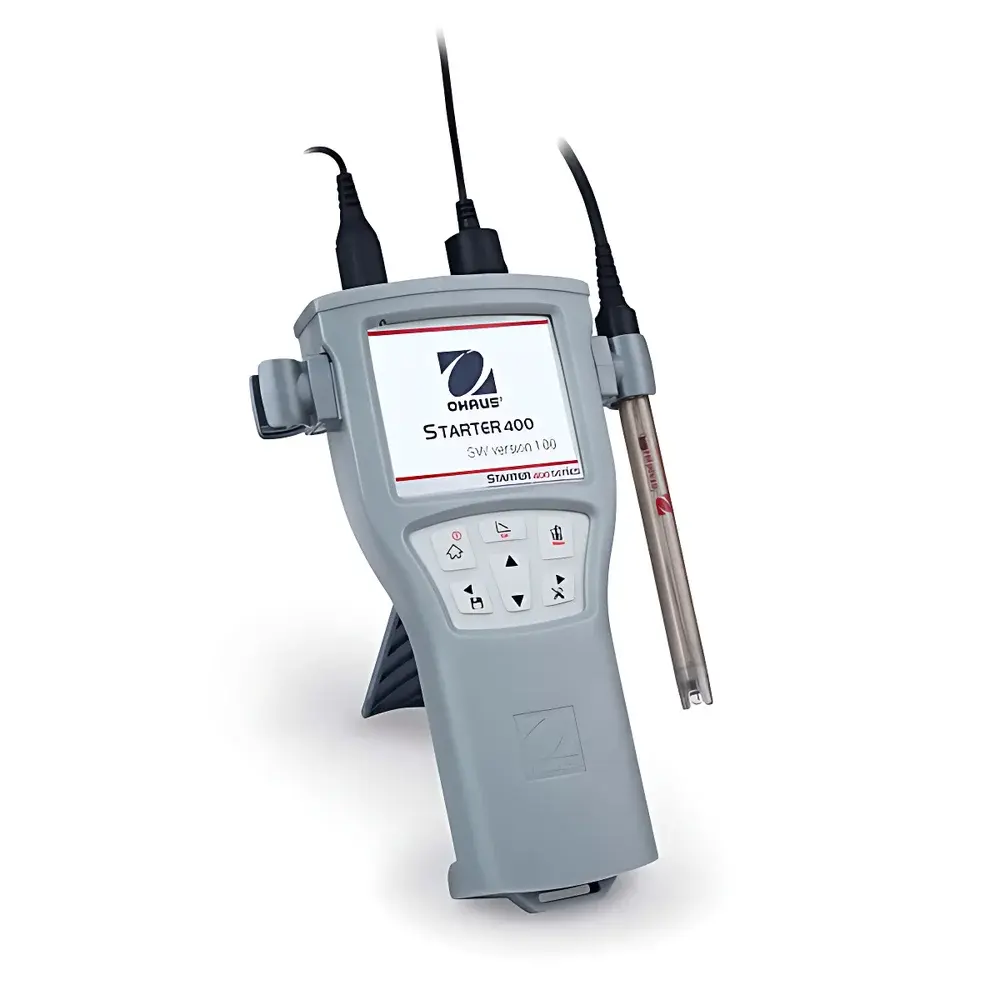
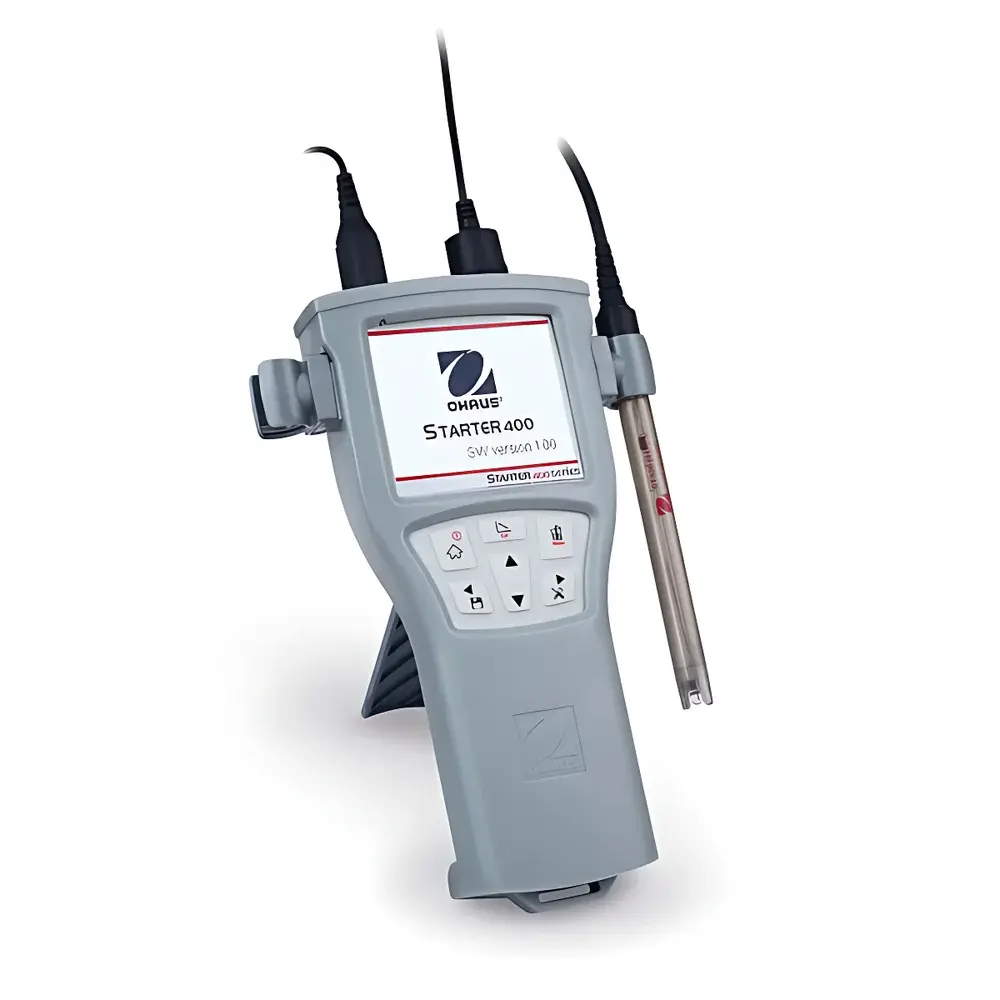
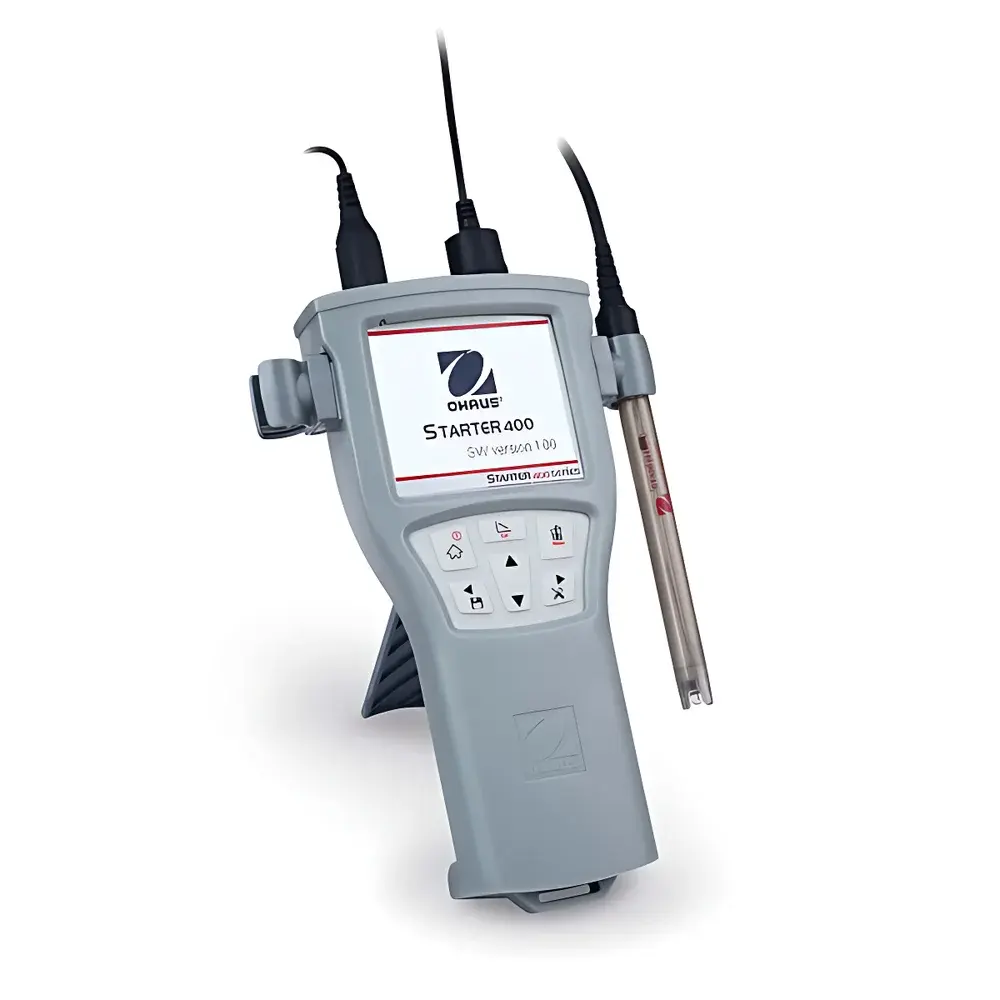
OHAUS ST400 Portable pH Meter
| Brand | OHAUS |
|---|---|
| Origin | Shanghai, China |
| Manufacturer Type | Authorized Distributor |
| Regional Classification | Domestic (China) |
| Model | ST400 |
| Instrument Type | Portable (not benchtop — correction based on product description) |
| Parameter Types | pH and Temperature |
| Measurement Accuracy | ±0.01 pH |
| Measurement Range | −2.00 to 16.00 pH |
| Resolution | 0.01 pH |
| Calibration Solutions | China-specific buffer set (pH 4.01, 7.00, 10.01 at 25 °C) |
| IP Rating | IP67 (instrument and electrode) |
| Battery | Rechargeable Li-ion, up to 40 h continuous operation, ≥300 charge cycles |
| Data Storage | 1000 measurement records |
| Interface | Micro-USB for data export |
| Display | Backlit LCD with graphical user interface |
Overview
The OHAUS ST400 Portable pH Meter is a rugged, field-deployable electrochemical instrument engineered for high-reliability pH and temperature measurements in demanding environmental and industrial applications. Built upon OHAUS’ legacy of precision instrumentation—spanning over 110 years in metrology—the ST400 applies rigorous design principles to portable electrochemistry. It operates on the potentiometric principle: measuring the potential difference between a pH-sensitive glass electrode and a stable reference electrode (Ag/AgCl), converting it into a pH value via the Nernst equation (−59.16 mV/pH unit at 25 °C). Its dual-parameter capability (pH + temperature) enables automatic temperature compensation (ATC) using an integrated thermistor, ensuring traceable accuracy across variable ambient conditions. Designed explicitly for in-situ analysis, the ST400 eliminates laboratory dependency for routine water quality assessments—including freshwater lakes, rivers, wastewater effluents, aquaculture systems, and municipal distribution networks.
Key Features
- IP67-rated enclosure and matching IP67-certified pH electrode—fully dust-tight and submersible up to 1 m for 30 minutes—enabling reliable operation in rain, splashing, or high-humidity field environments.
- Rechargeable lithium-ion battery delivering up to 40 hours of continuous measurement time per full charge, with ≥300 lifecycle durability—significantly reducing consumable waste and operational downtime versus disposable alkaline cells.
- Large backlit LCD display with intuitive icon-driven menu navigation; real-time visualization of pH value, temperature, electrode status (e.g., slope %, offset mV), calibration progress, and battery level.
- Dedicated ATC functionality with automatic recognition of temperature sensor input; supports manual temperature entry when external probe is unavailable.
- Three-point calibration protocol compliant with ISO 7888 and ASTM D1293, using standard Chinese national buffer solutions (pH 4.01, 7.00, and 10.01 at 25 °C); slope and offset diagnostics assist in identifying electrode aging or contamination.
Sample Compatibility & Compliance
The ST400 is validated for aqueous liquid samples with conductivity >20 µS/cm and total dissolved solids (TDS) <10,000 ppm. It is not intended for non-aqueous solvents, highly viscous media, or strongly oxidizing/reducing solutions without electrode compatibility verification. Electrode selection (e.g., double-junction, gel-filled, or refillable) must align with sample matrix to prevent junction clogging or reference electrolyte contamination. The instrument meets IEC 61010-1:2010 for electrical safety and EN 60529 for ingress protection. While not certified for GMP/GLP-regulated pharmaceutical manufacturing, its data integrity features support QA/QC workflows aligned with ISO/IEC 17025:2017 clause 7.7 (result reporting) and EPA Method 150.1 (field pH measurement in surface water monitoring).
Software & Data Management
The ST400 stores up to 1000 timestamped measurement records internally—including pH reading, temperature, date/time stamp, calibration ID, and electrode diagnostic metrics (slope, offset, response time). When memory approaches capacity, users initiate data export via micro-USB connection to a Windows/macOS host. No proprietary software is required: exported .csv files are natively readable in Excel, LabArchives, or LIMS platforms. Each record includes metadata sufficient for audit trail reconstruction—supporting basic traceability requirements under FDA 21 CFR Part 11 (when paired with organizational procedural controls). Firmware updates are delivered via USB mass storage mode, ensuring long-term instrument maintainability.
Applications
- Environmental field monitoring: rapid pH assessment of surface water, groundwater wells, stormwater runoff, and wetland sediments.
- Aquaculture and hydroponics management: daily tracking of pond or reservoir pH to maintain optimal biological conditions for fish or plant growth.
- Wastewater treatment plant (WWTP) operations: spot-checking influent/effluent pH during process control and compliance reporting (e.g., local discharge permits).
- Educational laboratories: undergraduate chemistry and environmental science courses requiring robust, low-maintenance instrumentation for outdoor experiments.
- Food & beverage pre-screening: preliminary pH checks of rinse water, cleaning-in-place (CIP) solutions, or agricultural irrigation sources.
FAQ
Is the ST400 suitable for use in seawater or high-salinity samples?
Yes—provided the included electrode is a double-junction or Ag/AgCl reference type with KNO₃ or saturated KCl electrolyte; however, frequent rinsing with deionized water post-measurement is required to prevent salt crystallization at the junction.
Does the ST400 support GLP-compliant electronic signatures or audit trails?
No—the device lacks user authentication, electronic signature capture, or immutable audit logging. It meets basic data integrity needs for field notebooks but requires supplemental procedural documentation for full GLP/GMP adherence.
Can third-party pH electrodes be used with the ST400?
Yes, if they feature BNC connectors and output signals within ±1200 mV (standard pH electrode range); however, OHAUS does not guarantee calibration stability or diagnostic functionality with non-OHAUS electrodes.
What is the recommended recalibration frequency for field use?
Daily two-point calibration (pH 7.00 + one bracketing point) is advised for critical applications; for routine surveillance, verification against a single check standard before each sampling session suffices.
How is temperature measured—integrated sensor or external probe?
Temperature is measured via a built-in NTC thermistor in the electrode shaft; no separate probe is needed unless custom configurations require remote sensing.
Related Products



