
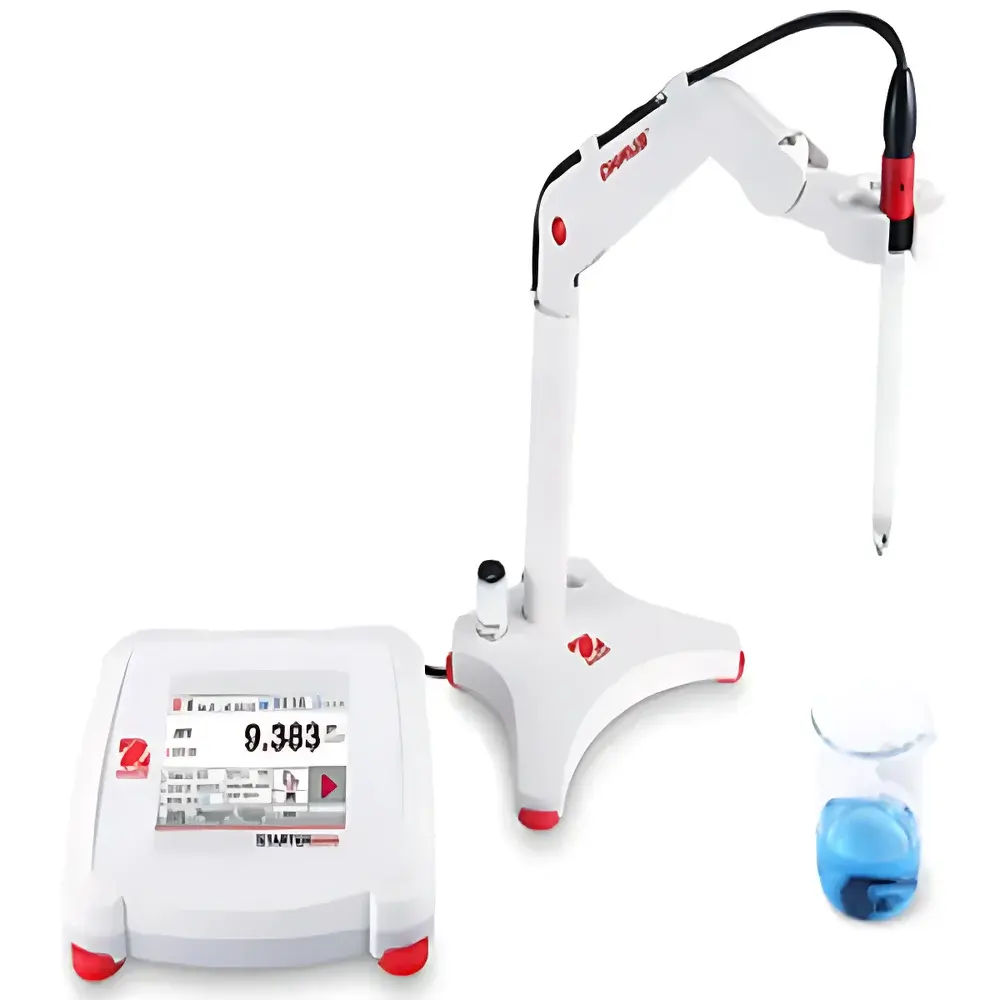
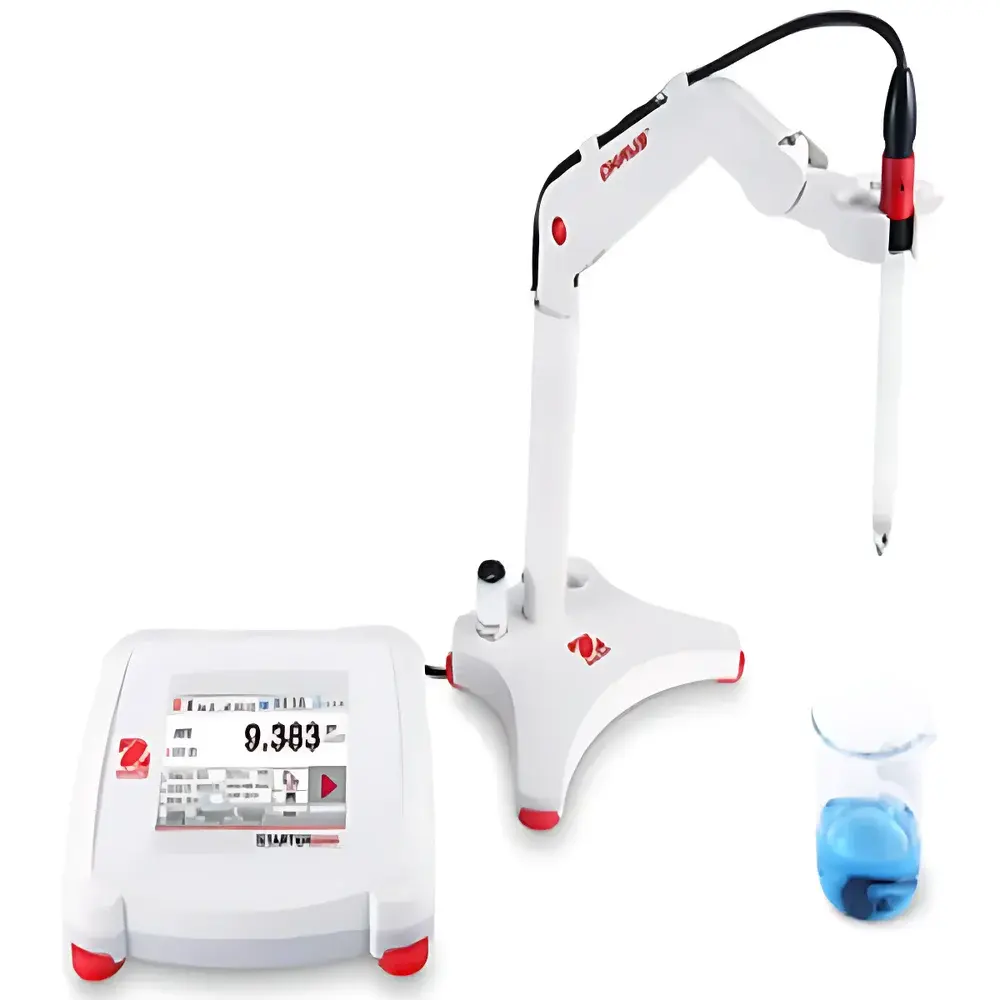
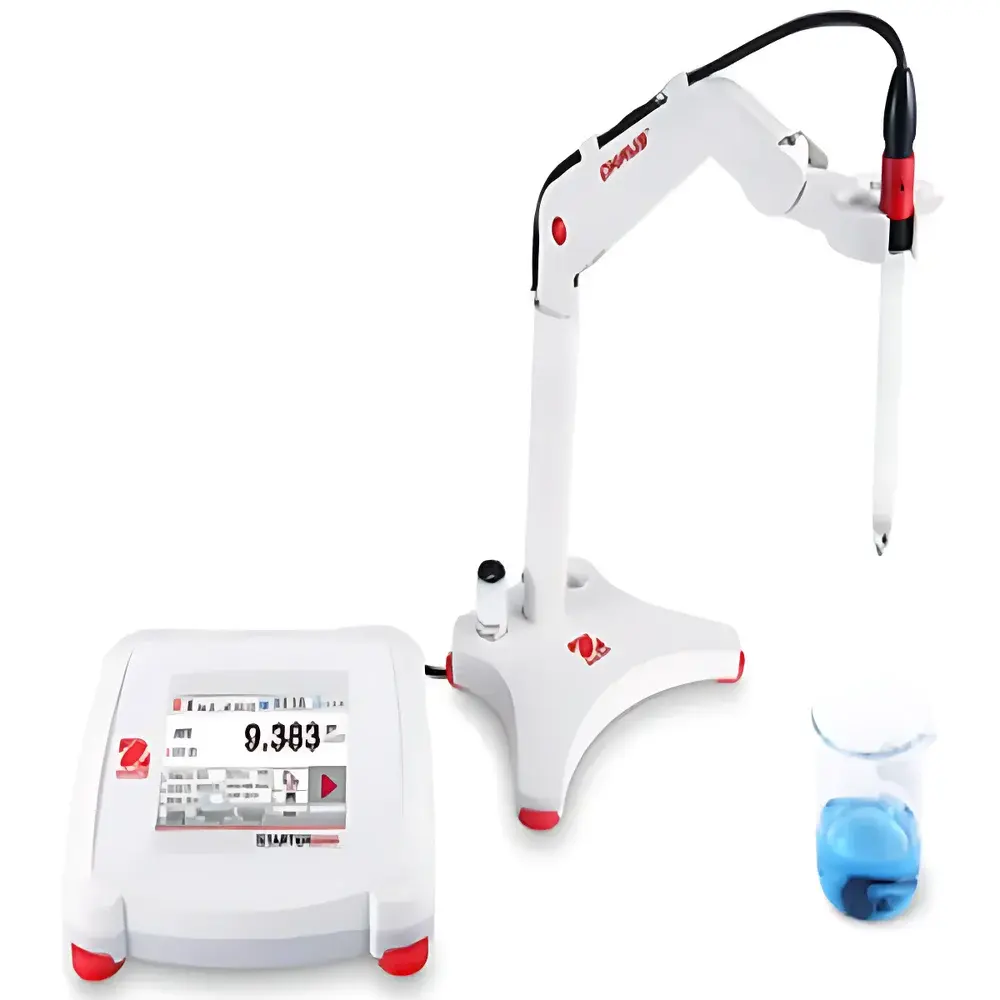
OHAUS ST5000/F Benchtop pH/ORP Meter
| Brand | OHAUS |
|---|---|
| Origin | USA |
| Model | ST5000/F |
| Instrument Type | Benchtop |
| Parameters Measured | pH and ORP (mV) |
| pH Range | –2.000 to 20.000 |
| mV Range | –1999.00 to +1999.00 |
| Temperature Range | –30 °C to +130 °C |
| pH Resolution | 0.001 |
| mV Resolution | 0.01 |
| Temperature Resolution | 0.1 °C |
| pH Accuracy | ±0.002 |
| mV Accuracy | ±0.03 |
| Temperature Accuracy | ±0.1 °C |
| Calibration Points | Up to 9-point pH calibration |
| Buffer Sets | 8 pre-defined + 1 user-defined |
| Calibration Modes | 3-point, endpoint, continuous measurement |
| Data Storage | 1000 readings with timestamp and electrode ID |
| GLP Compliance | Yes, with audit trail, calibration history, and sensor diagnostics |
| Connectivity | RS232 and USB |
| Display | 4.3-inch color TFT touchscreen |
| Enclosure Material | ABS |
| IP Rating | IP54 |
| Power | AC adapter (110–240 V, 50/60 Hz) + DC 9 V |
| Net Weight | 550 g |
Overview
The OHAUS ST5000/F is a high-precision benchtop pH and ORP meter engineered for rigorous laboratory environments where reproducibility, traceability, and regulatory compliance are non-negotiable. Built on a dual-parameter electrochemical measurement platform, it employs potentiometric principles—measuring the potential difference between a pH-sensitive glass electrode and a stable reference electrode—to determine hydrogen ion activity across an extended pH range of –2.000 to 20.000. Simultaneously, it supports redox potential (ORP) measurements from –1999.00 to +1999.00 mV with microvolt-level resolution, enabling accurate assessment of oxidation-reduction reactions in process control, environmental monitoring, and pharmaceutical formulation. Its integrated temperature compensation uses a 30 kΩ NTC thermistor for automatic, real-time correction per NIST-traceable standards, ensuring measurement integrity across –30 °C to +130 °C.
Key Features
- 4.3-inch full-color TFT touchscreen interface with intuitive icon-driven navigation and multi-language support (English, Spanish, French, German, Chinese)
- GLP-compliant data management including timestamped readings, electrode identification tagging, and full calibration history with operator ID logging
- Up to 9-point pH calibration with flexible buffer selection—eight factory-programmed sets (including DIN, NIST, US, and technical buffers) plus one fully customizable set
- Three distinct measurement modes: endpoint (stable-signal detection), continuous (real-time kinetics), and auto-hold (user-defined stability threshold)
- Dual-channel input architecture supporting simultaneous pH/mV and temperature acquisition with independent sensor diagnostics
- Rugged ABS housing rated IP54 for resistance to dust ingress and incidental water splashes—suitable for shared lab benches and QC environments
- Comprehensive electrode health monitoring, including slope calculation (%), offset verification, and response time diagnostics
Sample Compatibility & Compliance
The ST5000/F accommodates standard BNC and mini-DIN pH/ORP electrodes—including refillable, gel-filled, and solid-state variants—as well as external Pt100 or NTC temperature probes. Its wide pH range supports highly alkaline samples (e.g., caustic cleaning solutions, lithium battery electrolytes) and strongly acidic media (e.g., pickling baths, semiconductor etchants), while its extended mV range enables reliable redox monitoring in electroplating, wastewater treatment, and disinfection validation. The instrument complies with ISO/IEC 17025 documentation requirements and supports FDA 21 CFR Part 11 readiness through optional software integration. All calibration and measurement records adhere to Good Laboratory Practice (GLP) and Good Manufacturing Practice (GMP) frameworks, with built-in audit trails meeting EU Annex 11 and ICH Q7 expectations.
Software & Data Management
Data export is supported via RS232 serial output (with configurable baud rate and protocol) and USB host interface for direct connection to PCs or printers. Optional OHAUS LoggerPro™ software enables secure, password-protected data transfer, graphical trend analysis, report generation (PDF/CSV), and electronic signature capture. All stored entries include metadata: date/time stamp, measured value, unit, electrode serial number, calibration status, ambient temperature/humidity (if logged externally), and user ID. Internal memory retains up to 1000 readings with cyclic overwrite protection and manual archive lock functionality—critical for internal audits and regulatory inspections.
Applications
- Pharmaceutical quality control: pH verification of injectables, buffers, and cleaning validation solutions per USP and EP 2.2.3
- Food & beverage R&D: Acidification profiling during fermentation, shelf-life stability testing, and titratable acidity correlation
- Environmental labs: Monitoring extreme-pH effluents, acid mine drainage, and alkaline leachates per ASTM D1293 and EPA Method 150.1
- Academic research: Teaching electrochemistry fundamentals, calibrating custom reference electrodes, and validating sensor arrays
- Chemical manufacturing: In-process control of neutralization reactions, catalyst activation, and corrosion inhibitor efficacy
FAQ
Does the ST5000/F support automatic temperature compensation (ATC)?
Yes—it accepts analog or digital temperature inputs from integrated or external probes and applies NIST-referenced polynomial algorithms for pH correction.
Can I perform calibration without connecting a temperature probe?
Yes; manual temperature entry is permitted, though ATC is strongly recommended for accuracy above ±0.002 pH.
Is the instrument compatible with non-OHAUS electrodes?
Yes—any electrode with standard BNC or mini-DIN connectors and compliant output impedance (≤10⁹ Ω) functions reliably.
How is GLP compliance implemented in firmware?
Through mandatory operator login, immutable calibration logs, electronic signatures for critical actions, and tamper-evident timestamps synchronized to system clock.
What buffer standards are preloaded?
NIST (1.678, 4.005, 6.865, 9.180), DIN (1.679, 4.009, 6.867, 9.181), US (4.01, 7.00, 10.01), and technical (pH 12.45 at 25 °C).




