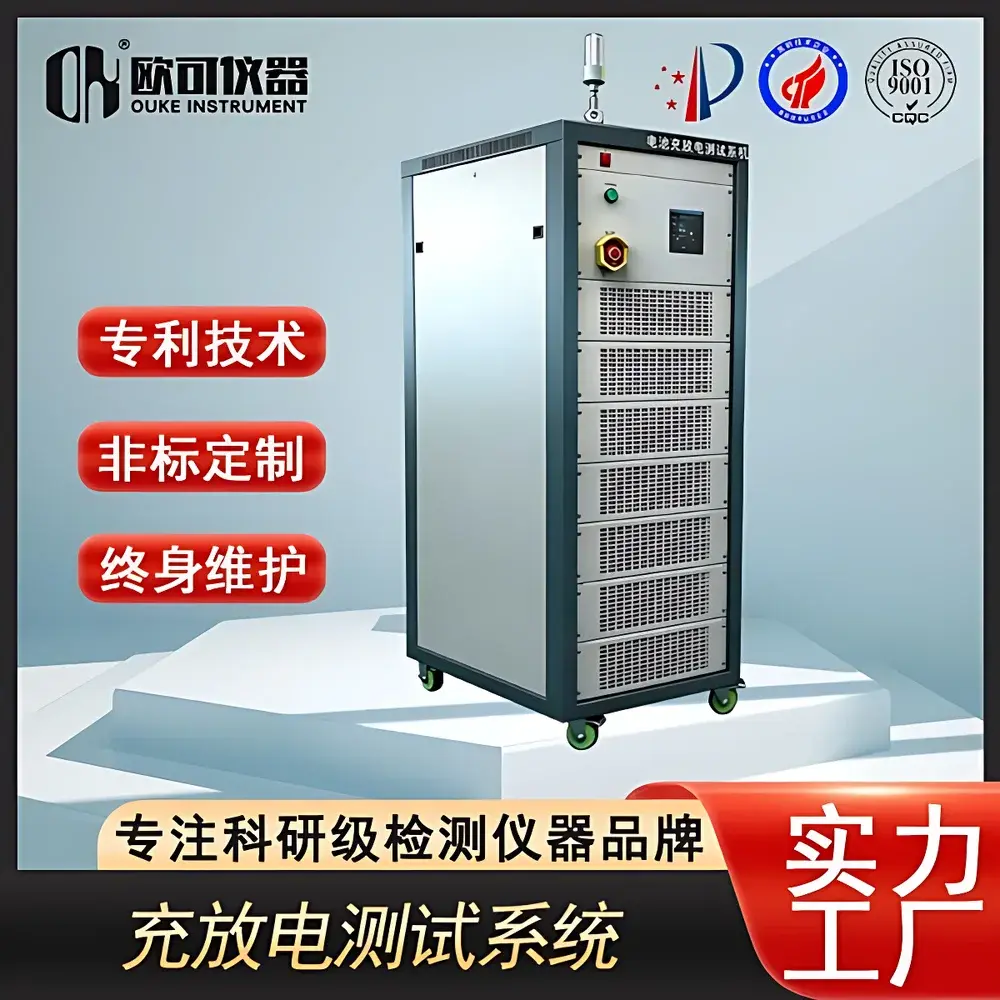
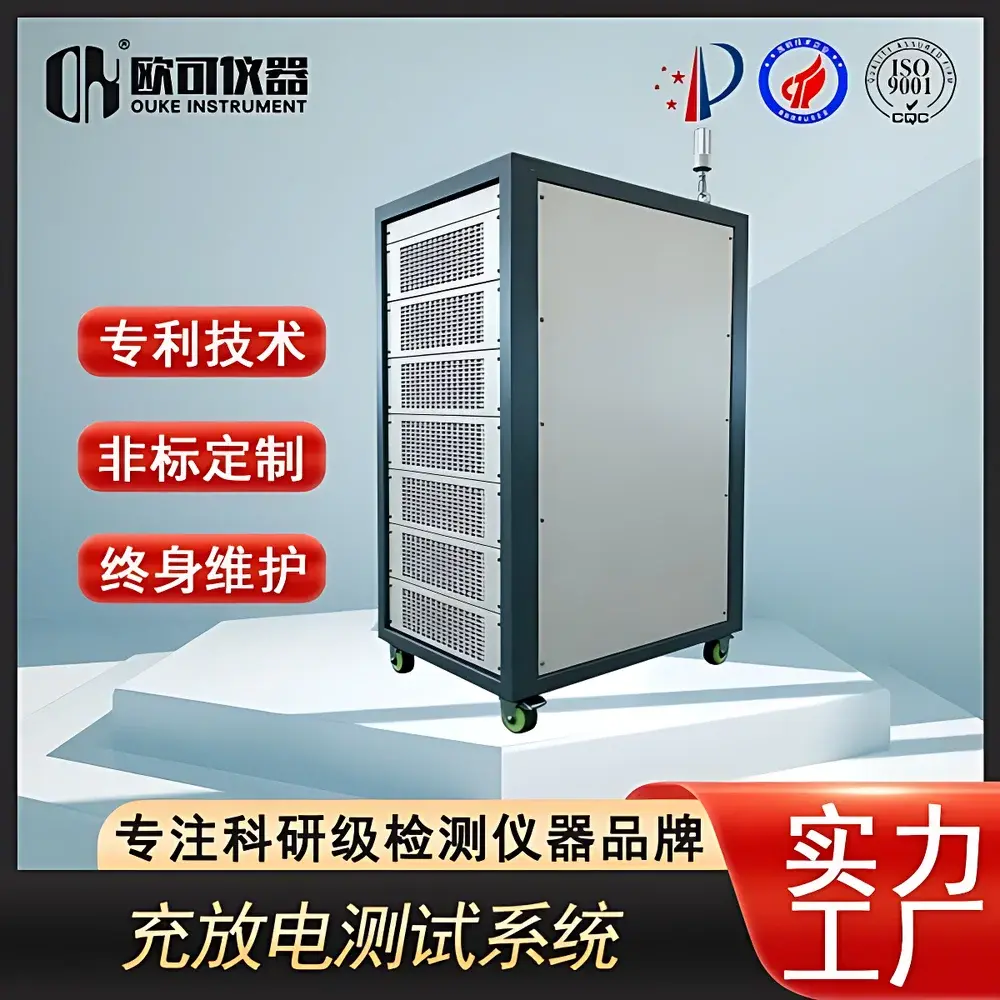
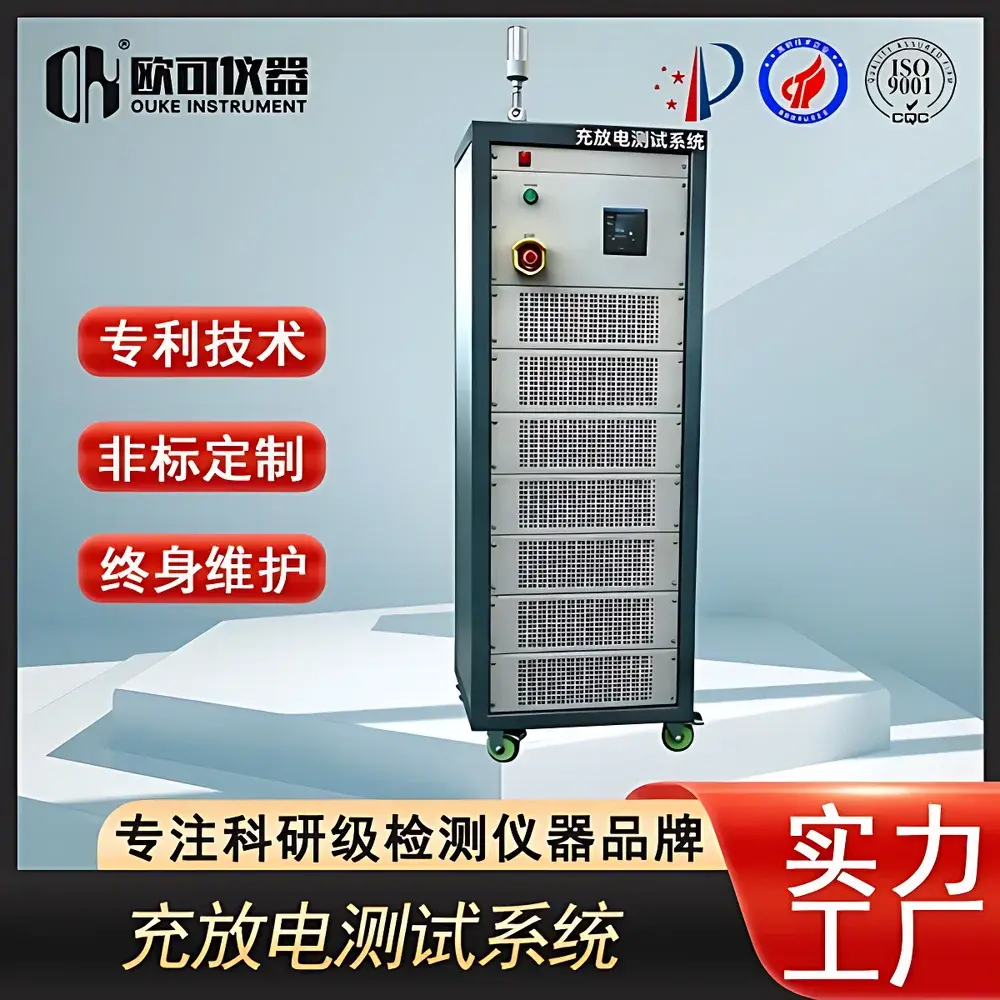
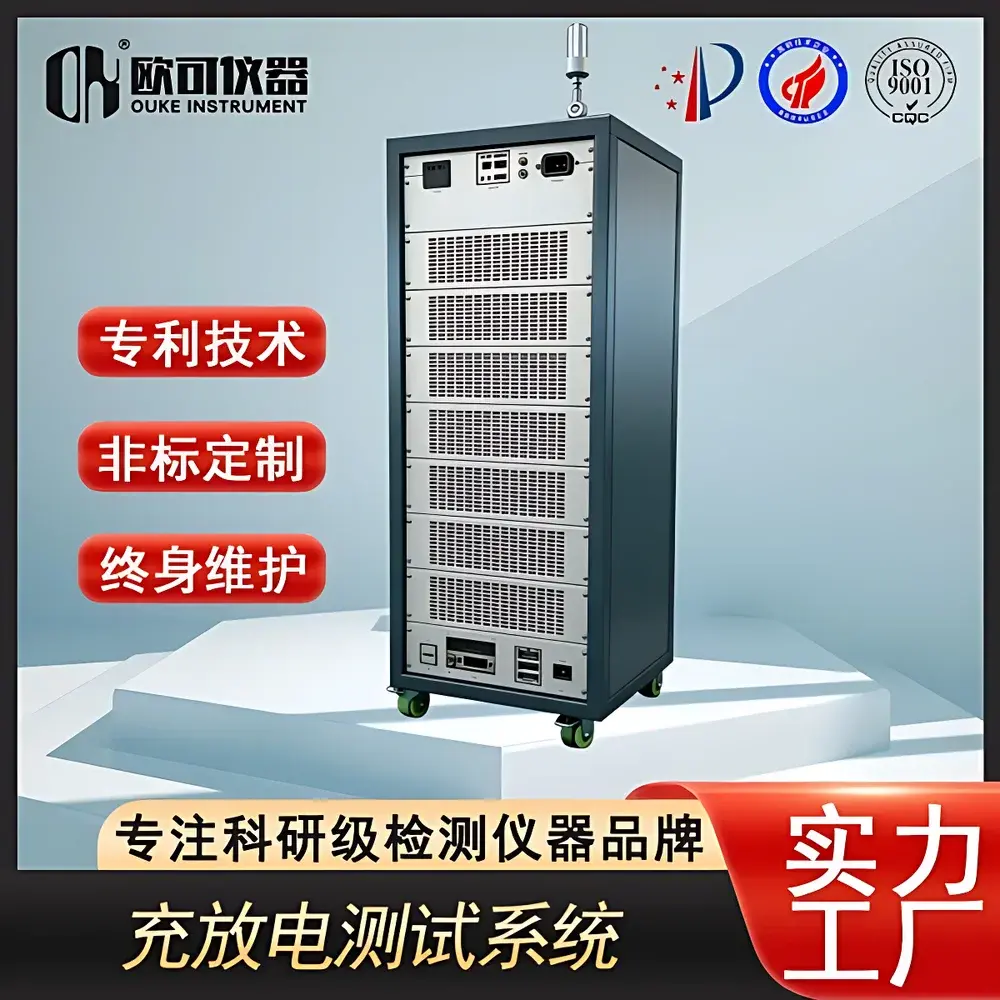
OK Instruments OK-CFDX-1 Advanced Battery Charge-Discharge Test System
| Brand | OK Instruments |
|---|---|
| Origin | Guangdong, China |
| Manufacturer Type | OEM/ODM Manufacturer |
| Country of Origin | China |
| Model | OK-CFDX-1 |
| Price | USD 4,950 (FOB Guangdong) |
| Voltage Range | 0–1000 V (expandable) |
| Voltage Accuracy | ±0.05% FS |
| Voltage Resolution | 1 mV |
| Charge Current Range | 0–200 A (expandable) |
| Discharge Current Range | 0–300 A (expandable) |
| Current Accuracy | ±0.05% FS |
| Current Resolution | 10 mA |
| Internal Resistance Range | 0–200 mΩ |
| IR Accuracy | ±1% FS |
| IR Method | AC Impedance at 1 kHz |
| Capacity Range | 0–1000 Ah |
| Capacity Accuracy | ±0.1% FS |
| Operating Temperature | −20 °C to +60 °C (optional −40 °C to +85 °C) |
| Temperature Control Accuracy | ±1 °C |
| Sampling Rate | 10–1000 Hz (user-selectable) |
| Data Storage | ≥1 million records |
| Data Export Formats | CSV, Excel (.xlsx), PDF |
| Communication Interfaces | RS485, Ethernet, USB (CAN, Modbus, Profinet optional) |
| Channel Configurations | 1–64 independent channels (benchtop or cabinet-mounted) |
| Power Input | AC 380 V ±10%, 50 Hz or AC 220 V ±10%, 50 Hz |
| Enclosure Rating | IP30 (IP54 optional) |
| Compliance | GB/T 31485–2015, GB/T 31486–2015, IEC 62619 |
Overview
The OK Instruments OK-CFDX-1 Advanced Battery Charge-Discharge Test System is a modular, high-fidelity electrochemical testing platform engineered for rigorous characterization and validation of lithium-ion cells, modules, and battery packs. Built upon bidirectional DC power architecture, it enables precise, synchronized control of charge and discharge processes under programmable current, voltage, power, and time-based protocols. The system operates on the principle of galvanostatic (constant-current), potentiostatic (constant-voltage), and power-controlled stimulation, coupled with real-time acquisition of voltage, current, accumulated capacity, surface temperature, and alternating-current internal resistance (AC-IR at 1 kHz). Its design adheres to fundamental electrochemical test methodologies defined in international standards—including IEC 62619 for industrial batteries and GB/T 31485–2015 for safety evaluation—ensuring traceable, reproducible data essential for R&D, quality assurance, and certification workflows.
Key Features
- Bidirectional channel architecture: Each channel integrates a regenerative DC power supply and electronic load, enabling energy recovery during discharge and minimizing grid draw and thermal load.
- High-precision metrology: Voltage measurement accuracy of ±0.05% full scale (FS) with 1 mV resolution; current accuracy of ±0.05% FS and 10 mA resolution—calibrated per channel against NIST-traceable references.
- Multi-mode operation: Supports CC/CV/CP charge, CC/CV/CP discharge, rest periods, pulse profiling, and dynamic waveform playback (e.g., WLTC, UDDS, or user-defined current/power profiles).
- Integrated AC-IR measurement: On-the-fly internal resistance determination using 1 kHz sinusoidal excitation, compliant with IEEE 1188 and SAE J2929 recommendations for state-of-health (SOH) assessment.
- Scalable channel topology: Configurable from single-channel benchtop units to 64-channel cabinet systems, with fully isolated, independently addressable channels—no cross-talk or shared bus limitations.
- Hardware-enforced safety layer: Dual-redundant protection including overvoltage, undervoltage, overcurrent, overtemperature, and short-circuit detection via analog comparators and FPGA-based logic—bypassing software latency.
Sample Compatibility & Compliance
The OK-CFDX-1 accommodates pouch, prismatic, and cylindrical lithium-ion cells (from 18650 to large-format LFP/NMC), as well as multi-cell modules and EV-grade battery packs up to 1000 V. Custom fixturing—including low-impedance Kelvin probes, thermocouple-integrated clamps, and high-current busbar interfaces—is available to ensure mechanical stability and electrical fidelity. All hardware and firmware comply with electromagnetic compatibility (EMC) requirements per IEC 61000-6-3 and IEC 61000-6-4. Software audit trails, electronic signatures, and configurable access levels align with GLP and GMP documentation practices. Full compliance with FDA 21 CFR Part 11 is supported via optional validated software package—including immutable raw data logging, user action timestamps, and revision-controlled test method templates.
Software & Data Management
The OK-BatteryTest Suite provides a deterministic, scriptable environment for test definition and execution. It features drag-and-drop step sequencing, parameter interpolation, conditional branching (e.g., “if voltage > 4.25 V, terminate step”), and Python API integration for custom algorithm deployment. Real-time visualization includes synchronized voltage/current/capacity/time plots with zoom, overlay, and derivative calculation (dV/dQ, dQ/dV). Raw data is stored in binary HDF5 format with embedded metadata (channel ID, timestamp, environmental conditions, calibration coefficients), ensuring long-term integrity. Export modules generate ISO/IEC 17025-compliant reports in CSV, Excel, and PDF—with customizable templates for internal QA, third-party certification, or OEM submission. Data retention policies support automated archiving to network-attached storage (NAS) or cloud object storage via SFTP or RESTful endpoints.
Applications
- Cell-level R&D: OCV-SOC mapping, rate capability analysis, cycle life benchmarking (up to 10,000+ cycles), and formation protocol optimization.
- Module/pack validation: Inter-cell voltage imbalance tracking, thermal propagation testing under fault conditions, and BMS algorithm verification using closed-loop CAN feedback.
- Quality control: Incoming material screening, end-of-line (EOL) functional testing, and statistical process control (SPC) using Cp/Cpk metrics derived from capacity and IR distributions.
- Regulatory compliance: Execution of mandatory tests per UN 38.3 (transport), IEC 62133 (safety), and UL 1642 (cell-level abuse tolerance).
- Accelerated aging studies: Combined stress testing (e.g., elevated temperature + high SOC + cycling) with Arrhenius-based lifetime modeling.
FAQ
What communication protocols does the OK-CFDX-1 support for integration into automated test lines?
Standard interfaces include RS485 (Modbus RTU), TCP/IP Ethernet (Modbus TCP), and USB 2.0. Optional fieldbus modules provide native CAN 2.0B, PROFINET IRT, and EtherCAT connectivity—enabling seamless synchronization with PLCs, climate chambers, and robotic handling systems.
Is the system suitable for testing solid-state batteries requiring ultra-low current resolution?
Yes—the base current resolution of 10 mA is configurable down to 1 mA in low-range modes (0–20 A), and optional high-sensitivity current shunts extend precision to ±0.02% FS for microampere-level self-discharge and leakage current monitoring.
How is calibration maintained across multiple channels and over time?
Each channel undergoes factory calibration with NIST-traceable standards. Field recalibration is supported via built-in reference sources and automated routines; calibration certificates—including uncertainty budgets per ISO/IEC 17025—are generated and stored with each test record.
Can the system perform simultaneous EIS measurements without external hardware?
The OK-CFDX-1 does not include integrated frequency response analysis (FRA); however, its programmable current/voltage output and synchronized 1 kHz sampling enable external EIS instrumentation (e.g., BioLogic or Gamry) to be triggered and time-aligned via TTL sync signals and shared clock distribution.
What level of cybersecurity is implemented for remote operation in networked lab environments?
Firmware implements TLS 1.2 encrypted communications, role-based authentication (RBAC), and configurable firewall rules. Audit logs capture all login attempts, configuration changes, and test start/stop events—exportable for SIEM integration per ISO/IEC 27001 guidelines.