
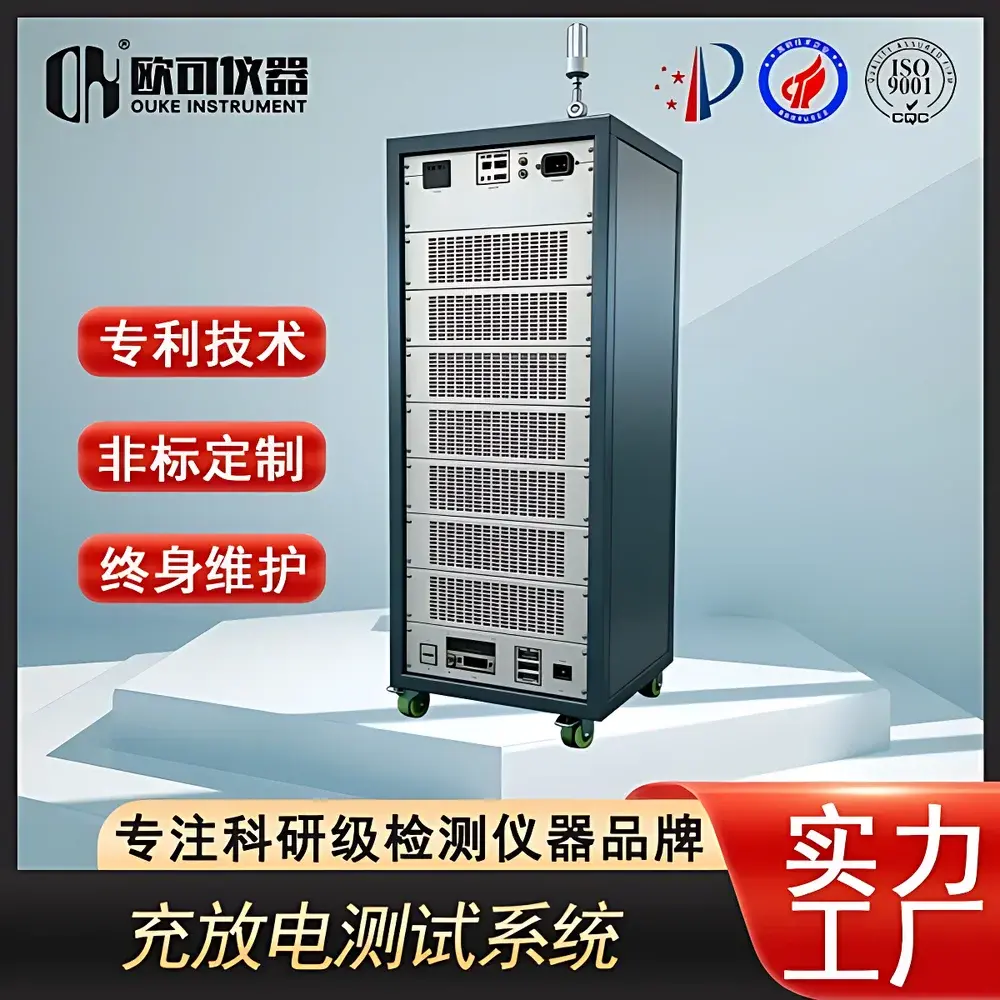
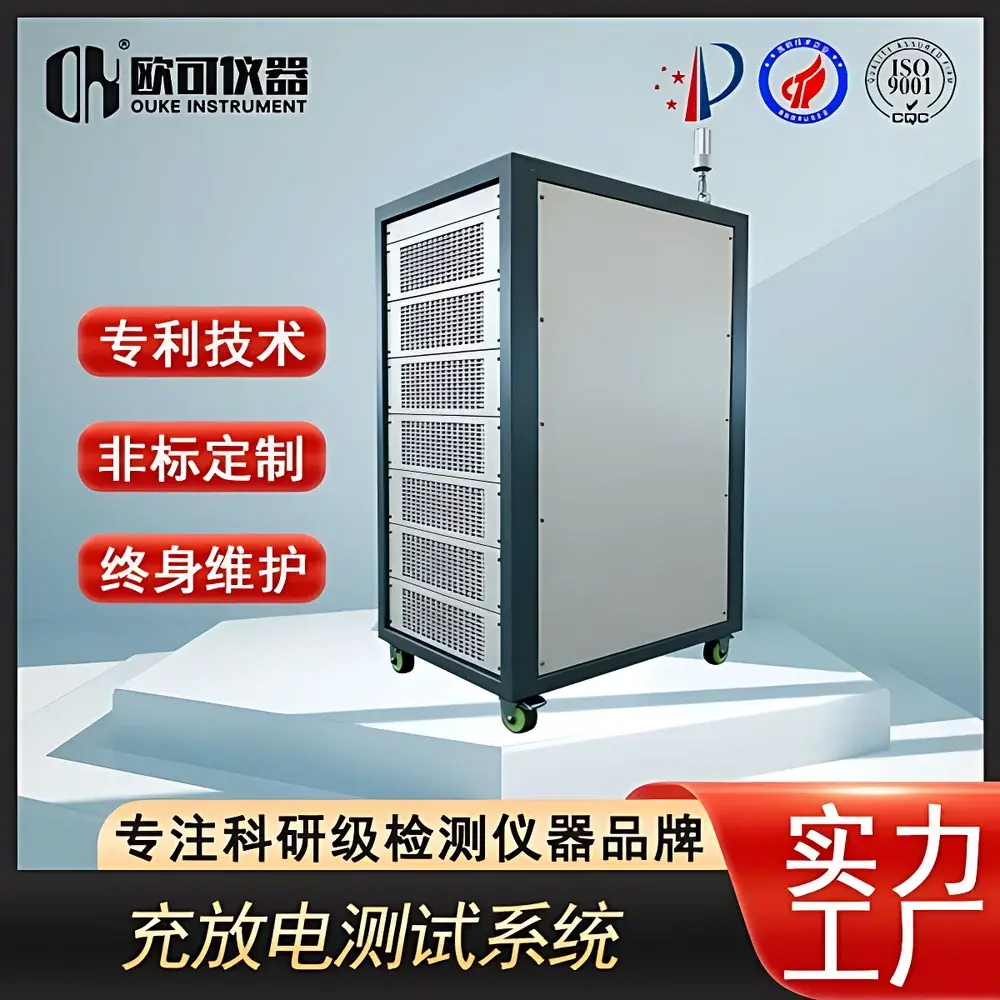
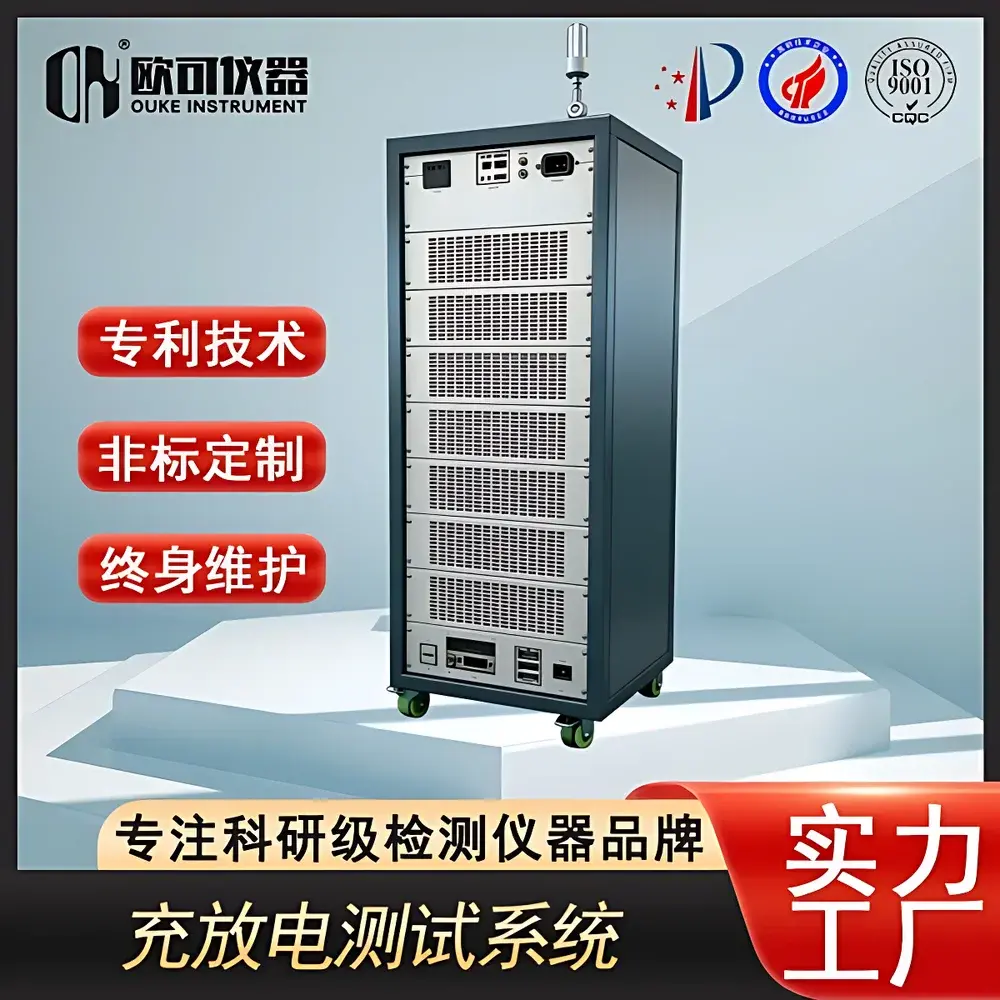
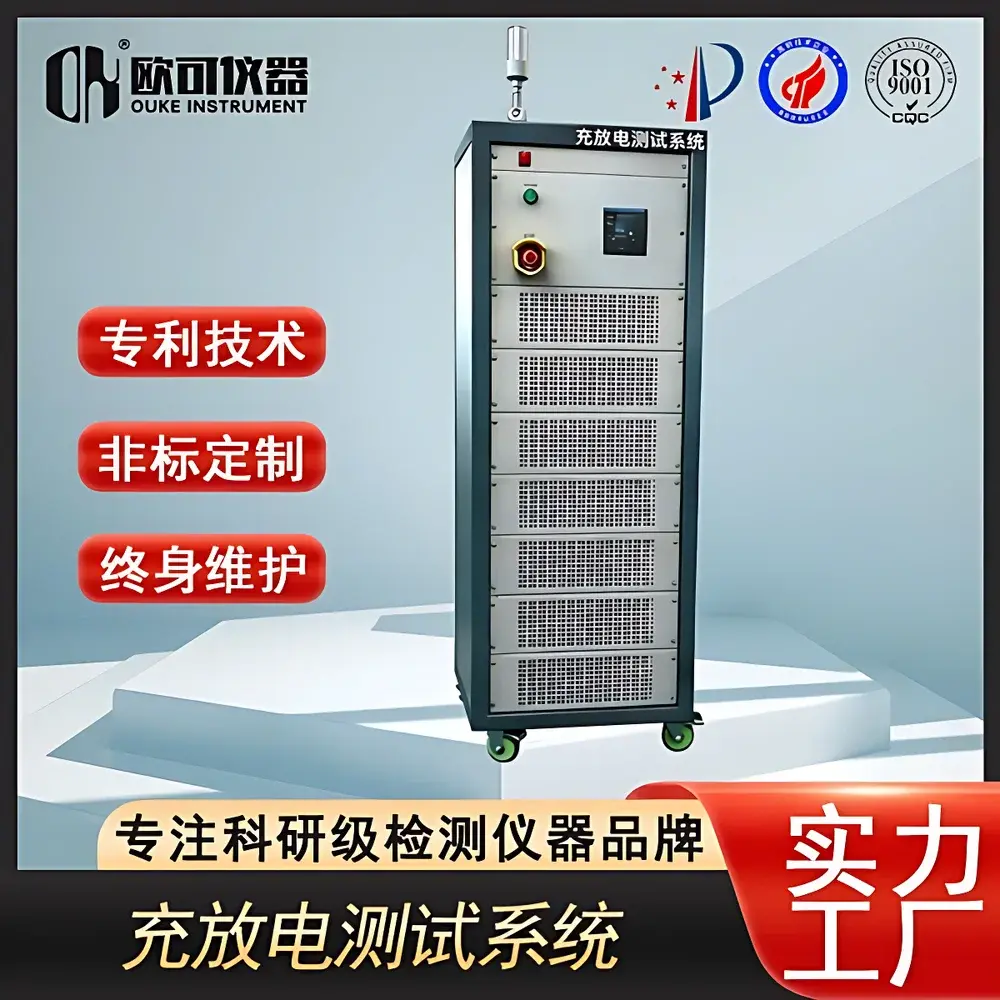
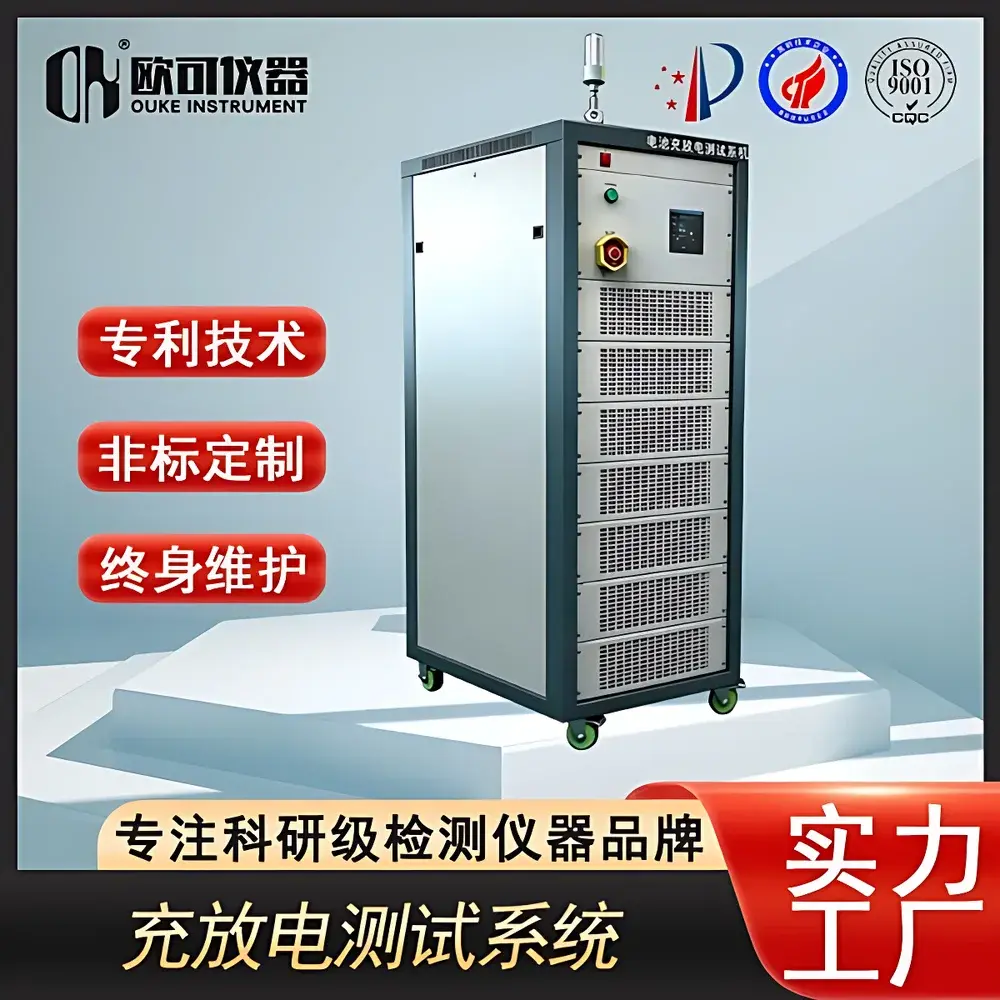
OK Instruments OK-CFDX-5 Battery Charge-Discharge Test System
| Brand | OK Instruments |
|---|---|
| Origin | Guangdong, China |
| Manufacturer Type | Direct Manufacturer |
| Country of Origin | China |
| Model | OK-CFDX-5 |
| Price | USD 2,700 (approx.) |
| Voltage Range | 0–1000 V (expandable) |
| Voltage Accuracy | ±0.05% FS |
| Voltage Resolution | 1 mV |
| Charge Current Range | 0–200 A (expandable) |
| Discharge Current Range | 0–300 A (expandable) |
| Current Accuracy | ±0.05% FS |
| Current Resolution | 10 mA |
| Internal Resistance Range | 0–200 mΩ |
| IR Accuracy | ±1% FS |
| IR Method | AC Impedance at 1 kHz |
| Capacity Range | 0–1000 Ah |
| Capacity Accuracy | ±0.1% FS |
| Operating Temperature Range | −20 °C to +60 °C (optional −40 °C to +85 °C) |
| Temperature Control Accuracy | ±1 °C |
| Sampling Rate | 10–1000 Hz (adjustable) |
| Data Storage Capacity | ≥1 million records |
| Data Export Formats | Excel, CSV, PDF |
| Communication Interfaces | RS485, Ethernet, USB (optional CAN, Modbus, PROFINET) |
| Channel Configuration | 1–64 channels (benchtop or cabinet-mounted) |
| Power Supply | AC 380 V ±10%, 50 Hz or AC 220 V ±10%, 50 Hz |
| Enclosure Rating | IP30 (industrial indoor), optional IP54 |
| Compliance | GB/T 31485–2015, GB/T 31486–2015, IEC 62619 |
Overview
The OK Instruments OK-CFDX-5 Battery Charge-Discharge Test System is a precision electrochemical testing platform engineered for rigorous performance evaluation of lithium-ion cells, modules, and battery packs. Based on bidirectional DC power conversion architecture, it implements programmable galvanostatic (CC), potentiostatic (CV), and power-controlled (CP) charge/discharge protocols with synchronized voltage, current, temperature, and internal resistance acquisition. The system operates on a closed-loop control principle, where real-time feedback from high-stability shunt-based current sensors and low-drift voltage dividers ensures traceable measurement fidelity across the full dynamic range. Designed for R&D labs, QC departments, and battery certification facilities, the OK-CFDX-5 supports standardized test execution per globally recognized regulatory frameworks—including IEC 62619 for industrial batteries and GB/T 31485–31486 for electric vehicle traction applications—enabling reproducible data generation under controlled thermal and electrical boundary conditions.
Key Features
- Bidirectional channel architecture integrating regenerative DC power supplies and electronic loads, enabling energy recovery during discharge cycles and reducing operational heat load.
- Modular channel design supporting scalable configurations from 1 to 64 independent test channels, each with fully isolated voltage/current control and hardware-level safety interlocks.
- High-fidelity metrology subsystem: 16-bit ADCs with auto-calibrating front-end circuitry deliver ±0.05% FS voltage and current accuracy, 1 mV/10 mA resolution, and sub-millisecond timing synchronization.
- Integrated AC impedance module operating at 1 kHz for rapid internal resistance (IR) assessment compliant with ISO 18353 and SAE J2929 Annex C methodologies.
- Multi-layer safety architecture comprising hardwired overvoltage/undervoltage/overcurrent/overtemperature cutoffs, software-configurable trip thresholds, and external interlock support for environmental chambers and explosion-proof enclosures.
- Thermal integration interface supporting direct communication with programmable climate chambers (−40 °C to +85 °C) for accelerated aging, low-temperature performance, and thermal runaway propagation studies.
Sample Compatibility & Compliance
The OK-CFDX-5 accommodates prismatic, cylindrical, and pouch-format lithium-ion cells (including NMC, LFP, LCO, and solid-state prototypes), as well as series/parallel modules and full EV battery packs up to 1000 V nominal. Fixture interfaces are configurable for low-contact-resistance connections via Kelvin sensing clamps or busbar-mount adapters. All test sequences adhere to mandatory safety and performance requirements outlined in IEC 62619 (secondary lithium cells for industrial applications), UN 38.3 (transportation safety), GB/T 31485–2015 (safety requirements for power batteries), and GB/T 31486–2015 (performance specifications). The system supports audit-ready operation under GLP and GMP-aligned workflows, including user access control, electronic signatures, and FDA 21 CFR Part 11-compliant audit trails when paired with validated software configuration.
Software & Data Management
The embedded OK-BatteryLab™ software provides a deterministic, scriptable test environment with drag-and-drop step editing, built-in templates for standard protocols (e.g., capacity calibration, cycle life, HPPC, OCV-SOC mapping), and Python API support for custom algorithm integration. Real-time visualization includes synchronized multi-parameter plots (V, I, T, dV/dQ, ΔV/Δt), statistical overlays, and deviation trend tracking. Raw data is stored in binary time-series format with metadata tagging (operator ID, batch number, ambient conditions) and exportable to CSV, Excel, or PDF without loss of timestamp precision. Local database indexing enables sub-second retrieval of historical runs by parameter ranges, failure events, or cycle count intervals. Remote monitoring and control are supported via HTTPS-based web interface or OPC UA server for MES/SCADA integration.
Applications
- Cell-level characterization: capacity retention, Coulombic efficiency, rate capability, open-circuit voltage (OCV) vs. state-of-charge (SOC) profiling, and pulse power response.
- Module and pack validation: cell-to-cell voltage/temperature uniformity analysis, balancing effectiveness verification, and BMS communication protocol interoperability testing.
- Accelerated life testing: calendar aging under constant SOC/stress conditions and cycle aging under WLTC, UDDS, or custom drive-cycle profiles imported via CSV waveform files.
- Safety qualification: overcharge/overdischarge tolerance, thermal abuse response, and self-discharge rate quantification across temperature gradients.
- Electrochemical diagnostics: DCIR pulse analysis, hybrid pulse power characterization (HPPC), and correlation with EIS-derived parameters when used with optional frequency-response analyzers.
- Process development support: electrode formulation screening, electrolyte optimization, and formation protocol refinement through high-throughput parallel channel testing.
FAQ
What standards does the OK-CFDX-5 comply with for battery safety testing?
It supports test execution per GB/T 31485–2015, GB/T 31486–2015, IEC 62619, and UN 38.3. Optional firmware modules enable automated pass/fail reporting against these criteria.
Can the system perform real-time impedance measurements during cycling?
Yes—the integrated 1 kHz AC impedance function allows periodic or continuous internal resistance monitoring without interrupting charge/discharge steps.
Is remote operation and data access supported?
Yes—via secure web interface (HTTPS), RESTful API, and OPC UA connectivity for integration into factory automation systems.
How is measurement traceability ensured?
Each unit ships with NIST-traceable calibration certificates for voltage, current, and temperature channels; onboard self-diagnostic routines verify sensor linearity and gain stability before every test run.
What environmental chamber compatibility does the system offer?
Standard digital I/O and Modbus TCP interfaces enable synchronized control with major climate chamber brands (Weiss, ESPEC, Angelantoni), including automatic temperature ramping triggered by voltage thresholds or cycle count milestones.





