
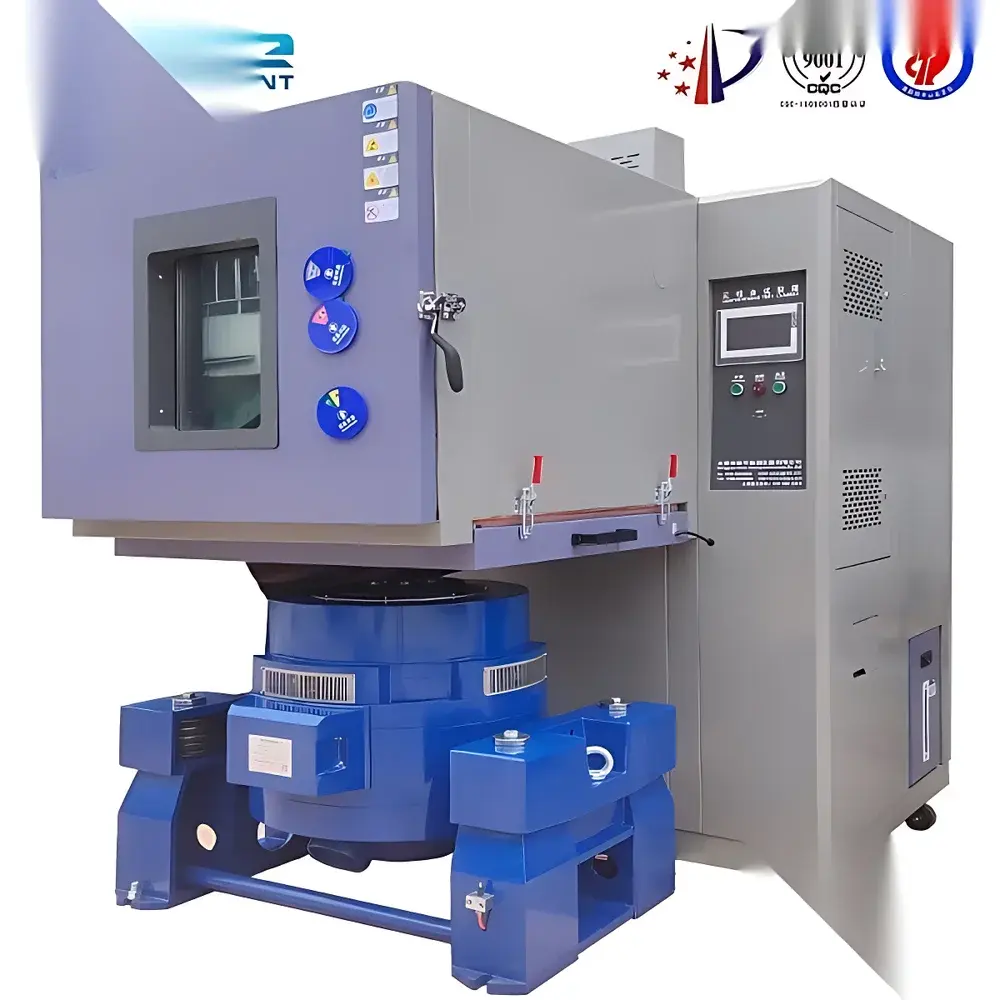
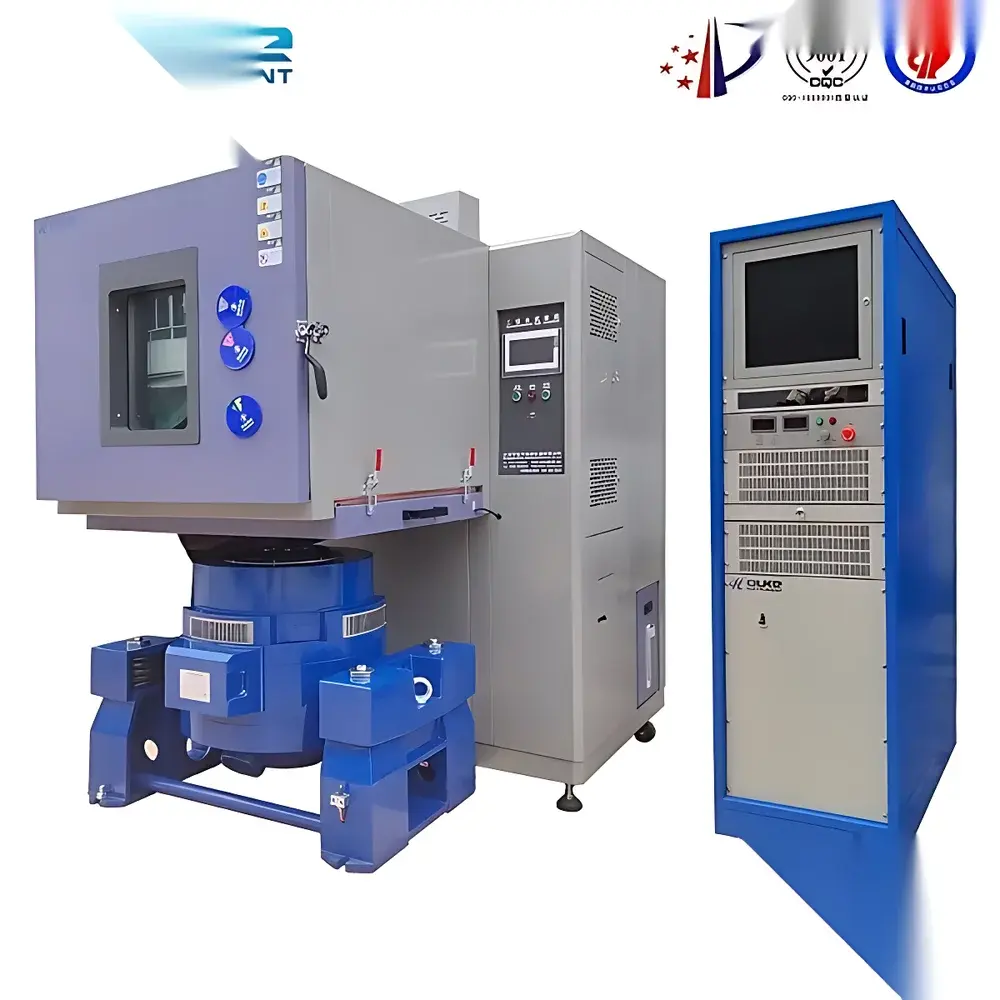
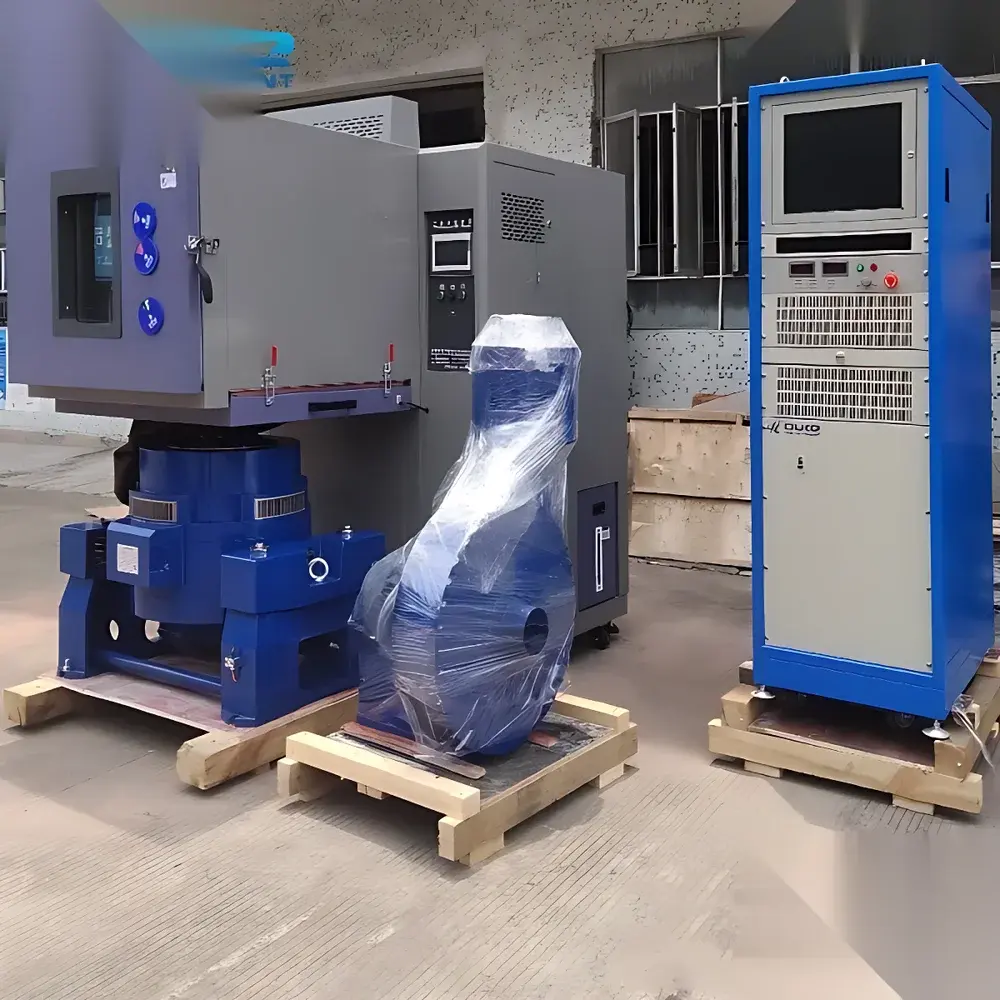
OKE Combined Temperature-Humidity-Vibration Environmental Test Chamber for Electronics Industry
| Brand | Other Brands |
|---|---|
| Origin | Imported |
| Manufacturer Type | Authorized Distributor |
| Price | USD 21,500 (FOB) |
| Temperature Range Options | -20°C to 150°C / -40°C to 150°C / -60°C to 150°C / -80°C to 150°C |
| Humidity Range | 20–98% RH |
| Temp. Uniformity | ≤ ±2°C |
| Temp. Stability | ≤ ±0.5°C |
| Humidity Deviation | +2 / -3% RH |
| Heating Rate | -20°C → 100°C in ≈35 min |
| Cooling Rate | 25°C → -40°C in ≈50 min |
| Vibration Interface | Removable vibration table with rail-guided deployment |
| Control System | OYO 8226 Touchscreen Programmable Controller (100 programs × 1000 segments × 999 cycles) |
| Communication | RS-232 / RS-485 interface compliant with SCPI protocol |
| Compliance | Designed per IEC 60068-2-1, IEC 60068-2-2, IEC 60068-2-14, IEC 60068-2-30, and MIL-STD-810H environmental test standards |
Overview
The OKE Combined Temperature-Humidity-Vibration Environmental Test Chamber is an integrated reliability validation platform engineered for accelerated stress testing of electronic components, printed circuit assemblies (PCBAs), automotive ECUs, aerospace avionics modules, and consumer electronics under simultaneous multi-stress conditions. Unlike sequential single-stress chambers, this system applies controlled thermal cycling, humidity exposure, and mechanical vibration—concurrently—within a single enclosed workspace, replicating real-world field degradation mechanisms such as solder joint fatigue, intermetallic growth, condensation-induced corrosion, and microcrack propagation in conformal coatings or encapsulants. The chamber operates on the principle of coupled environmental simulation: temperature and humidity are regulated via PID-controlled refrigeration and steam-based humidification subsystems, while vibration is delivered through a dynamically isolated electrodynamic shaker mounted on a precision linear rail system. This architecture enables strict decoupling of vibration energy from thermal/humidity control loops—critical for maintaining measurement integrity during combined-mode operation per IEC 60068-2-67 and JEDEC JESD22-A108.
Key Features
- Modular vibration integration: A rail-mounted, motorized vibration table slides fully into or out of the test chamber cavity—eliminating cross-contamination of thermal insulation and enabling non-vibratory humidity/temperature-only tests without hardware reconfiguration.
- Hermetic sealing architecture: Multi-layer gasketing between the vibration table and chamber base employs alternating epoxy resin layers and high-temperature silicone rubber (rated to 200°C), ensuring long-term compression set resistance and leak-tight performance at extreme RH levels.
- Dual-wall thermal envelope: Outer shell constructed from A3 carbon steel with electrostatic powder coating; inner chamber lined with mirror-finish SUS304 stainless steel; insulation composed of either polyurethane rigid foam (λ = 0.022 W/m·K) or ultra-fine glass fiber (density ≥ 48 kg/m³), achieving thermal loss < 0.8 kW at -70°C steady state.
- Optical observation system: Triple-glazed, low-iron tempered viewing window with embedded conductive ITO film (surface resistivity < 10⁴ Ω/sq) for anti-fogging and EMI shielding—enabling real-time visual inspection without compromising chamber integrity.
- Intelligent control interface: OYO 8226 touchscreen controller with dual-language UI (English/Chinese), real-time trend logging, programmable alarm thresholds, and password-protected screen lock to prevent accidental parameter modification during unattended operation.
Sample Compatibility & Compliance
The chamber accommodates test specimens up to 600 mm × 600 mm × 600 mm (W×D×H) on its standard vibration table (100 kg payload capacity, 5–2000 Hz frequency range, 50 gpeak acceleration). It supports standardized sample mounting fixtures per ISO 10816-1 (vibration severity) and ASTM D4332 (conditioning protocols). All operational parameters—including ramp rates, dwell times, and humidity setpoints—are traceable to NIST-traceable PT100 platinum resistance thermometers and capacitive RH sensors calibrated annually per ISO/IEC 17025 requirements. The system meets full compliance with IEC 60068-2 series for environmental testing of electrotechnical products, including thermal shock (Part 1 & 2), damp heat cyclic (Part 30), and combined temperature/humidity/vibration (Part 67). Documentation packages include factory calibration certificates, FAT/SAT reports, and optional IQ/OQ/PQ validation templates aligned with FDA 21 CFR Part 11 and ISO 13485 quality management systems.
Software & Data Management
The OYO 8226 controller supports local data storage (≥10,000 hours of timestamped temperature/humidity/vibration channel logs) and remote supervision via RS-232/RS-485 serial interfaces using standard SCPI command syntax. Optional PC software (OKE-TestLink v3.2) provides graphical test sequence design, live multi-channel waveform overlay, automated report generation (PDF/CSV), and audit trail export with user action timestamps—fully compliant with GLP/GMP electronic record requirements. All logged data includes metadata: operator ID, test program version, chamber serial number, sensor calibration expiry dates, and environmental deviation flags. Data encryption (AES-128) and role-based access control (RBAC) are available upon request for regulated industries.
Applications
This chamber serves critical roles across R&D, quality assurance, and production release phases: qualification testing of automotive ADAS radar modules per AEC-Q200; HALT/HASS screening of 5G RF front-end ICs; moisture sensitivity level (MSL) verification of QFN/BGA packages under JEDEC J-STD-020; reliability assessment of battery management systems (BMS) exposed to coastal humidity and road-induced vibration; and accelerated life testing of medical imaging PCBs operating in MRI suite environments. Its ability to sustain simultaneous -60°C/95% RH with 10 grms random vibration makes it suitable for evaluating cryogenic electronics used in satellite payloads and quantum computing cryostats.
FAQ
Does the chamber support automatic switching between vibration-on and vibration-off modes within a single test program?
Yes—via programmable logic within the OYO 8226 controller, users can define discrete vibration activation windows synchronized precisely with temperature/humidity ramps.
What is the maximum allowable cable feedthrough diameter for signal/power lines?
The standard left-side port has a 50 mm internal diameter, sealed with replaceable silicone grommets rated for -80°C to +150°C operation.
Is third-party calibration certification available with delivery?
All units ship with NIST-traceable calibration certificates for temperature, humidity, and vibration channels, issued by an ILAC-MRA accredited lab.
Can the system be integrated into a central MES or LIMS environment?
Yes—via Modbus TCP gateway add-on or direct RS-485 integration using open protocol documentation provided with the controller.
What maintenance intervals are recommended for the refrigeration and humidification subsystems?
Compressor oil and filter replacement every 12 months; stainless-steel humidifier tank descaling every 3 months (or per water conductivity monitoring); annual verification of PT100 and RH sensor drift.
Related Products



