
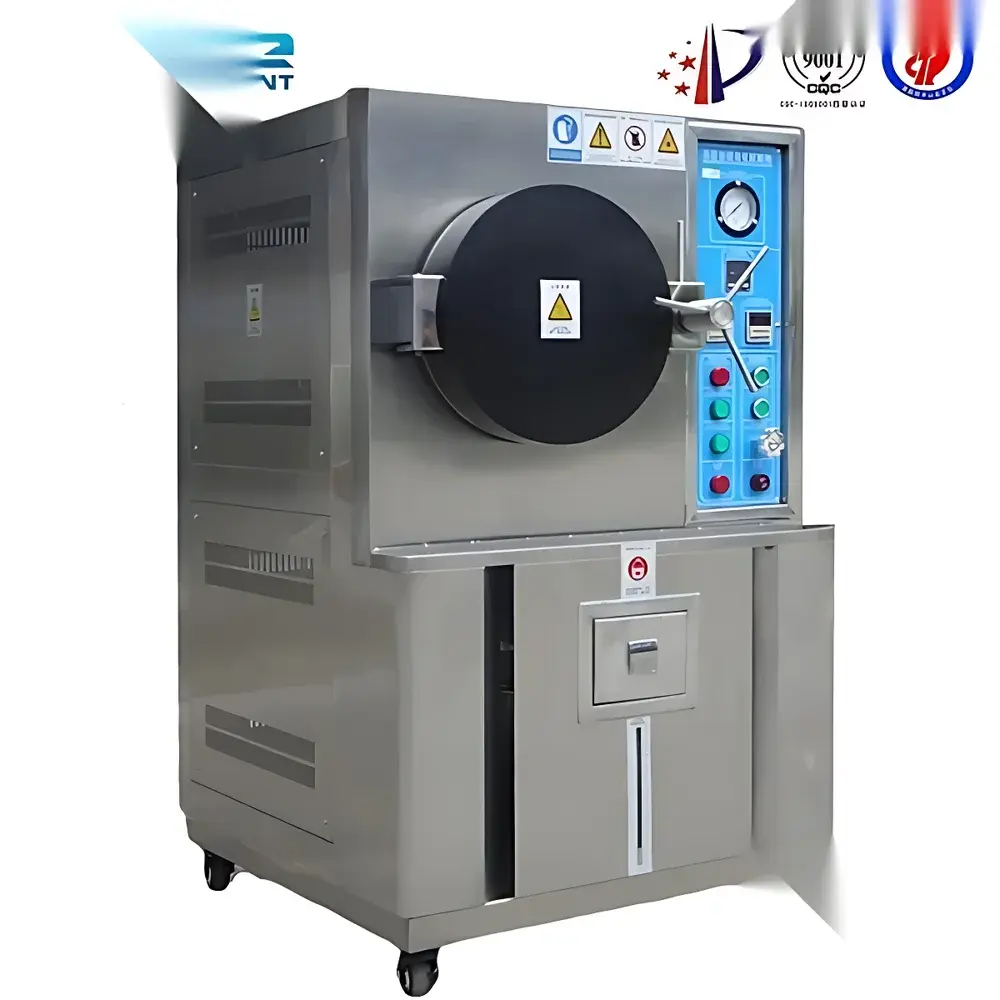
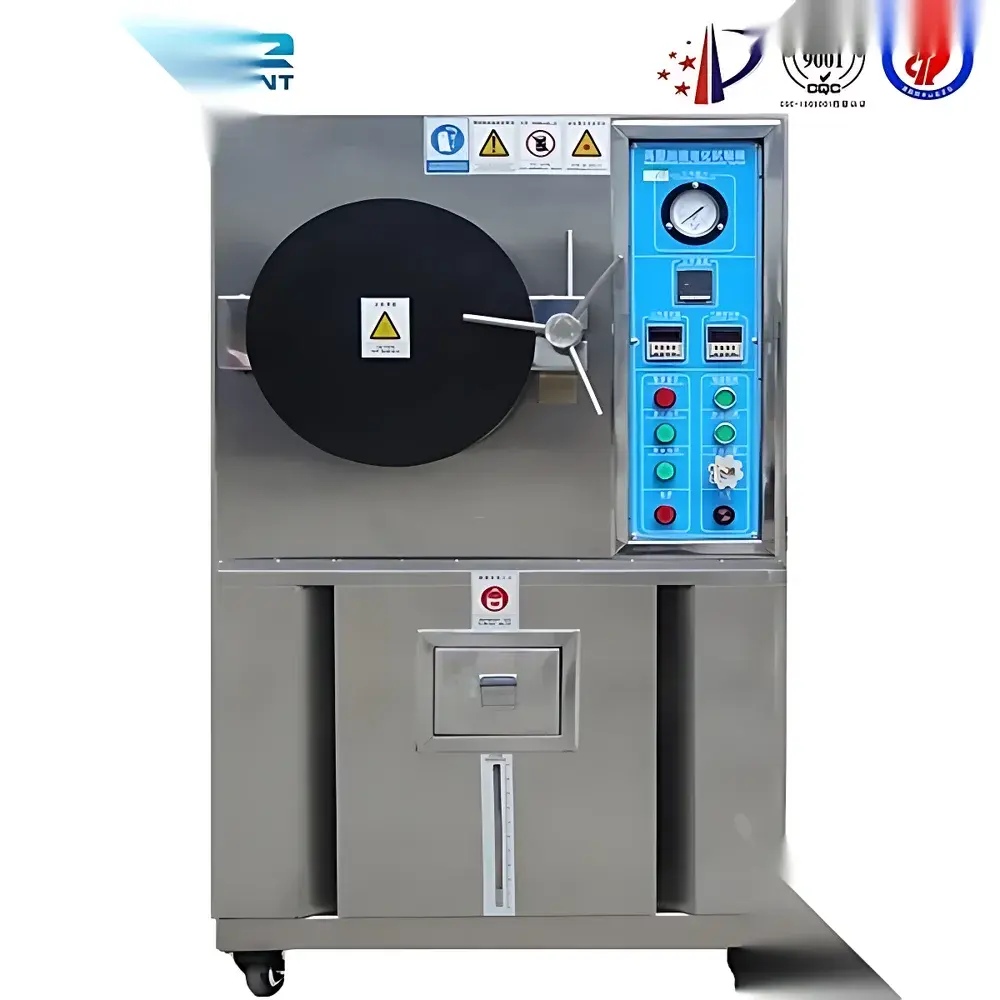
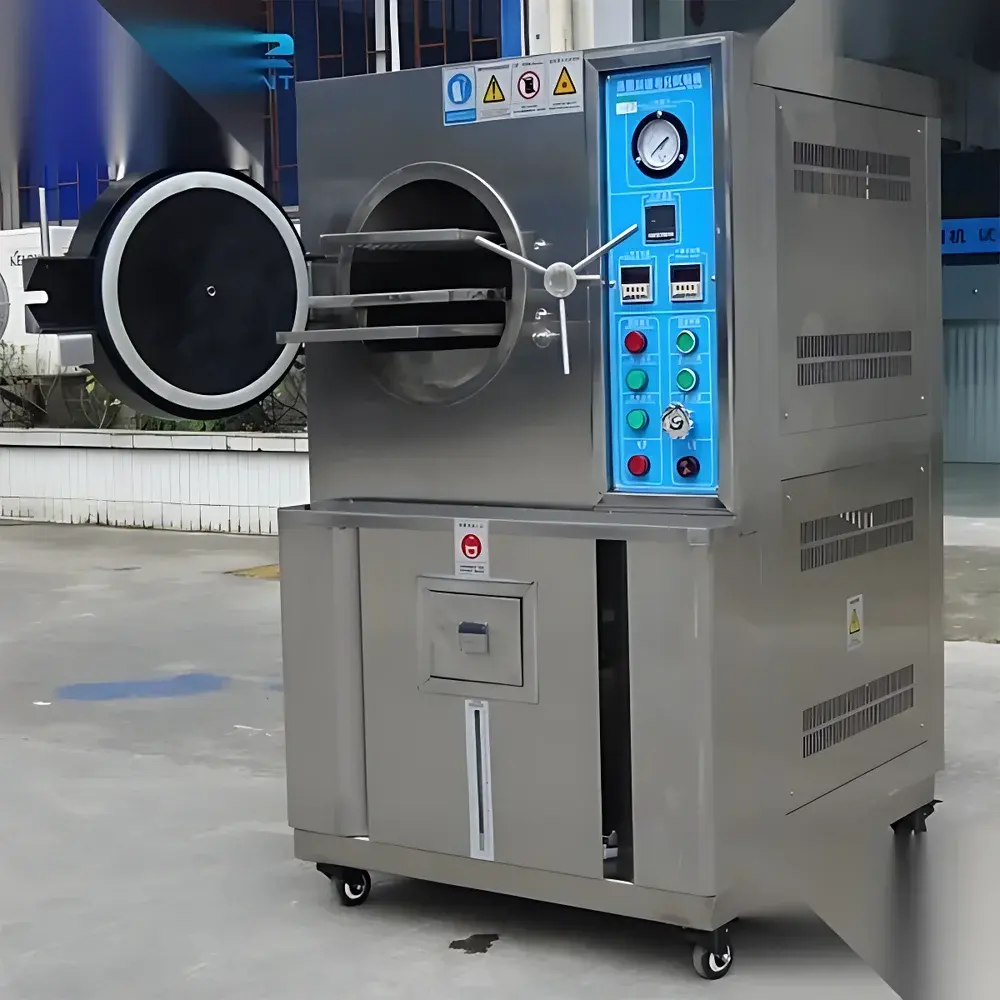
OKO Instruments HAST Accelerated Aging Test Chamber for Mobile Display Panels
| Brand | OKO Instruments |
|---|---|
| Model Options | OK-HAST-25 (Ø25×40 cm), OK-HAST-30 (Ø30×50 cm), OK-HAST-40 (Ø40×60 cm), OK-HAST-50 (Ø50×70 cm) |
| Temperature Range | 100–132 °C |
| Humidity Range | 75–100 %RH (saturated steam) |
| Pressure Range | Ambient + 0–4 kg/cm² (≈0–392 kPa gauge) |
| Max. Continuous Operation | 400 hours |
| Chamber Safety Rating | 65 kgf/cm² hydrostatic test at 140 °C |
| Dual-Stage Pressure Safety System | Electronic controller + mechanical pressure relief valve |
| Water Level Monitoring | Integrated capacitive sensor with auto-refill function |
| Steam Generation | Isolated stainless-steel steam generator chamber |
| Door Mechanism | Ergonomic dual-lever locking system |
Overview
The OKO Instruments HAST Accelerated Aging Test Chamber is an engineered environmental stress screening system designed specifically for highly accelerated stress testing (HAST) of moisture-sensitive electronic components—particularly mobile display modules, LCD panels, OLED assemblies, and integrated circuit packages. Operating on the principle of elevated temperature, high humidity, and controlled overpressure, the chamber replicates years of field-level moisture ingress and thermal degradation in a fraction of the time, enabling rapid reliability qualification per industry standards including JEDEC JESD22-A118, JESD22-A110, and IEC 60068-2-66. Unlike conventional damp heat tests, HAST introduces saturated steam under positive pressure to accelerate hydrolytic degradation at the die attach, wire bond, and passivation layer interfaces—making it indispensable for validating hermeticity, corrosion resistance, and long-term interfacial stability of miniaturized display subassemblies prior to mass production release.
Key Features
- Isolated steam generation chamber constructed from high-purity 316L stainless steel, preventing direct steam impingement on test specimens and ensuring uniform thermal-hygrometric distribution.
- Dual-path high-temperature solenoid valves (imported, rated >150 °C) minimize failure probability and support precise pressure modulation during extended test cycles.
- Ergonomic dual-lever door locking mechanism eliminates manual torque dependency—reducing operator fatigue and improving repeatability of seal integrity across daily use.
- Two-stage cold air purge system: initial evacuation pre-test and dynamic air removal during pressurization—enhancing pressure stability, test reproducibility, and thermodynamic equilibrium control.
- Capacitive water level sensing with closed-loop auto-refill capability maintains uninterrupted operation even during 400-hour continuous HAST protocols.
- Redundant safety architecture: primary electronic pressure regulation integrated with secondary mechanical burst-disc relief valve and emergency manual depressurization knob compliant with ASME BPVC Section VIII requirements.
- Pressure vessel certified for 65 kgf/cm² hydrostatic test at 140 °C—exceeding standard operational limits and supporting rigorous internal audit readiness.
Sample Compatibility & Compliance
The chamber accommodates flat-panel display units up to 120 mm diagonal (OK-HAST-50 model), PCB substrates, flex circuits, COG (chip-on-glass) modules, and encapsulated driver ICs. Its cylindrical chamber geometry minimizes dead zones and supports homogeneous steam saturation. All models comply with ISO/IEC 17025 calibration traceability frameworks when operated with NIST-traceable reference sensors. The system meets functional safety prerequisites for GLP-compliant reliability labs and supports audit-ready documentation per FDA 21 CFR Part 11 when paired with optional validated software modules. It is routinely deployed in Tier-1 display OEM qualification labs for AEC-Q200-compliant component screening and IPC-J-STD-033 moisture sensitivity level (MSL) verification.
Software & Data Management
While the base configuration features a microprocessor-based PID controller with real-time digital displays for temperature, pressure, and humidity, optional Ethernet-enabled firmware supports Modbus TCP and OPC UA integration into centralized MES or LIMS platforms. Logged data—including ramp rates, dwell stability deviations, and pressure transient profiles—is timestamped and exportable in CSV/Excel format. Audit trails include operator ID, parameter change history, alarm events, and safety interlock activations—fully aligned with GMP Annex 11 and ICH Q9 quality risk management expectations. Remote monitoring via secure HTTPS interface enables off-site validation oversight without compromising data integrity.
Applications
- Accelerated life testing of AMOLED and LTPS LCD display modules under JEDEC HAST conditions.
- Hermeticity validation of glass-lid sealed touch sensors and in-cell fingerprint modules.
- Intermetallic growth assessment at Cu/Al bonding interfaces under combined thermal-moisture stress.
- Qualification of underfill and edge-seal materials used in foldable display hinge assemblies.
- Failure mode analysis (FMA) of delamination, popcorning, and conductive anodic filament (CAF) formation in high-density FPCB stacks.
- Process capability studies for plasma-enhanced ALD barrier coatings applied to emissive layers.
FAQ
What standards does this HAST chamber support?
It is configured to execute JEDEC JESD22-A118 (unbiased HAST), JESD22-A110 (biased HAST), and IEC 60068-2-66 test profiles with full parameter traceability.
Can the chamber be integrated into an automated test line?
Yes—via optional Modbus TCP or OPC UA protocol support, enabling synchronization with robotic handlers, barcode-triggered test initiation, and automated report generation.
Is calibration documentation provided?
Each unit ships with a factory calibration certificate referencing NIST-traceable standards for temperature (±0.3 °C), pressure (±0.5 %FS), and relative humidity (±2 %RH).
How is condensation managed during depressurization?
A programmable slow-depressurization ramp (adjustable 0.1–2.0 kg/cm²/min) minimizes thermal shock and prevents condensate pooling on sensitive display surfaces.
What maintenance intervals are recommended?
Steam generator descaling every 200 operating hours; pressure relief valve functional verification quarterly; full system performance verification annually per ISO/IEC 17025 guidelines.



