
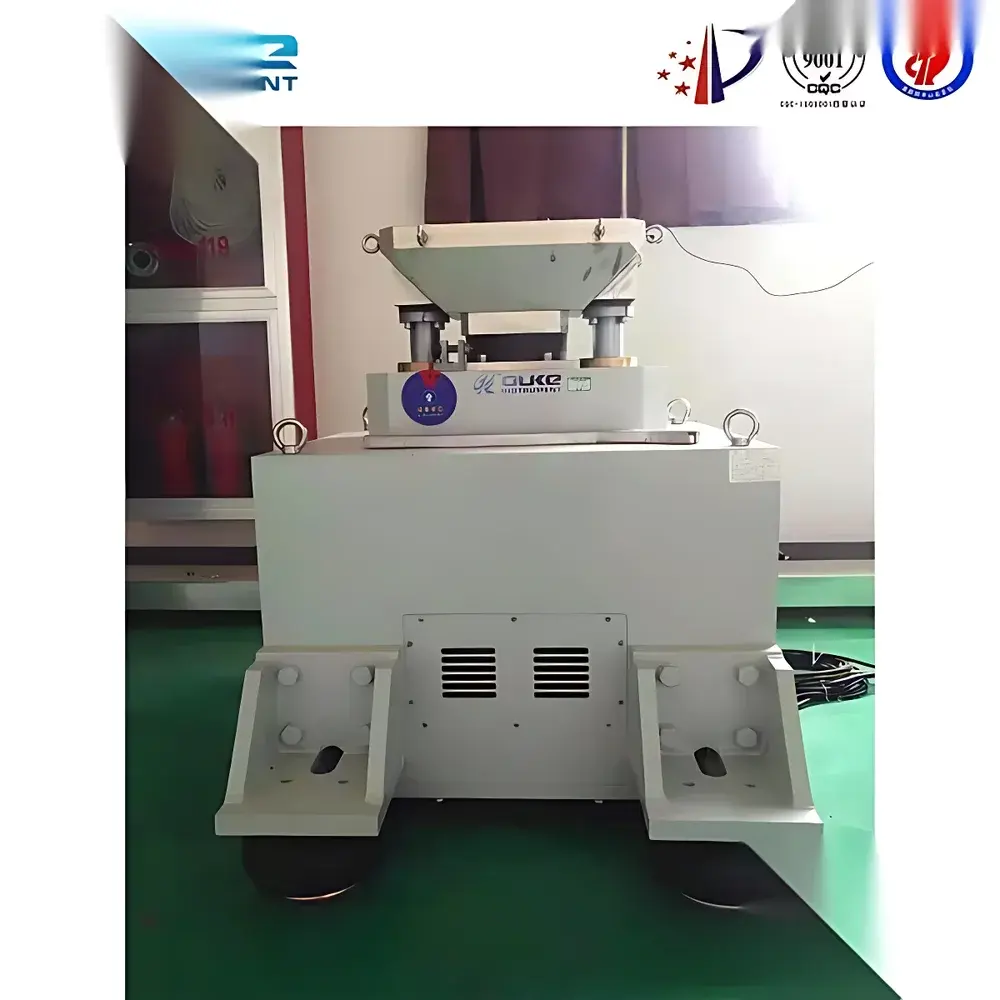
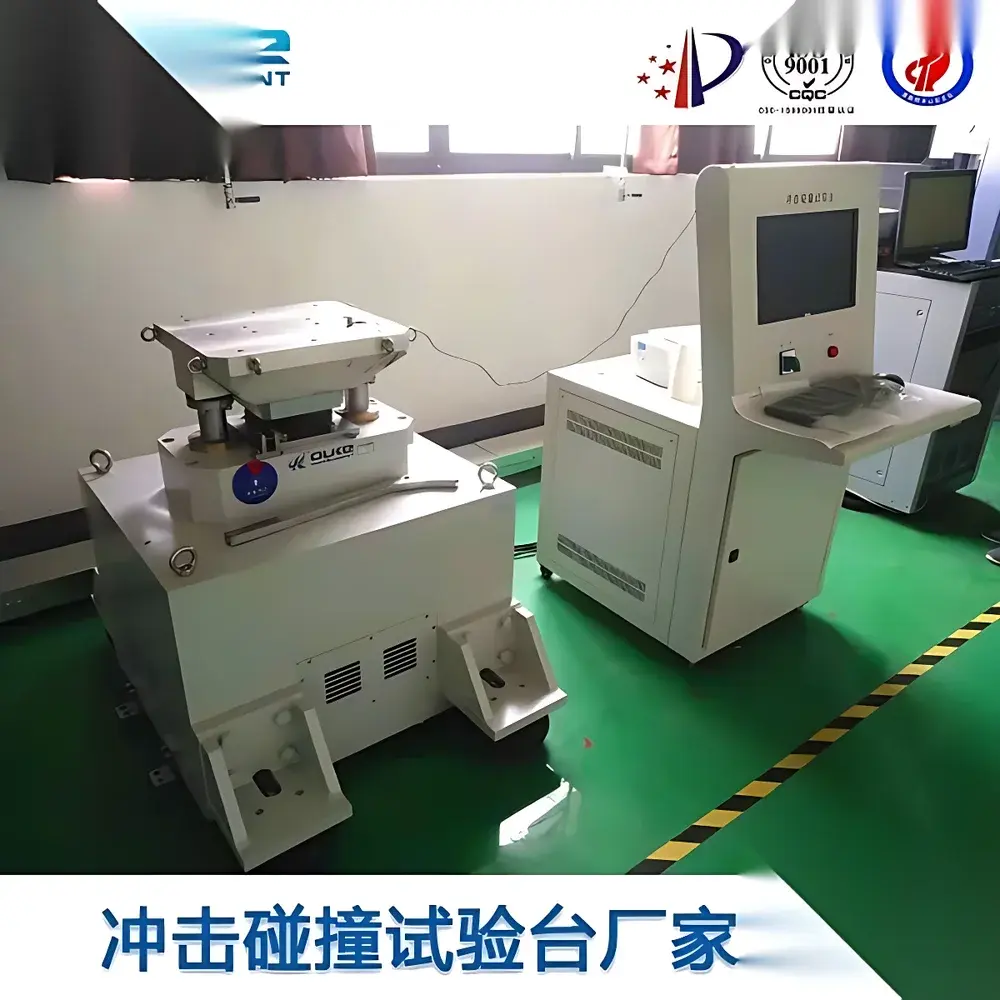
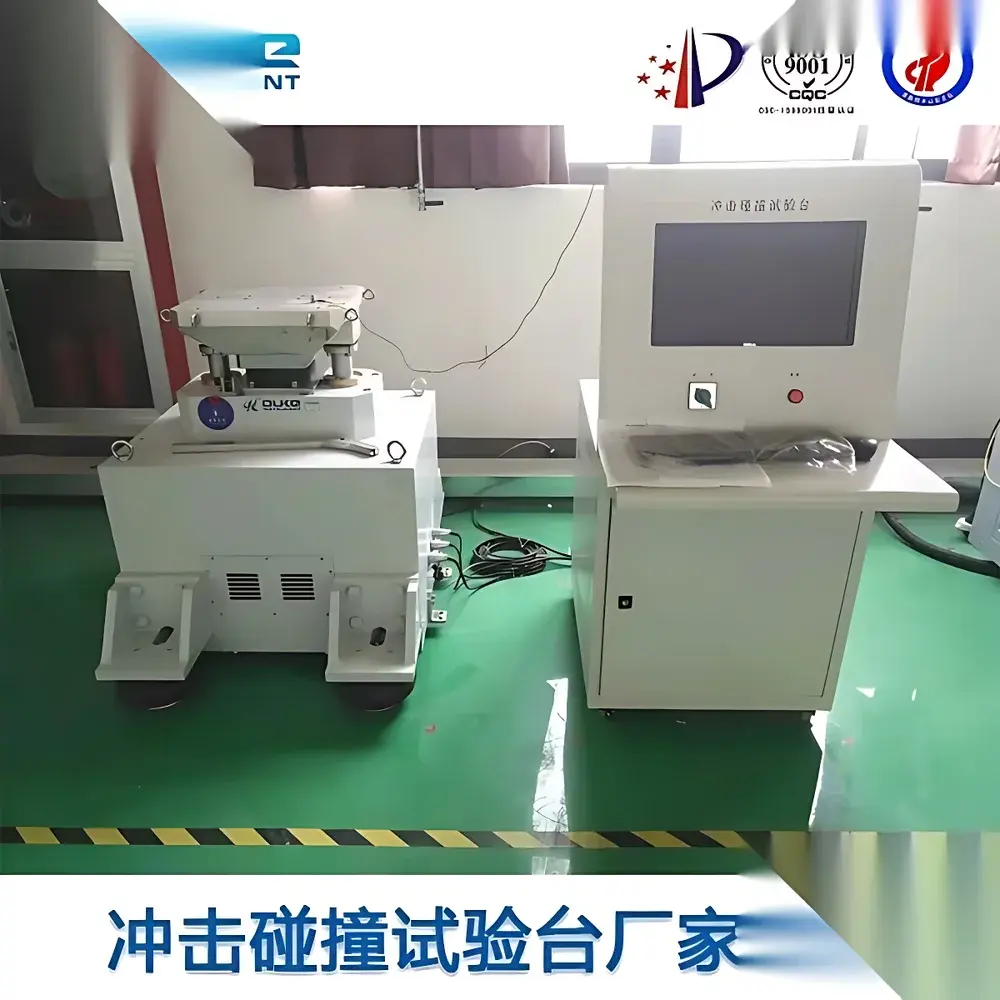
OKPZ Series Electromechanical Shock Test Table
| Brand | Other Brands |
|---|---|
| Origin | Imported |
| Manufacturer Type | Authorized Distributor |
| Max Load Capacity | 50–800 kg |
| Peak Acceleration Range | 30–1000 m/s² (models OKPZ-50 to OKPZ-200) |
| Pulse Duration | 1–30 ms |
| Repetition Rate | 10–60 impacts/min |
| Table Dimensions | 500×700 mm to 1000×1000 mm |
| Maximum Drop Height | 0–80 mm |
| Continuous Operation Time | ≥8 h |
| Power Supply | 220 VAC ±10% / 380 VAC ±10%, 50 Hz |
| Environmental Operating Range | Temperature –40°C to +50°C, Humidity <85% RH (at 25°C) |
| Compliance | GB/T 2423.5–1995, GB/T 2423.6–1995, IEC 60068-2-27, IEC 60068-2-29, JJG 497–2000 |
Overview
The OKPZ Series Electromechanical Shock Test Table is a precision-engineered mechanical shock simulation system designed for laboratory- and production-line-based evaluation of product robustness under controlled transient acceleration environments. Unlike hydraulic or pneumatic shock machines, the OKPZ series employs a direct-drive DC motor coupled with a high-rigidity lifting mechanism and programmable drop-height control to generate repeatable half-sine shock pulses—consistent with the fundamental waveform requirements defined in IEC 60068-2-27 and GB/T 2423.5. The system operates on the principle of gravitational free-fall impact: the test table (carrying the specimen) is elevated to a preset height and released onto a calibrated elastomeric cushion, producing a well-characterized acceleration-time profile. Pulse amplitude (peak g-level), duration, and repetition frequency are independently adjustable via height control, cushion material selection, and motor speed regulation—enabling full compliance with qualification testing protocols for electronics, automotive components, aerospace subassemblies, and medical devices.
Key Features
- Electromechanically actuated lift-and-drop architecture ensures high repeatability and minimal maintenance compared to solenoid- or air-driven alternatives.
- Five standardized models (OKPZ-50 through OKPZ-800) cover load capacities from 50 kg to 800 kg, supporting both small PCB assemblies and large industrial enclosures.
- Adjustable drop height (0–80 mm) enables precise tuning of peak acceleration across the specified range (30–1000 m/s²), validated per JJG 497–2000 calibration methodology.
- Modular cushion interface accepts interchangeable elastomer pads (e.g., rubber, polyurethane, neoprene) to tailor pulse duration (1–30 ms) and spectral content.
- Integrated safety interlocks include door position sensing, over-travel limit switches, zero-signal verification prior to release, and emergency stop circuitry compliant with IEC 61508 SIL2 functional safety principles.
- Stable continuous operation capability (>8 hours) supports extended reliability screening campaigns without thermal derating or mechanical fatigue-induced drift.
Sample Compatibility & Compliance
The OKPZ platform accommodates specimens mounted directly on its rigid aluminum or steel table surface (500×700 mm to 1000×1000 mm), with optional fixture plates and T-slot configurations available for custom mounting. All models meet the mechanical and metrological requirements of major international standards: GB/T 2423.5–1995 (impact testing), GB/T 2423.6–1995 (bump testing), IEC 60068-2-27 (shock), and IEC 60068-2-29 (repetitive shock). Calibration traceability follows national metrology guidelines (JJG 497–2000), and system documentation supports GLP/GMP audit readiness—including full configuration records, calibration certificates, and uncertainty budgets for acceleration and timing parameters.
Software & Data Management
Control and monitoring are performed via a dedicated Windows-based application that interfaces with embedded motion controllers and digital accelerometers. The software provides real-time waveform preview, pre-test parameter validation, automated test sequencing (including multi-height step tests), and post-acquisition analysis tools for peak g, velocity change (Δv), and pulse symmetry assessment. Raw time-history data is exported in ASCII or MATLAB-compatible formats. Audit trails record all user actions, parameter changes, and system status events—supporting FDA 21 CFR Part 11 compliance when deployed with electronic signature modules and role-based access control.
Applications
- Qualification testing of consumer electronics per MIL-STD-810H Method 516.7 (Shock) and IEC 60068-2-27.
- Vibration-isolation component validation, including shock mounts, grommets, and damping brackets.
- Automotive ECU and sensor durability assessment under road-induced transient loads.
- Aerospace avionics box survivability verification during launch and landing scenarios.
- Medical device packaging integrity testing (e.g., ISO 11607-2 simulated distribution shocks).
- Research into material response to high-strain-rate loading, particularly for polymer composites and solder joint reliability modeling.
FAQ
What shock pulse shapes can the OKPZ system generate?
The system is optimized for half-sine pulses per IEC 60068-2-27; trapezoidal and sawtooth waveforms are not supported.
Is third-party calibration certification included with shipment?
Yes—each unit ships with a factory calibration report traceable to national standards; NIST-traceable certification is available as an optional add-on.
Can the system be integrated into an existing environmental test chamber?
Mechanical integration is feasible with custom mounting frames and feedthrough provisions; electrical isolation and EMI shielding must be verified per IEC 61000-6-4.
What maintenance intervals are recommended?
Lubrication of lifting guide rails every 500 operating hours; annual verification of accelerometer linearity and drop-height encoder accuracy.
Does the controller support remote operation via Ethernet or RS-232?
Standard Ethernet (TCP/IP) connectivity is provided; RS-232 is available upon request for legacy SCADA integration.
Related Products



