
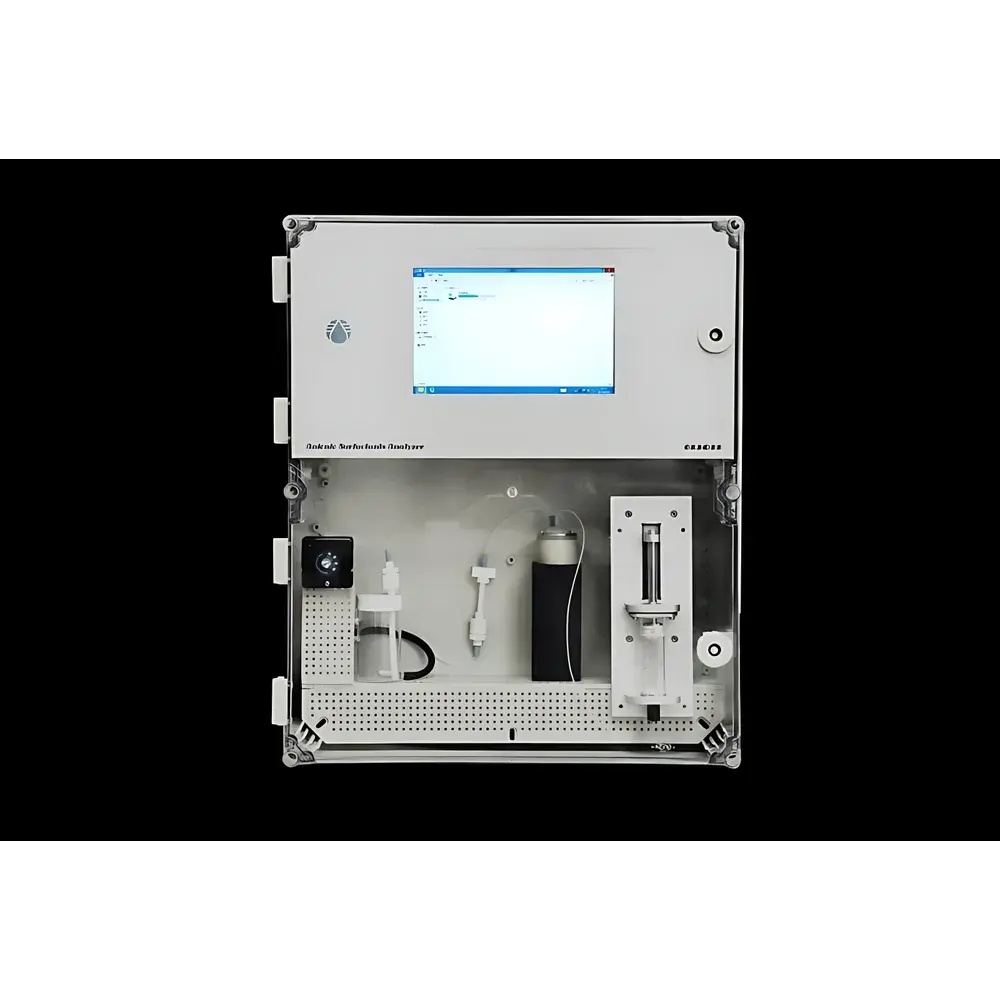
OL1011 Online Infrared Spectrophotometric Oil Analyzer
| Origin | Shanghai, China |
|---|---|
| Manufacturer Type | Authorized Distributor |
| Origin Category | Domestic (PRC) |
| Model | OL 1011 |
| Instrument Type | Online |
| Measurement Principle | Infrared Spectrophotometry (ASTM D7066 / HJ 637–2012 compliant) |
| Measurement Range | Low Range: 0.01–10 mg/L |
| Medium Range | 0.1–1000 mg/L |
| High Range | 1–100,000 mg/L (with auto-dilution for over-range samples) |
| Detection Limit | 0.01 mg/L |
| Accuracy | ±2% of reading |
| Resolution | 0.001 mg/L |
| Wavenumber Range | 3400–6000 cm⁻¹ |
| Absorbance Range | 0.0000–2.0000 AU |
| Repeatability | RSD < 2% |
| Sample Volume | 10–1000 mL |
| Extraction Ratio | Adjustable from 0.01× to 100× |
| Analysis Time | < 5 minutes per cycle |
| Calibration & Cleaning Intervals | User-configurable |
| Operating Temperature | 0–40 °C |
| Ambient Water Temperature Tolerance | 0–90 °C |
| Enclosure Rating | IP65 |
| Power Supply | 220 V ±10%, 50 Hz |
| Dimensions | 500 × 195 × 600 mm |
| Weight | 12 kg |
| Data Interface | MODBUS RTU (RS-485) or PROFIBUS DP |
| Control Options | Integrated touchscreen HMI or remote SCADA integration |
| Extraction Solvent | Carbon Tetrachloride (CCl₄) or Tetrachloroethylene (C₂Cl₄) |
| Adsorbent | Magnesium Silicate (for biogenic oil separation) |
| Solvent Recovery | Automated containment and collection system |
Overview
The OL1011 Online Infrared Spectrophotometric Oil Analyzer is an industrial-grade, fully automated instrument engineered for continuous, real-time quantification of total petroleum hydrocarbons (TPH), petroleum hydrocarbons (PHC), and biogenic oils (e.g., animal and vegetable oils) in aqueous effluents. It operates on the principle of infrared absorption spectroscopy—specifically measuring absorbance at three standardized wavenumbers: 2960 cm⁻¹ (CH₂ asymmetric stretch), 2930 cm⁻¹ (CH₃ asymmetric stretch), and 3030 cm⁻¹ (aromatic C–H stretch), as defined in China’s environmental standard HJ 637–2012 and aligned with ASTM D7066 methodology. The system integrates solvent-based liquid–liquid extraction, phase separation, selective adsorption, and spectrophotometric detection into a single compact platform. Designed for unattended operation in harsh industrial environments, it delivers trace-level sensitivity (LOD = 0.01 mg/L), high linearity across six orders of magnitude, and compliance-ready data integrity.
Key Features
- Patented dual-phase separation module: Enables robust, clog-resistant partitioning of aqueous and organic phases—even for turbid, suspended-solid-laden or emulsified wastewater streams. Reverse-pressure solvent flush prevents membrane fouling and eliminates carryover between analyses.
- Simultaneous tri-parameter analysis: Measures total oil, petroleum hydrocarbons, and biogenic oils in a single analytical cycle via integrated magnesium silicate adsorption column with real-time reagent depletion monitoring.
- Automated solvent recovery system: Captures and contains halogenated solvents (CCl₄ or C₂Cl₄) in sealed reservoirs, reducing operator exposure and supporting OSHA-compliant waste handling protocols.
- Adaptive range extension: Built-in precision dilution module activates automatically when sample concentration exceeds user-defined thresholds—ensuring measurement validity without manual intervention.
- Configurable operational logic: Independent scheduling of calibration, cleaning, and zero-check routines; adjustable extraction ratio (0.01×–100×); programmable sampling interval (minutes or hours).
- Ruggedized field deployment: IP65-rated enclosure, 0–90 °C inlet water tolerance, and modular service design enable reliable operation in wastewater treatment plants, refinery outfalls, and mining sump stations.
Sample Compatibility & Compliance
The OL1011 is validated for direct online analysis of raw and treated water matrices including surface water, municipal sewage, cooling tower blowdown, and industrial process effluents from petrochemical, metallurgical, thermal power, coal mining, and port terminal operations. Its methodology satisfies regulatory requirements under HJ 637–2012 and is technically compatible with EPA Method 1664B (when using C₂Cl₄) and ISO 9377-2 for hydrocarbon content determination. All spectral acquisitions, calibration logs, maintenance events, and alarm triggers are timestamped and stored locally—supporting GLP/GMP-aligned audit trails. Optional firmware modules provide 21 CFR Part 11-compliant electronic signatures and role-based access control for regulated environments.
Software & Data Management
Embedded Linux-based controller hosts a responsive 7-inch capacitive touchscreen HMI with intuitive workflow navigation, real-time chromatogram-like spectral preview, and dynamic trend visualization. Data export supports CSV and XML formats via USB or Ethernet. Native MODBUS RTU (RS-485) and PROFIBUS DP protocols enable seamless integration into existing DCS/SCADA systems without gateway hardware. Historical records—including absorbance spectra, calibration coefficients, solvent consumption metrics, and adsorbent usage counters—are retained for ≥12 months onboard. Remote diagnostics and firmware updates can be performed securely over TLS-encrypted connections. Audit logs capture all configuration changes, user logins, and critical fault conditions with SHA-256 hashing for forensic traceability.
Applications
- Continuous monitoring of refinery wastewater discharge points for regulatory compliance reporting (e.g., permit limits under local environmental ordinances)
- Real-time detection of hydrocarbon leaks in upstream oilfield produced water streams
- Performance verification of dissolved air flotation (DAF) and activated carbon treatment units
- Process optimization in steel mill rolling mill coolant systems and aluminum anodizing rinse lines
- Early warning of biogenic oil breakthrough in food processing plant pre-treatment basins
- Long-term trend analysis for environmental impact assessments (EIAs) and ISO 14001-certified EMS programs
FAQ
What extraction solvents are supported, and are alternatives permitted?
The OL1011 is validated for carbon tetrachloride (CCl₄) and tetrachloroethylene (C₂Cl₄). Substitution with other IR-transparent solvents requires method revalidation per HJ 637–2012 Annex B.
Does the system meet international calibration traceability requirements?
Yes—calibration standards are traceable to NIM (National Institute of Metrology, China) certified reference materials; optional NIST-traceable CRM kits are available for cross-border validation.
Can the instrument operate without on-site personnel oversight?
Fully autonomous operation is supported for ≥30 days between scheduled maintenance, assuming stable inlet water quality and ambient temperature within specification.
How is data integrity ensured during communication outages?
All measurements and metadata are buffered in non-volatile memory and transmitted upon network recovery with sequence-verified packet reassembly.
Is third-party software integration possible beyond MODBUS/PROFIBUS?
Yes—RESTful API access (HTTPS) and OPC UA server modules are available as factory-installed options for enterprise-level MES/PI System integration.
Related Products







