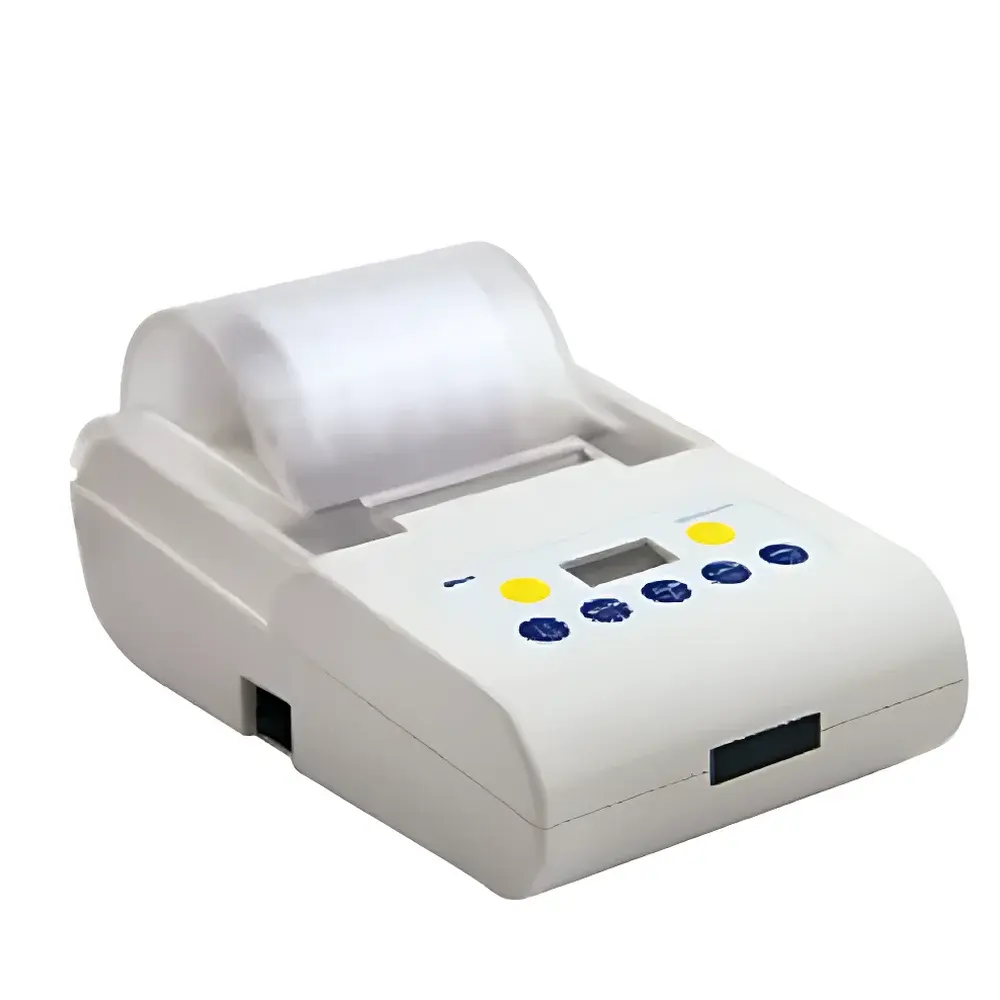
Olaide OLT-120 Series Balance Data Printer
| Brand | Olaide / OLT Olaide |
|---|---|
| Origin | Beijing, China |
| Manufacturer Type | Authorized Distributor |
| Regional Classification | Domestic (China) |
| Model | Olaide OLT-120 Series Balance Data Printer |
| Price | ¥3600 |
| Printing Method | 8-pin impact dot matrix |
| Data Interface | RS-232C |
| Characters per Line | ≥40 |
| Embedded Application | Statistical Analysis |
| Paper Specifications | 57 mm width, plain paper (non-thermal), ribbon-fed |
| Physical Dimensions (W×H×L) | 114.6 × 86.6 × 188.2 mm |
| Minimum Sample Weight Management | Supported |
Overview
The Olaide OLT-120 Series Balance Data Printer is a dedicated, regulatory-compliant peripheral device engineered for seamless integration with laboratory and industrial weighing systems. It operates on the principle of impact-based dot-matrix printing—utilizing an 8-pin shuttle-type print head and standard inked ribbons (ERC-22 or ERC-09)—to produce permanent, archival-grade hardcopy records directly from connected balances and scales. Unlike thermal printers, its non-thermal, plain-paper output ensures long-term legibility without fading, meeting critical documentation requirements in regulated environments. Designed for interoperability across global instrumentation ecosystems, the OLT-120 supports bidirectional RS-232C communication with electronic balances from Sartorius, Mettler Toledo, Ohaus, A&D, Shimadzu, AND, Adam Equipment, and major Chinese manufacturers—including moisture analyzers, pH meters, and electrochemical workstations. Its architecture aligns with GLP (Good Laboratory Practice) and GMP (Good Manufacturing Practice) frameworks by enabling traceable, time-stamped, operator-verified data capture—essential for audit readiness and quality system compliance.
Key Features
- Regulatory-ready reporting: Generates GLP/GMP-compliant printouts containing date/time stamps, instrument ID, sample ID/batch number, operator signature (via RFID authentication), and full audit trail metadata.
- Integrated statistical engine: Performs real-time calculations on up to 300 sequential weighings using 64-bit double-precision floating-point arithmetic—outputting mean, standard deviation, coefficient of variation, sum, min/max values, and range—with user-selectable parameters.
- Multi-mode operational flexibility: Supports seven distinct print modes—Weighing, Tare/Net, Statistics, Formulation, Summation, Average, and Loss-on-Drying (LOD)—each optimized for specific QA/QC workflows.
- Customizable report templates: Fully editable header/footer sections allow inclusion/exclusion of manufacturer name, instrument model & serial number, sample name/batch ID, timestamp, sequence number, and digital signature fields.
- RFID-enabled electronic signature: Integrates with ISO/IEC 14443-compatible RFID readers to authenticate operators and auto-populate signed reports—enabling role-based access control and automated usage logging.
- Barcode-driven sample management: Compatible with standard USB or RS-232 barcode scanners for automatic sample ID/batch entry—eliminating manual transcription errors and accelerating high-throughput workflows.
- Mass data retention & export: Stores >10,000 weight records internally; exports structured CSV/Excel-compatible files via USB flash drive for downstream statistical analysis or LIMS integration.
Sample Compatibility & Compliance
The OLT-120 is validated for use with Class I and II analytical and precision balances (per OIML R76 and NIST Handbook 44), as well as industrial platform scales and moisture analyzers operating within ±0.1 mg to ±1 g readability ranges. It satisfies documentation requirements under ISO/IEC 17025:2017 (clause 7.7), USP <1058> Analytical Instrument Qualification, and FDA 21 CFR Part 11 (when deployed with RFID authentication and audit-trail-enabled firmware). Its LOD mode implements temperature-corrected volume conversion per JJG 646–2006 (Chinese national metrology regulation), calculating Kt factors and reporting volumetric results at 20 °C—making it suitable for pipette and volumetric glassware calibration. The printer’s plain-paper output meets archival standards defined in ISO 12653-1 for document permanence (≥100 years under controlled storage).
Software & Data Management
No host PC or proprietary software is required—the OLT-120 executes all processing onboard via embedded firmware. Configuration is performed via intuitive OLED menu navigation (128×64 pixels, bilingual Chinese/English display) or ASCII command protocol over RS-232. All settings—including statistical parameters, LOD termination thresholds (e.g., % weight change ≤0.1%), tare delay intervals, and batch limits—are stored non-volatile memory. Audit logs record every print event, RFID login, configuration change, and ribbon replacement—retained for ≥12 months. Data export preserves original timestamps, operator IDs, and raw weight values in tab-delimited format compatible with Excel, MATLAB, and LIMS platforms such as LabWare or Thermo Fisher SampleManager.
Applications
- Pharmaceutical QC labs: Generating auditable balance records for API release testing, excipient blending verification, and stability study weight tracking per ICH Q5C.
- Coal and mineral analysis: Executing GB/T 211-compliant total moisture determination via automated LOD cycling—especially where fumes preclude closed-chamber moisture analyzers.
- Reference material certification: Documenting gravimetric preparation of CRM stock solutions with traceable uncertainty propagation and statistical validation.
- Calibration laboratories: Supporting pipette and volumetric flask verification per ISO 8655 and ASTM E1272, including multi-point repeatability assessment and Kt-corrected volume reporting.
- Food & agriculture testing: Enforcing AOAC 990.11-compliant moisture loss protocols and compositional analysis with batch-level statistical summaries.
FAQ
Does the OLT-120 support direct connection to modern USB-equipped balances?
Yes—via optional RS-232-to-USB adapter (FTDI chipset compliant), retaining full command set compatibility and real-time data streaming.
Can statistical reports be generated without printing?
No—the statistical engine is tightly coupled to print execution; however, exported CSV files contain all calculated metrics for offline analysis.
Is the internal clock battery-backed for uninterrupted time stamping during power loss?
Yes—the RTC (Real-Time Clock) uses a soldered lithium coin cell with ≥5-year service life and maintains accuracy within ±2 seconds/month.
What ribbon types are certified for archival use?
ERC-22 (standard duty) and ERC-09 (high-yield, fade-resistant) ribbons—both rated for ≥1 million characters and compliant with ISO 11799 for document longevity.
How is user permission hierarchy enforced?
Three-tier roles (Operator, Supervisor, Administrator) are assigned via RFID tag programming; password fallback is disabled to ensure Part 11 integrity.