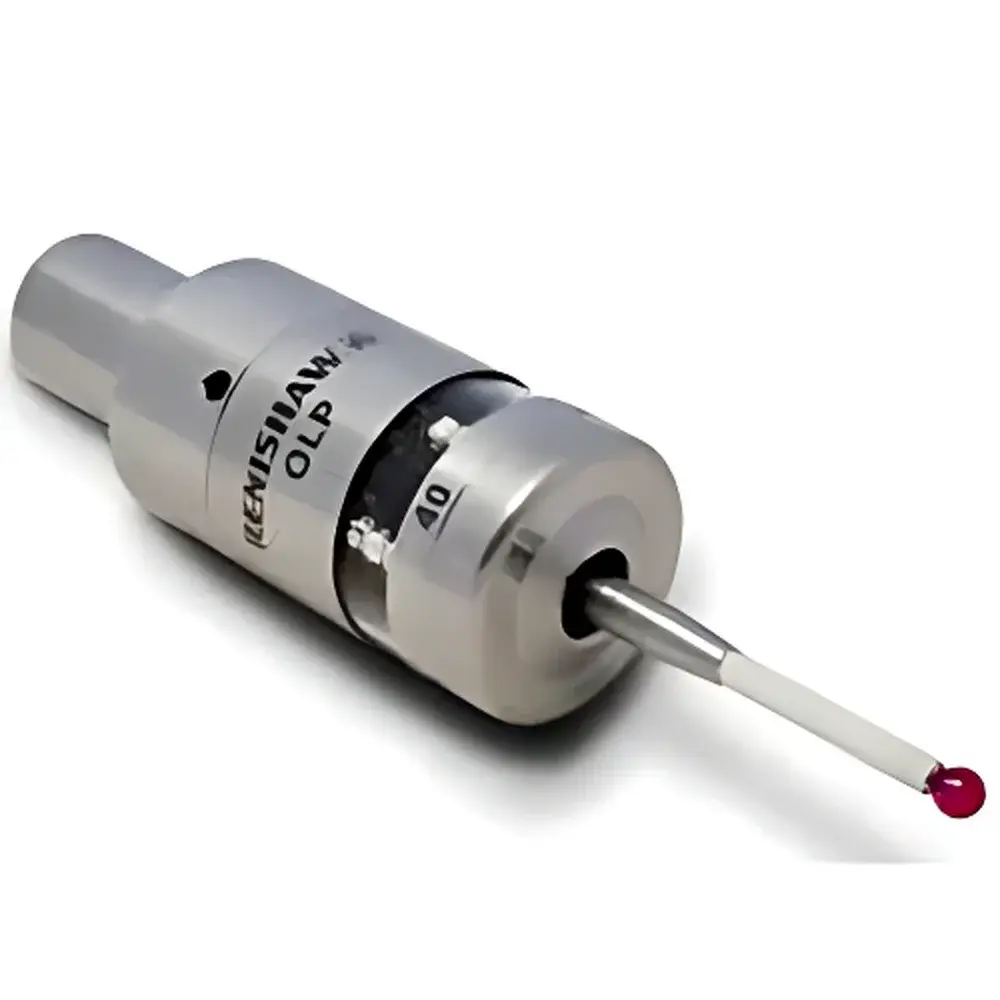
OLP40 Ultra-Compact In-Machine Tool Setting and Workpiece Inspection Probe by Renishaw
| Brand | Renishaw |
|---|---|
| Origin | United Kingdom |
| Model | OLP40 |
| Communication | Radio or Optical Transmission |
| Repeatability (Unidirectional) | 1 µm |
| Diameter | 40 mm |
| Length | 58.3 mm |
| Ingress Protection Rating | IPX8 |
| Application | CNC Turning Centers & Lathes |
| Compliance | Designed for ISO 230-2 (Machine Tool Testing) and ISO 10791-6 (Test Conditions for Machining Centers) |
Overview
The Renishaw OLP40 is an ultra-compact, high-precision in-machine probe engineered specifically for tool setting and workpiece inspection on CNC turning centers and precision lathes. Utilizing either robust radio-frequency (RF) or optical signal transmission—selected based on machine architecture and electromagnetic environment—the OLP40 enables real-time, contact-based dimensional verification without requiring manual intervention or part removal. Its measurement principle is based on a kinematically stable, spring-loaded stylus mechanism that triggers a highly repeatable electrical signal upon physical contact with the workpiece or tool surface. This analog-to-digital trigger event is synchronized with the machine’s CNC controller via standard interface protocols (e.g., Renishaw’s RMI-Q or RMI-O modules), allowing seamless integration into Siemens SINUMERIK, Fanuc, Heidenhain, and Mitsubishi control platforms. The probe operates within the dynamic thermal and mechanical constraints of turning environments, delivering metrological confidence directly at the point of manufacture.
Key Features
- Ultra-compact form factor (Ø40 mm × 58.3 mm) enables installation in confined turret spaces and behind rotating chucks without interference.
- Unidirectional repeatability of ±1 µm ensures consistent, traceable results across repeated touch cycles—critical for statistical process control (SPC) and first-article verification.
- IPX8-rated housing provides full submersion resistance, protecting internal electronics from coolant flooding, high-pressure washdowns, and prolonged exposure to emulsions and cutting oils.
- Dual-signal transmission options: RF mode offers immunity to line-of-sight obstruction and reflective surface interference; optical mode delivers lower latency and higher immunity to EMI in electrically noisy shops.
- Integrated probe cap protection system—mechanically decoupled from the body—deflects chips, swarf, and abrasive debris while maintaining stylus alignment and tactile sensitivity.
- No battery required: powered parasitically from the machine’s probe interface module, eliminating maintenance downtime associated with battery replacement or charging cycles.
Sample Compatibility & Compliance
The OLP40 is compatible with all ferrous and non-ferrous workpiece materials commonly machined on turning centers—including steel, stainless steel, aluminum alloys, titanium, brass, and hardened plastics—provided surface roughness remains within Ra ≤ 6.3 µm for reliable triggering. It supports both static (post-machining) and dynamic (in-process) probing sequences, including diameter verification, face positioning, thread lead checks, and chuck runout compensation. From a regulatory standpoint, the probe design adheres to electromagnetic compatibility (EMC) requirements per EN 61326-1 and safety standards under EN 60204-1. Its metrological performance supports compliance with ISO 9001:2015 clause 7.1.5 (monitoring and measuring resources) and facilitates audit-ready documentation under AS9100D and IATF 16949 quality management systems.
Software & Data Management
The OLP40 interfaces natively with Renishaw’s Productivity+™ software suite, enabling automated cycle programming, geometric error mapping, and statistical analysis of in-process measurements. All probe events—including trigger timestamp, axis position, and stylus deflection vector—are logged with millisecond resolution and stored in ASCII or CSV format for post-processing in third-party SPC tools (e.g., Minitab, InfinityQS). When deployed in regulated environments (e.g., aerospace or medical device manufacturing), the system supports 21 CFR Part 11-compliant electronic signatures and audit trails when paired with Renishaw’s Intuitive Probing Platform (IPP) and validated PLC logic. Data integrity is preserved through cyclic redundancy check (CRC) validation of each transmitted packet and hardware-level watchdog timers preventing silent communication failures.
Applications
- Automated tool offset registration during setup—reducing manual trial cuts and minimizing scrap on high-value components.
- In-cycle workpiece diameter and length verification to detect thermal growth or tool wear drift before tolerance violation.
- Chuck face and jaw concentricity mapping to correct for fixture-induced runout prior to finishing passes.
- First-piece validation against CAD nominal geometry using GD&T-aware probing routines (e.g., true position, circularity).
- Process capability studies (Cp/Cpk) using sequential in-machine data to demonstrate statistical stability per AIAG SPC manual guidelines.
- Integration with digital twin workflows where probe-derived metrology feeds back into adaptive machining parameters in real time.
FAQ
Can the OLP40 be used on live-tooling lathes with Y-axis movement?
Yes—the probe’s mechanical design and RF/optical transmission architecture are fully compatible with simultaneous multi-axis motion, provided the machine’s control firmware supports synchronized probing interrupts.
Does the OLP40 require calibration against a master artifact?
While no routine recalibration is needed due to its kinematic stability and factory-traceable certification, initial system-level calibration (including stylus tip qualification and probe-to-machine coordinate transformation) must be performed using Renishaw’s QC20-W ballbar or AxiSet Check-Up kit per ISO 10360-5.
Is the probe suitable for dry machining environments?
Yes—its IPX8 rating applies equally to immersion in coolant and exposure to dry, dusty conditions; however, optical transmission mode may require periodic lens cleaning in high-particulate settings.
How does the OLP40 handle vibration from heavy roughing passes?
The probe’s internal damping and low-mass stylus assembly suppress false triggering up to 10 g RMS acceleration; sustained vibration above this threshold should be mitigated via machine damping or timing probe activation during idle or finishing phases.
Can multiple OLP40 probes operate simultaneously on one machine?
Yes—RF variants support channel-hopping and ID-based packet addressing; optical variants require spatial separation or time-division multiplexing to prevent signal crosstalk.