
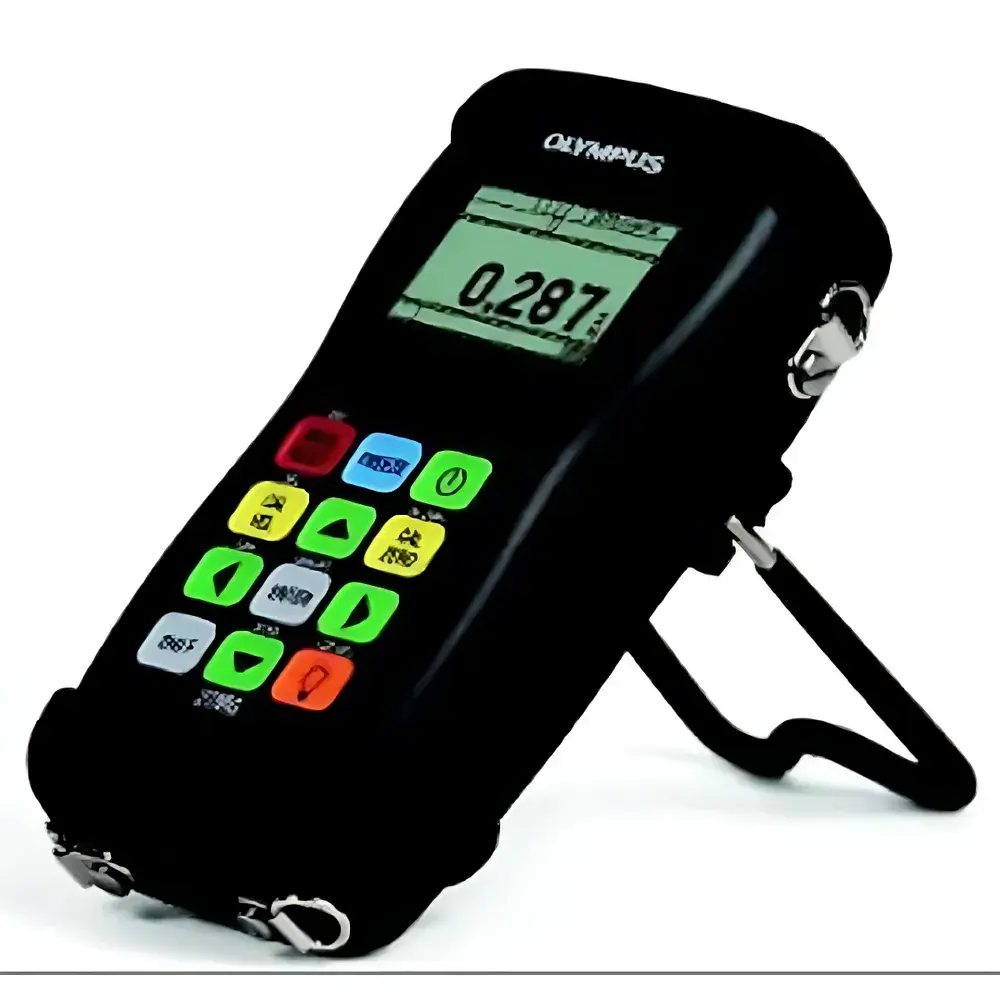
Olympus 27MG Ultrasonic Thickness Gauge
| Brand | Olympus |
|---|---|
| Origin | Japan |
| Model | 27MG |
| Weight | 340 g |
| Dimensions (W × H × D) | 84.0 × 152.4 × 39.6 mm |
| IP Rating | IP65 |
| Operating Temperature | –10 °C to 50 °C |
| Battery Life | Up to 150 h (no backlight) / 30 h (with backlight) |
| Thickness Range | 0.080–635 mm |
| Material Sound Velocity Range | 0.508–18.699 mm/µs |
| Resolution Options | 0.1 mm (low) / 0.01 mm (standard) |
| Probe Frequency Range | 2.25–10 MHz |
| Receiver Bandwidth | 1–18 MHz |
| Display | Backlit LCD with color-coded keypad |
| Compliance | EN 15317, MIL-STD-810F Method 511.4, NFPA 70 Class I, Div 2, Group D |
Overview
The Olympus 27MG Ultrasonic Thickness Gauge is an entry-level, single-element dual-transducer ultrasonic instrument engineered for rapid, non-destructive wall thickness assessment of metallic structures subject to internal corrosion or erosion. It operates on the pulse-echo principle: a high-frequency acoustic pulse is transmitted into the material via a dual-element transducer; the time-of-flight between the initial pulse and the first backwall echo is measured and converted to thickness using the known sound velocity of the test material. This method enables accurate, one-sided measurements without requiring access to the internal surface—making it ideal for in-service inspection of pipelines, pressure vessels, storage tanks, structural steel, and process equipment across oil & gas, power generation, marine, and infrastructure maintenance applications.
Key Features
- Automatic Probe Recognition: Detects connected Olympus dual-element probes (e.g., D790, D791, D798 series) and auto-loads optimized calibration parameters—including V-path correction—to ensure consistent measurement fidelity across probe types.
- Thermal Zero Compensation: Dynamically adjusts zero offset during measurements on hot surfaces (up to 50 °C), mitigating thermal drift errors common in field inspections of steam lines or exhaust ducts.
- Adjustable Gain Control: Enables manual gain tuning to optimize signal-to-noise ratio when measuring highly attenuative materials such as cast iron, austenitic stainless steel, or coarse-grained alloys.
- Min/Max Capture Mode: Records up to 20 readings per second, automatically tracking minimum and maximum thickness values—critical for identifying localized pitting or general wall loss in corroded zones.
- Programmable High/Low Alarms: Visual (flashing display) and audible alerts trigger when measured thickness falls outside user-defined thresholds—supporting rapid pass/fail decisions during walkdown inspections.
- Ruggedized IP65 Enclosure: Sealed, impact-resistant housing with tactile, color-coded membrane keypad and audible keypress feedback ensures reliable operation in dusty, humid, or splash-prone industrial environments.
Sample Compatibility & Compliance
The 27MG is validated for use on homogeneous, isotropic metals including carbon steel, stainless steel, aluminum, copper, brass, and titanium. It is not suitable for layered composites, plastics, or non-metallic materials unless specifically calibrated for those acoustical properties. Its design conforms to EN 15317:2013 (“Non-destructive testing — Ultrasonic thickness measurement — Characterization and verification of ultrasonic thickness measuring equipment”), ensuring metrological traceability and repeatability under defined environmental conditions. The device meets MIL-STD-810F Method 511.4 for operation in explosive atmospheres (NFPA 70, Class I, Division 2, Group D), enabling safe use in petrochemical facilities where flammable vapors may be present. While not inherently 21 CFR Part 11 compliant, its data output supports external audit-trail systems when integrated into documented QA/QC workflows aligned with ISO 9001 or API RP 570.
Software & Data Management
The 27MG does not feature onboard data logging or USB connectivity; measurements are displayed in real time and retained only in volatile memory until overwritten. For traceable reporting, users typically record readings manually or employ external digital tools (e.g., tablet-based inspection apps) that interface via visual screen capture or operator transcription. Olympus offers optional PC software (e.g., Olympus Scientific Software Suite) for post-acquisition analysis when paired with compatible gauges—but the 27MG itself relies on direct operator interpretation and field decision-making. Its multilingual interface (English, French, German, Spanish, Italian, Portuguese, Russian, Polish, Swedish) facilitates cross-border deployment and reduces language-related misinterpretation risks during multinational maintenance campaigns.
Applications
- Corrosion monitoring of above-ground and buried piping systems in refineries and chemical plants
- Wall thickness verification of ASME Section VIII pressure vessels during turnaround inspections
- In-service assessment of ship hull plating, ballast tanks, and cargo hold structures
- Thickness mapping of boiler tubes, heat exchanger shells, and condenser water boxes
- Structural integrity screening of bridge girders, offshore platform legs, and wind turbine tower sections
- Quality assurance checks on newly fabricated or repaired metal components prior to commissioning
FAQ
What probe comes standard with the 27MG?
The Olympus D7910 dual-element transducer is included as the standard probe, optimized for general-purpose corrosion mapping on flat or slightly curved steel surfaces.
Can the 27MG measure through coatings?
No—it requires direct couplant contact with the base metal surface. Paint, epoxy, or plastic linings must be removed at the measurement point to avoid erroneous readings caused by interference from coating echoes.
Is calibration required before each use?
A two-point calibration (zero and span) using certified thickness standards is recommended at the start of each shift or when changing material type, temperature, or probe—per ASTM E797 and ISO 2400 guidelines.
Does the 27MG support thickness averaging over multiple readings?
It does not compute statistical averages internally; however, Min/Max mode allows operators to observe thickness variability within a localized area and manually derive representative values.
How is battery life affected by backlight usage?
With backlight enabled continuously, battery runtime decreases from ~150 hours to approximately 30 hours—consistent with AA alkaline cell discharge characteristics under sustained load.
Related Products



