
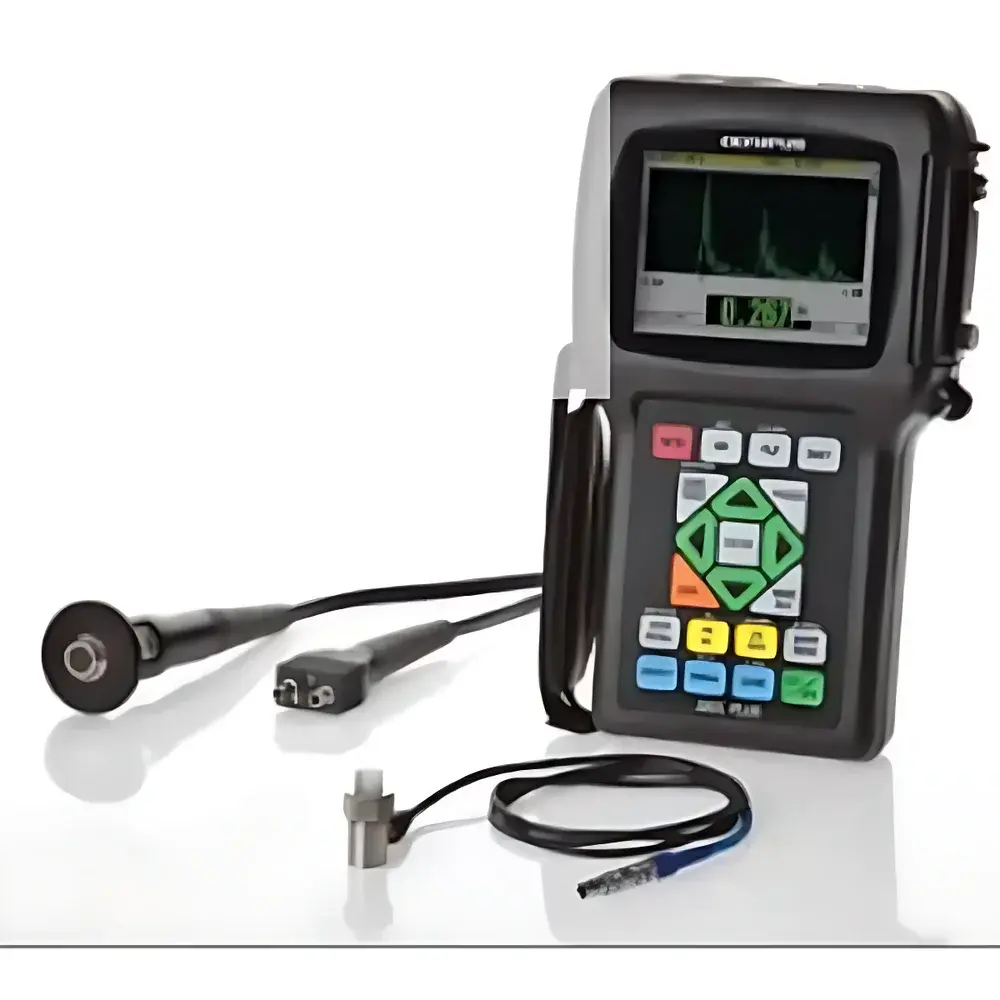
Olympus 38DL PLUS Advanced Ultrasonic Thickness Gauge
| Brand | Olympus |
|---|---|
| Origin | Japan |
| Model | 38DL PLUS |
| IP Rating | IP67 |
| Compliance | EN 15317 |
| Weight | 0.814 kg |
| Operating Temperature | –10 °C to 50 °C |
| Display | Color transflective VGA (56.16 mm × 74.88 mm) |
| Thickness Range | 0.080 mm to 635.00 mm (material- and probe-dependent) |
| Resolution Options | 0.1 mm (low), 0.01 mm (standard), 0.001 mm (high-res option) |
| Sound Velocity Range | 0.508 mm/µs to 13.998 mm/µs |
| Dual-element Probe Frequency Range | 2.0 MHz to 30 MHz (–3 dB) |
| High-Penetration Option | 0.50 MHz to 30 MHz (–3 dB) |
| Data Storage | 475,000 thickness readings or 20,000 waveforms (internal) |
| Interface | USB 1.0, RS-232, VGA video output |
| Battery Life | Up to 14.7 h (Li-ion) |
| Fast charge | 2–3 h |
| Environmental Certification | MIL-STD-810F (shock, vibration, explosive atmosphere per NFPA 70, Class I, Div. 2, Group D) |
Overview
The Olympus 38DL PLUS Advanced Ultrasonic Thickness Gauge is a field-deployable, high-fidelity instrument engineered for precision thickness measurement across demanding industrial environments. It operates on pulse-echo and through-transmission ultrasonic principles—utilizing time-of-flight (TOF) analysis of acoustic waves propagated through solid materials. The device supports both dual-element (contact) and single-element (delay-line, immersion, or EMAT-compatible) transducers, enabling robust thickness quantification in applications ranging from corrosion monitoring in carbon steel piping to high-resolution metrology of thin-walled aerospace alloys and multi-layer composites. Its architecture integrates real-time signal processing with adaptive gain control, digital filtering, and V-path compensation algorithms—ensuring measurement stability under variable surface conditions, temperature gradients, and coating interference.
Key Features
- Fully compatible with Olympus dual-element and single-element probes—including high-frequency (up to 30 MHz) and low-frequency high-penetration (down to 0.5 MHz) configurations.
- Multi-mode measurement capability: standard pulse-echo, echo-to-echo (for coated surfaces), THRU-COAT® (simultaneous metal + coating thickness), and delay-line/water-path modes.
- IP67-rated ruggedized enclosure with integrated rubber overmold, tested to MIL-STD-810F for shock (15 g, 11 ms half-sine), vibration (1 hr/axis), and operation in explosive atmospheres (NFPA 70, Class I, Div. 2, Group D).
- Color transflective VGA display with selectable indoor/outdoor color schemes—optimized for readability under direct sunlight or total darkness.
- Standard resolution of 0.01 mm; optional high-resolution software enables 0.001 mm thickness discrimination using appropriate transducers and calibration standards.
- B-scan imaging with up to 10,000 data points per scan line, supporting visual defect mapping and wall-loss profiling.
- Onboard statistical engine with min/max/avg reporting, differential mode, reduction rate calculation, and programmable alarm thresholds.
- VGA video output for external display or documentation; USB 1.0 and RS-232 interfaces for bidirectional data exchange and firmware updates.
Sample Compatibility & Compliance
The 38DL PLUS accommodates a broad spectrum of industrial materials—including ferrous and non-ferrous metals, plastics, composites, ceramics, and elastomers—provided acoustic impedance and attenuation characteristics fall within operational limits. It is routinely deployed for in-service inspection of pipelines, pressure vessels, storage tanks, boiler tubes, ship hulls, and aircraft skins. Its design complies with EN 15317 (Ultrasonics — Characterization and verification of ultrasonic thickness measuring equipment), ensuring traceable performance validation. While not inherently 21 CFR Part 11 compliant, audit-ready data integrity is supported via password-protected configuration locking, timestamped waveform capture, and GageView™-generated CSV exports with full metadata (probe ID, velocity, gain, gate settings). Optional software modules extend functionality to oxidation layer evaluation (e.g., mill scale in hot-rolled steel) and multi-layer analysis (up to four discrete layers with independent velocity assignment).
Software & Data Management
The integrated alphanumeric data logger stores up to 475,000 thickness readings or 20,000 waveforms with embedded setup parameters. Nine configurable file structures—including incremental, 2-D/3-D grid, boiler tube map, and custom point-based layouts—support asset-specific inspection workflows. Each TML (Thickness Measurement Location) ID supports up to four user-defined annotations, and files are tagged with 32-character names and 20-character alphanumeric IDs. Internal and external MicroSD cards enable seamless data backup, cross-device synchronization, and offline report generation. GageView™ software (Windows-based) provides comprehensive post-processing: dataset consolidation, statistical summarization, B-scan playback, color-coded DB-grid visualization (three programmable threshold bands), Excel-compatible CSV export, and firmware/probe setup file management. All communications—whether via USB or RS-232—are deterministic and protocol-verified to prevent data corruption during transfer.
Applications
- Corrosion under insulation (CUI) assessment using dual-element probes with echo-to-echo mode on externally coated piping.
- Precision thickness verification of turbine blades, heat exchanger tubes, and clad reactor components using high-frequency single-crystal transducers.
- Quality assurance of laminated composites (e.g., CFRP/aluminum hybrids) via multi-layer software option.
- In-process thickness monitoring of extruded plastic profiles or rubber linings using low-frequency high-penetration probes.
- Regulatory compliance testing per ASTM E797, ISO 16809, and API RP 579–1/ASME FFS-1 for fitness-for-service evaluations.
- Field verification of weld overlay thickness and cladding bond integrity in refinery infrastructure.
FAQ
Does the 38DL PLUS require calibration traceable to NIST or other national standards?
Yes—calibration must be performed using certified reference blocks (e.g., ASTM E747 or ISO 5577 traceable standards) with known thicknesses and sound velocities matching the test material. Olympus recommends annual verification and as-needed recalibration following mechanical shock or extreme thermal cycling.
Can the instrument measure through thick paint or epoxy coatings without removing them?
Yes—THRU-COAT® technology enables simultaneous measurement of substrate metal thickness and coating thickness using specialized dual-element probes (e.g., D7906-SM, D7908), provided coating thickness remains within specified limits and acoustic coupling is consistent.
Is GageView™ software validated for use in regulated industries (e.g., pharmaceutical or nuclear)?
GageView™ itself is not formally 21 CFR Part 11 validated out-of-the-box; however, its audit trail capabilities (user logins, change timestamps, immutable CSV exports) support qualification under site-specific validation protocols aligned with GLP/GMP requirements.
What is the maximum measurable thickness for cast iron using the high-penetration option?
Maximum measurable thickness depends on grain structure, attenuation coefficient, and probe selection—not solely on instrument specification. With 0.5 MHz transducers and optimized gain/filtering, measurements exceeding 500 mm are achievable on low-attenuation castings; empirical validation with representative samples is required.
How does the instrument handle temperature-induced sound velocity drift during extended field use?
The 38DL PLUS supports manual and automatic temperature compensation when paired with an optional thermocouple probe. Users may input real-time temperature values or define linear velocity-vs.-temperature coefficients per material grade to correct TOF-derived thickness calculations.



