
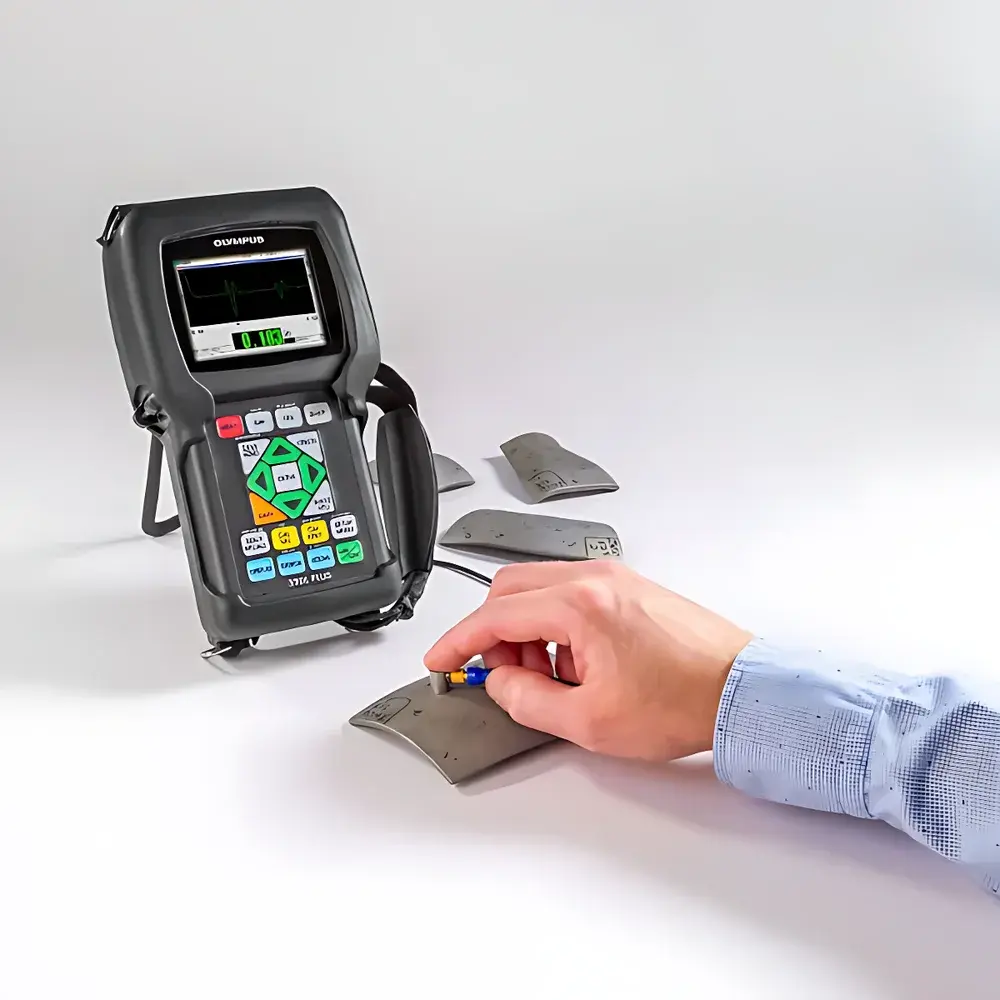
Olympus 39DL PLUS Ultrasonic Thickness Gauge
| Brand | Olympus |
|---|---|
| Origin | Japan |
| Model | 39DL PLUS |
| Update Rate | up to 60 Hz |
| Connectivity | Integrated Wireless (Wi-Fi/Bluetooth) |
| Application Type | Precision & Corrosion Thickness Measurement |
| Compliance | Designed for ASTM E797, ISO 16809, and NACE SP0106-compliant inspection workflows |
Overview
The Olympus 39DL PLUS Ultrasonic Thickness Gauge is an advanced handheld instrument engineered for high-accuracy, real-time thickness measurement of metallic and non-metallic materials using pulse-echo ultrasonic principles. It operates by transmitting a high-frequency sound wave (typically 1–15 MHz) through a test material and measuring the time-of-flight (TOF) between the initial pulse and the back-wall echo. This time-based calculation—converted to thickness using the material’s known acoustic velocity—is fundamental to non-destructive evaluation (NDE) in industrial maintenance, pipeline integrity management, and pressure vessel inspection. Unlike basic gauges relying on single-echo detection, the 39DL PLUS employs dual-gate digital signal processing to isolate and track multiple echoes—including front-surface, back-wall, and internal interface reflections—enabling reliable measurements on corroded, coated, or multi-layered surfaces without manual probe coupling adjustment.
Key Features
- High-Speed Digital Processing: Delivers up to 60 thickness readings per second, supporting rapid scanning across large surface areas while maintaining measurement stability under variable coupling conditions.
- Advanced Echo Recognition: Utilizes digital gate positioning and amplitude thresholding to distinguish true back-wall signals from noise, lift-off echoes, or coating interference—critical for accurate remaining-wall-thickness assessment in corrosion monitoring.
- Integrated Wireless Communication: Built-in Wi-Fi and Bluetooth modules enable direct data streaming to tablets, PCs, or cloud-based asset management platforms, eliminating manual transcription and reducing reporting latency.
- Rugged Industrial Design: IP67-rated enclosure with shock-absorbing rubber overmolding; operating temperature range from –10 °C to 50 °C; compliant with MIL-STD-810G for vibration, drop, and environmental durability.
- Multi-Material Velocity Library: Preloaded with acoustic velocity values for over 200 common engineering materials—including carbon steel, stainless alloys, aluminum, titanium, fiberglass, and plastics—with user-definable entries for custom composites.
- Real-Time A-Scan Display: High-resolution grayscale waveform screen allows immediate visual verification of signal quality, gate placement, and echo integrity—essential for method validation and operator training.
Sample Compatibility & Compliance
The 39DL PLUS accommodates a broad spectrum of industrial substrates, including ferrous and non-ferrous metals, thermoset and thermoplastic polymers, ceramics, and fiber-reinforced composites. Its dual-element and single-element transducer support enables optimized performance on rough, curved, or highly attenuative surfaces. The instrument conforms to international standards governing ultrasonic thickness testing methodology and reporting, including ASTM E797 (Standard Practice for Measuring Thickness by Manual Ultrasonic Pulse-Echo Contact Method), ISO 16809 (Ultrasonic Testing — Characterization and Verification of Ultrasonic Thickness-Measuring Equipment), and NACE SP0106 (Control of Corrosion in Aboveground Storage Tank Bottoms). Data logging and report generation are structured to support GLP/GMP documentation requirements, with optional audit-trail-enabled firmware versions compliant with FDA 21 CFR Part 11 for regulated environments.
Software & Data Management
Olympus’ companion software—GageView Pro—provides comprehensive post-processing capabilities, including statistical analysis (mean, SD, min/max), thickness mapping overlays, trend charting, and customizable report templates aligned with API RP 570 or ASME B31.4/B31.8 inspection protocols. All measurements are timestamped, geotagged (when paired with GPS-enabled devices), and stored with full metadata: transducer ID, calibration date, material velocity, gain setting, and operator ID. Encrypted export options (CSV, PDF, XML) ensure secure transfer to enterprise CMMS or RBI platforms. Firmware updates are delivered via over-the-air (OTA) deployment, preserving calibration traceability and version control across fleets.
Applications
- Corrosion under insulation (CUI) screening on petrochemical piping systems
- In-service wall loss assessment of boiler tubes, heat exchanger shells, and reactor vessels
- Quality assurance of castings, forgings, and extruded profiles during manufacturing
- Thickness verification of aircraft skin panels, wing spars, and composite radomes
- Monitoring degradation in marine hull plating, offshore platform legs, and subsea flowlines
- Validation of coating thickness on lined tanks and flue gas desulfurization (FGD) ductwork
FAQ
What transducers are compatible with the 39DL PLUS?
The gauge supports Olympus standard M-series and D-series dual-element transducers (e.g., M112, D790) as well as single-element delay-line and immersion probes—selected based on material type, surface condition, and required resolution.
Does the 39DL PLUS require annual recalibration?
Yes. Per ISO/IEC 17025 and manufacturer recommendations, periodic calibration verification using certified thickness standards (e.g., NIST-traceable step wedges) is required at least annually—or more frequently under heavy usage or after mechanical impact.
Can it measure through paint or epoxy coatings?
Yes, when configured with appropriate dual-element transducers and gated signal processing; however, coating thickness must remain below 0.5 mm for reliable substrate measurement without correction algorithms.
Is the device suitable for high-temperature applications?
Standard operation is rated to 50 °C ambient; for elevated surface temperatures (>50 °C), high-temp transducers with thermal isolation boots and specialized couplants are required—and measurement accuracy may be affected by velocity drift.
How does it handle measurements on small-diameter pipes?
With curvature-compensated transducers (e.g., Olympus C552) and adjustable beam spread settings, the 39DL PLUS achieves stable readings on pipes down to 12.7 mm (0.5 in) OD, provided proper probe centering and coupling.



