
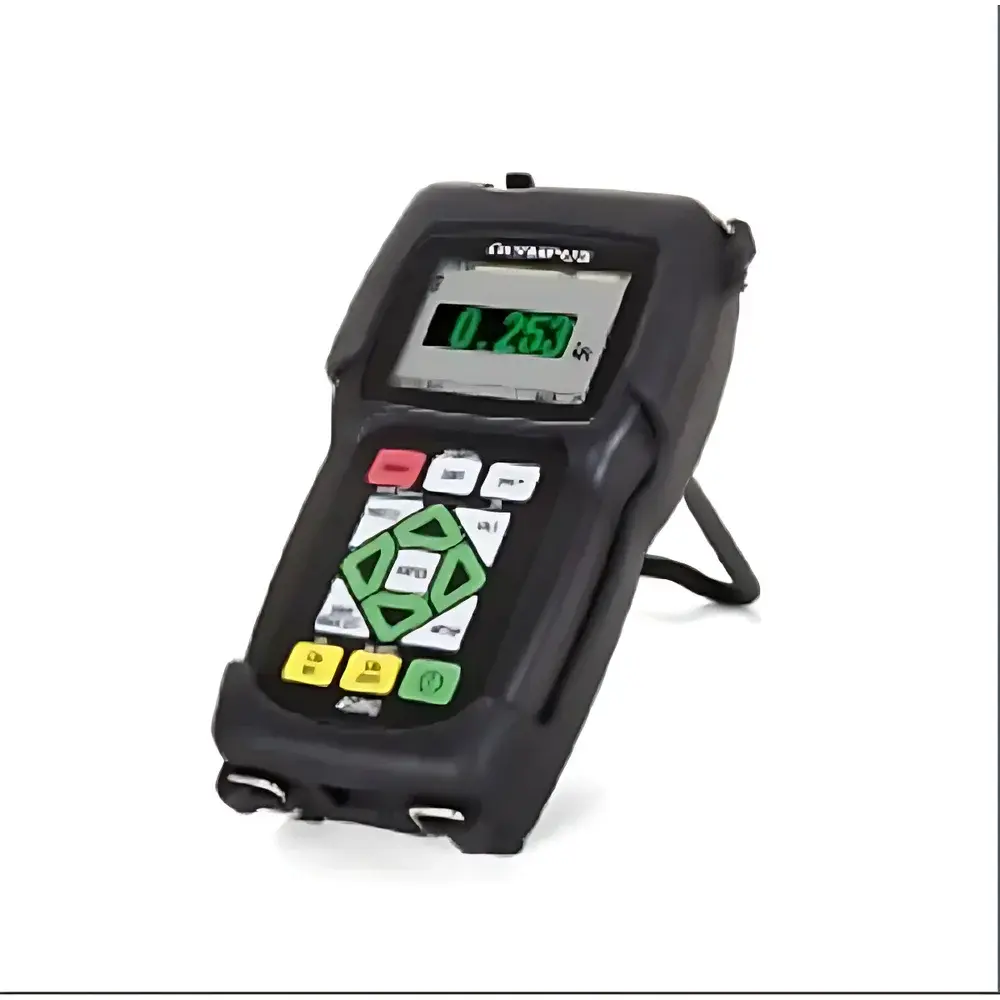
Olympus 45MG Advanced Ultrasonic Thickness Gauge
| Brand | Olympus |
|---|---|
| Origin | Japan |
| Model | 45MG |
| Operating temperature | –10 °C to 50 °C |
| Thickness range | 0.080 mm to 635 mm (material-, probe-, and configuration-dependent) |
| Resolution options | 0.1 mm / 0.01 mm / 0.001 mm |
| Sound velocity range | 0.508–18.699 mm/µs |
| Single-element mode | 2.25–30 MHz (standard), 0.5–30 MHz (High Penetration option) |
Overview
The Olympus 45MG Advanced Ultrasonic Thickness Gauge is an industrial-grade, field-deployable instrument engineered for high-reliability thickness assessment in demanding non-destructive testing (NDT) environments. Based on pulse-echo ultrasonic time-of-flight (TOF) principles, the 45MG measures material thickness by calculating the transit time of high-frequency acoustic waves through a test specimen and back from its far surface—or between successive backwall echoes—using calibrated sound velocity values. Its architecture supports dual-element (contact) and single-element (delay-line, immersion, or contact) transducer configurations, enabling precise evaluation of wall loss due to corrosion, erosion, or mechanical deformation across metallic, polymeric, composite, ceramic, and glass substrates. Designed for compliance with EN 15317 (ultrasonic equipment performance requirements), the 45MG delivers traceable, repeatable measurements under variable surface conditions—including painted, coated, or thermally elevated surfaces—without requiring coating removal or process interruption.
Key Features
- Ruggedized IP67-rated enclosure with shock-absorbing rubber overmold; certified to MIL-STD-810G for drop (15 g, 11 ms half-sine), vibration (1 hr/axis), and hazardous atmosphere operation (NFPA 70, Class I, Div 2, Group D)
- QVGA transflective color display with dual indoor/outdoor viewing modes and tactile, function-color-coded keypad supporting ambidextrous operation
- Standard echo-to-echo mode for true base-metal thickness measurement beneath coatings; optional Thru-Coating mode simultaneously reports substrate and coating thicknesses using independent velocity calibration
- Expandable functionality via five password-protected software options: Single-Element Mode, High-Penetration Single-Element Mode, Data Logger, Real-Time A-Scan Display, and Custom Application Setup Recall
- Integrated bidirectional alphanumeric data logger (up to 475,000 thickness readings or 20,000 waveform captures) with USB 2.0 and microSD (≤2 GB) export capability
- Zero-offset thermal compensation algorithm for stable high-temperature measurements up to 500 °C when paired with Olympus D932-series high-temp probes (e.g., D790-SL, D790-RL)
- Time-based B-scan imaging with freeze-minimum function; stores up to 10,000 points per scan for cross-sectional thickness profiling
Sample Compatibility & Compliance
The 45MG accommodates a broad spectrum of industrial materials—including carbon steel, stainless alloys, aluminum, titanium, cast iron, fiberglass-reinforced polymers (FRP), PVC, acrylic, borosilicate glass, technical ceramics, and elastomeric compounds—provided appropriate transducer selection and velocity calibration are applied. It supports ASTM E797 (standard practice for measuring thickness by manual ultrasonic pulse-echo contact method) and aligns with ISO 16809:2012 (non-destructive testing — ultrasonic testing — ultrasonic thickness measurement). For regulated industries, the instrument’s password-protected configuration lock, audit-ready data logging (with timestamped file naming and ID encoding), and deterministic measurement traceability support GLP/GMP documentation requirements. While not inherently 21 CFR Part 11 compliant, its data export architecture facilitates integration into validated laboratory information management systems (LIMS) where electronic record integrity is enforced at the enterprise level.
Software & Data Management
The 45MG’s embedded firmware enables seamless configuration management via GageView™ Pro (Windows-based PC interface), allowing users to import/export probe setups, calibration records, and measurement templates. The optional Data Logger package includes full bidirectional synchronization: thickness values, waveform snapshots (RF, full-wave, or half-wave detected), and user-defined metadata (e.g., location tags, operator IDs, inspection notes) are stored with 32-character filenames and 20-character alphanumeric codes. Six configurable file structures—standard or application-specific—are supported, facilitating automated reporting of statistical summaries (mean, min/max, standard deviation) and thickness trend analysis. All stored data retain native resolution settings (0.001 mm in Single-Element mode), ensuring metrological consistency across inspection campaigns. MicroSD cards serve as portable archives compatible with offline QA review and third-party analytics tools.
Applications
Primary deployment domains include pipeline integrity management (remaining wall thickness in corroded carbon steel pipes), pressure vessel inspection (ASME Section VIII compliance verification), ship hull monitoring, aerospace component screening (turbine blade root thickness, composite wing skin delamination assessment), and manufacturing QA (bottle wall uniformity, extruded profile tolerance verification). The High-Penetration option extends utility to highly attenuative media such as thick rubber tires, FRP storage tanks, and ductile iron castings. Thru-Coating capability eliminates pre-inspection surface preparation in maintenance workflows—critical for offshore platforms and chemical processing facilities where coating preservation is mandated. Material velocity measurement functionality further supports metallurgical process control, including nodularity assessment in ductile iron and density mapping in fiber-reinforced laminates.
FAQ
Does the 45MG require probe recalibration when switching between coated and uncoated surfaces?
No—Thru-Coating and Echo-to-Echo modes apply real-time velocity compensation based on preloaded material parameters; only initial velocity calibration per substrate type is required.
Can the 45MG perform measurements on curved or irregular geometries?
Yes—when used with appropriately focused or small-diameter probes (e.g., V260-SM for concave glass), and with manual gain/blanking adjustments enabled via A-Scan mode.
Is the data logger output compatible with CSV or XML formats for LIMS integration?
GageView Pro exports tab-delimited text files (.txt) and proprietary .gvi files; third-party parsers can convert these to CSV/XML within validated IT environments.
What is the minimum measurable thickness for thin plastic films using the Single-Element option?
With a 20 MHz delay-line probe, the instrument achieves reliable detection down to 0.08 mm (0.003 in.) in rigid plastics, subject to surface flatness and couplant consistency.
How does the zero-offset thermal compensation function improve high-temperature accuracy?
It dynamically adjusts the probe delay value in real time to counteract thermal drift in the piezoelectric element and wear plate, maintaining TOF calculation fidelity without manual re-zeroing during extended hot-surface inspections.



