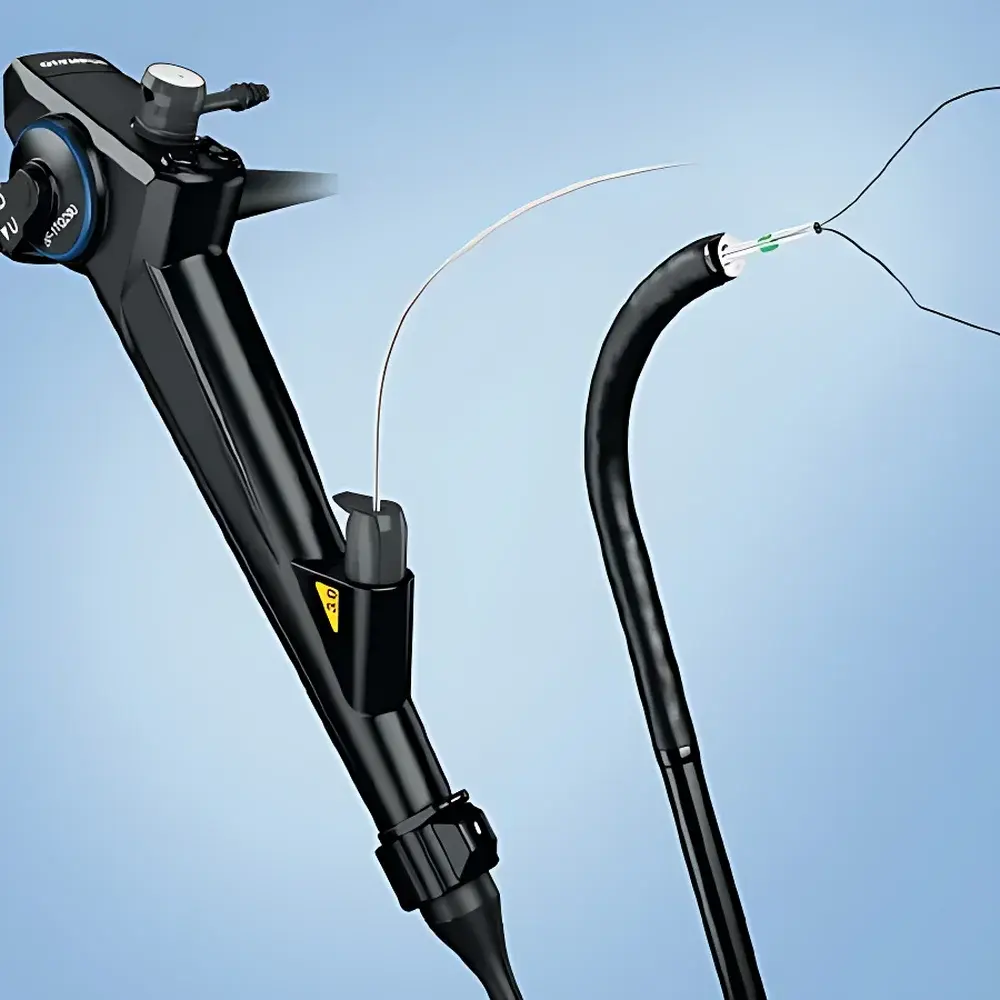
Olympus BF-1TQ290 Therapeutic Electronic Bronchoscope
| Brand | Olympus |
|---|---|
| Country of Origin | Japan |
| Model | BF-1TQ290 |
| Insertion Tube Outer Diameter | 6.0 mm |
| Distal Tip Outer Diameter | 5.9 mm |
| Working Length | 600 mm |
| Field of View | 120° |
| Direction of View | Forward |
| Depth of Field | 2–100 mm |
| Instrument Channel ID | 3.0 mm |
| Minimum Focusing Distance | 3.0 mm from distal tip |
| Insertion Tube Rotation | ±120° |
| Compatible Light Source | Olympus CLV-290SL / CLV-290 |
| Compatible Video Processor | Olympus CV-290 |
| NBI (Narrow Band Imaging) | Yes |
| Range ID Function | Yes |
| Waterproof One-Touch Connector | Yes |
| High-Frequency Electrocautery Compatible | Yes |
| Laser Compatibility | Nd:YAG and 810 nm Diode Lasers |
| EBUS-Compatible | Yes |
| Reprocessing Compatibility | Fully compatible with Olympus ETD series cleaners/disinfectors and drying cabinets |
| Sterilization Compatibility | Ethylene Oxide (ETO) and Plasma Sterilization supported |
Overview
The Olympus BF-1TQ290 is a high-performance therapeutic electronic bronchoscope engineered for precision diagnostics and interventional pulmonology. Designed on the EVIS EXERA III platform, it integrates advanced optical imaging, enhanced maneuverability, and seamless integration with Olympus’ CV-290 video processing system and CLV-290SL cold light source. Its measurement principle relies on high-resolution complementary metal-oxide-semiconductor (CMOS) imaging coupled with real-time digital signal processing to deliver consistent, low-noise visualization across the full 120° field of view. The forward-viewing optical system features a depth of field spanning 2–100 mm, enabling reliable focus across varied airway geometries — from proximal tracheal segments to distal subsegmental bronchi. As a Class IIa medical device compliant with ISO 13485:2016 and meeting essential requirements under the EU MDR (Regulation (EU) 2017/745), the BF-1TQ290 supports clinical workflows requiring traceability, reproducibility, and regulatory alignment in both diagnostic and therapeutic settings.
Key Features
- Ultra-slim distal tip (5.9 mm OD) and insertion tube (6.0 mm OD) for improved patient tolerance and access to peripheral airways
- 3.0 mm instrument channel enabling passage of biopsy forceps, cytology brushes, laser fibers, and EBUS mini-probes without compromising suction or irrigation flow
- ±120° insertion tube rotation mechanism for precise angulation control during transbronchial biopsy, fiducial placement, or targeted ablation
- Narrow Band Imaging (NBI) mode optimized for enhanced contrast of mucosal and submucosal vasculature — clinically validated per guidelines from the British Thoracic Society (BTS) and American College of Chest Physicians (ACCP)
- Integrated Range ID chip storing scope-specific metadata (model, serial number, usage count, reprocessing history) — supports automated logging within hospital asset management systems
- Waterproof one-touch connector eliminating need for waterproof caps and reducing risk of fluid ingress during setup or reprocessing
- Full compatibility with Olympus ETD-320/ETD-330 automated endoscope reprocessors and EDH-300 drying cabinets — ensuring adherence to AAMI ST91:2023 and SGNA Standards for cleaning validation
Sample Compatibility & Compliance
The BF-1TQ290 is validated for use across adult and pediatric populations where anatomical constraints permit safe insertion. It accommodates standard 2.8 mm and 3.0 mm therapeutic accessories including argon plasma coagulation (APC) probes, cryoprobes, and radiofrequency ablation catheters. Device labeling and IFU conform to IEC 62304 (software lifecycle), IEC 60601-1 (electrical safety), and ISO 15883-1/-4 (reprocessing validation). All materials contacting mucosal surfaces comply with ISO 10993-1 for biocompatibility. Reprocessing protocols align with FDA-cleared instructions and are auditable under GLP/GCP frameworks. The scope’s design supports full-cycle traceability — from initial sterilization batch records to cumulative usage metrics logged via Range ID — fulfilling documentation requirements for Joint Commission EC.02.05.01 and ISO 14971 risk management files.
Software & Data Management
When connected to the Olympus CV-290 processor, the BF-1TQ290 leverages embedded firmware supporting DICOM-SR structured reporting, JPEG2000-compressed image capture, and synchronized video export at 60 fps. The system logs procedural metadata—including date/time stamps, user IDs, NBI activation status, and zoom levels—into encrypted internal memory. These logs are exportable via USB or PACS-integrated network transfer for inclusion in EMR systems such as Epic or Cerner. Audit trail functionality complies with FDA 21 CFR Part 11 requirements for electronic records and signatures, including operator authentication, immutable timestamps, and revision history retention. Firmware updates are delivered via secure Olympus Service Portal with SHA-256 hash verification and rollback capability.
Applications
The BF-1TQ290 serves core applications in interventional pulmonology, including but not limited to: transbronchial lung biopsy (TBLB) under fluoroscopic or electromagnetic navigation guidance; endobronchial ultrasound-guided transbronchial needle aspiration (EBUS-TBNA) using 21G or 22G aspiration needles; photodynamic therapy (PDT) and laser ablation of central airway tumors; placement of airway stents and valves; and intratumoral injection of immunomodulatory agents. Its optical fidelity and rotational control also support research-grade airway morphometry studies and longitudinal assessment of treatment response in conditions such as sarcoidosis, granulomatosis with polyangiitis (GPA), and post-transplant bronchiolitis obliterans syndrome (BOS).
FAQ
Is the BF-1TQ290 compatible with non-Olympus video processors?
No — full functionality (including NBI, Range ID, and auto-exposure optimization) requires native integration with Olympus CV-290 or newer platforms.
What reprocessing validation standards does the BF-1TQ290 meet?
It satisfies AAMI ST91:2023 for automated endoscope reprocessors and has undergone biological indicator testing per ISO 15883-5 using Geobacillus stearothermophilus spores.
Can the scope be sterilized using steam autoclaving?
No — steam sterilization is contraindicated. Validated terminal sterilization methods include ethylene oxide (ETO) and low-temperature hydrogen peroxide plasma.
Does the 3.0 mm instrument channel support simultaneous suction and instrument passage?
Yes — the channel maintains ≥200 mL/min suction capacity even with a 2.8 mm biopsy forceps fully inserted.
How is the Range ID data accessed and managed?
Data is read automatically upon connection to a CV-290 processor and can be exported as CSV via USB or queried programmatically through Olympus’ OpenLink API for enterprise integration.