
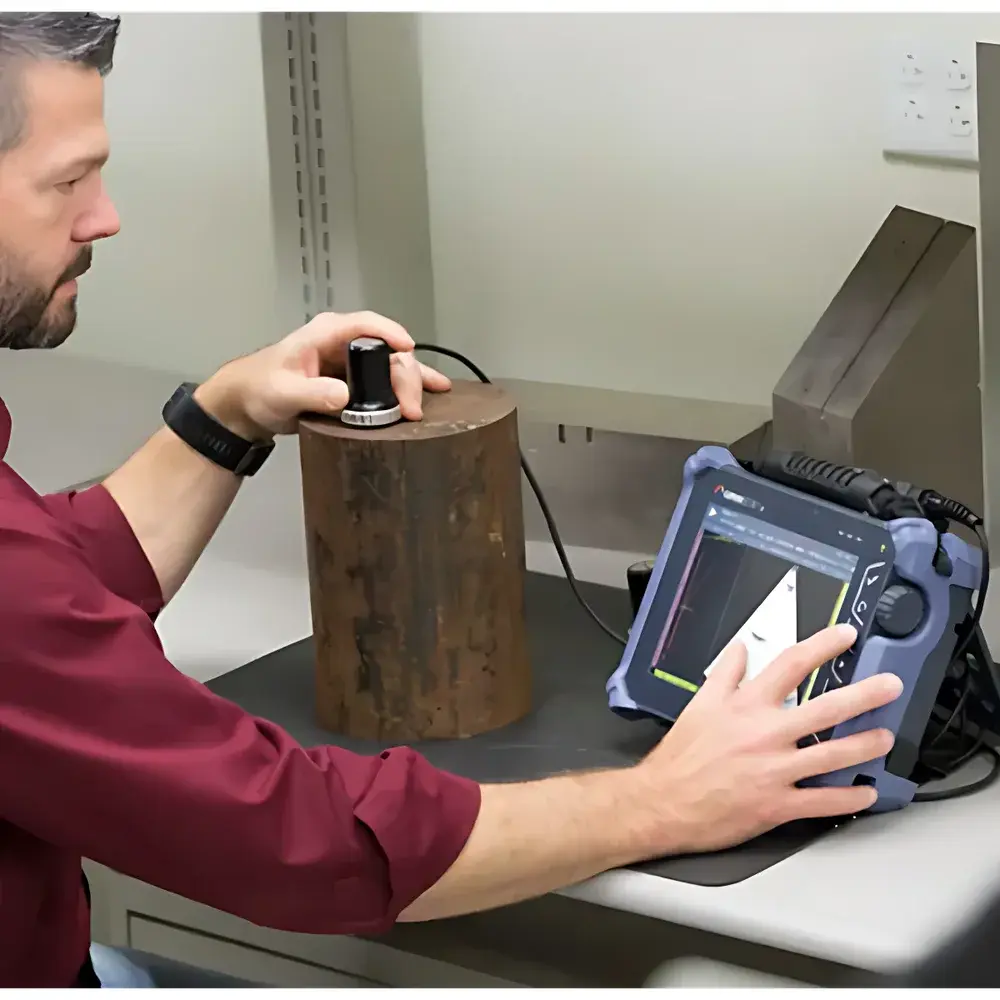
Olympus DGS Phased Array Probe Kit with MXU Software v4.4 for OmniScan MX2/SX
| Brand | Olympus |
|---|---|
| Origin | Japan |
| Product Type | Imported NDT Instrument |
| Model | DGS |
| Portability | Portable |
| Compatible Instruments | OmniScan MX2, OmniScan SX |
| Software Version | MXU v4.4 |
| Supported Probe Series | DGS1, Atlas A24 |
| Calibration Standard | DGS (Distance-Gain-Size) Method |
| Regulatory Compliance | ASTM E2700, ISO 16810, EN 13588, ASME BPVC Section V Article 4 |
Overview
The Olympus DGS Phased Array Probe Kit with MXU Software v4.4 is a purpose-engineered solution for quantitative ultrasonic flaw detection in critical welded joints, heavy-section forgings, and high-stress structural components. Built upon the Distance-Gain-Size (DGS) methodology—a widely accepted amplitude-based sizing technique standardized in ASTM E2700 and ISO 16810—this system integrates specially designed phased array probes (DGS1 and Atlas A24 series) with the MXU v4.4 software module for OmniScan MX2 and SX instruments. Unlike conventional time-of-flight diffraction (TOFD) or synthetic aperture focusing technique (SAFT) approaches, DGS leverages calibrated reference reflectors to generate depth-dependent gain curves, enabling direct estimation of flaw size without reliance on comparative side-drilled hole (SDH) or flat-bottomed hole (FBH) standards. The system operates under pulse-echo mode using shear-wave or longitudinal-wave beam steering, delivering deterministic amplitude response across defined depth ranges—particularly advantageous in near-surface inspection of thin-to-moderate thickness welds (6.35–19 mm), bolted connections, and stress-corrosion cracking (SCC) assessment in bridge infrastructure.
Key Features
- DGS1 Series Probes: Compact, integrated wedge-probe assemblies optimized for manual shear-wave scanning; available at 2 MHz and 4 MHz center frequencies; designed for near-surface detection in butt, fillet, and T-joint welds.
- Atlas A24 Series Probes: Direct-contact, wear-face-replaceable longitudinal-wave probes with 2 MHz / 4 MHz options; eliminate wedge interface echoes; engineered for high-duty-cycle applications including pin/bolt inspection and heavy forging evaluation.
- MXU v4.4 Software Integration: Enables automated DGS curve generation per focal law; supports single-reflector full-range calibration; provides real-time S-scan overlay with DGS reference lines for immediate amplitude-based sizing interpretation.
- Hardware Compatibility: Fully certified for use with Olympus OmniScan MX2 and SX flaw detectors; firmware and software synchronization ensures traceable configuration management and audit-ready parameter logging.
- Robust Mechanical Design: DGS1 probes feature monolithic wedge integration for consistent angle stability; A24 probes incorporate transparent polyurethane wear faces (0.5 mm thick, pack of 12) and removable retaining rings (MRN-24) for extended service life and repeatable coupling performance.
Sample Compatibility & Compliance
The DGS probe kit is validated for use on carbon steel, low-alloy steel, and stainless steel components with surface roughness ≤ Ra 6.3 µm and curvature radius ≥ 50 mm. It meets requirements for Level 2/3 NDT personnel qualification per ISO 9712 and supports inspection protocols compliant with ASME BPVC Section V Article 4 (Phased Array Ultrasonic Testing), EN 13588 (Characterization and Sizing of Discontinuities), and API RP 2X (Ultrasonic Examination of Offshore Structural Fabrication). All probe configurations are supplied with individual calibration certificates traceable to NIST standards, and MXU v4.4 maintains full audit trail functionality—including user login, parameter change timestamps, and scan data versioning—supporting GLP/GMP environments and FDA 21 CFR Part 11 compliance when deployed with appropriate IT infrastructure.
Software & Data Management
MXU v4.4 delivers full offline analysis capability via OmniPC software, allowing post-acquisition review of high-resolution A-scan, S-scan, and C-scan datasets on Windows-based workstations. Each acquired scan retains complete raw RF data, focal law metadata, and DGS curve parameters. Users may define custom acceptance criteria based on industry-specific codes (e.g., AWS D1.1, ISO 5817, or client-defined defect thresholds) and export reports in PDF, CSV, or XML formats. The software enforces role-based access control and supports digital signature workflows for report finalization. All saved projects include embedded instrument firmware version, probe serial number, and environmental calibration logs—ensuring full technical traceability from field acquisition to regulatory submission.
Applications
- Weld inspection in constrained geometries: root pass evaluation in narrow-gap welds, heat-affected zone (HAZ) cracking detection, and partial-penetration joint assessment.
- Bridge maintenance: high-precision sizing of corrosion-induced pitting and SCC in suspension cable anchorages, pin connections, and gusset plates.
- Power generation: volumetric assessment of turbine rotor bores, generator retaining rings, and thick-section piping welds where near-field resolution is critical.
- Heavy manufacturing: verification of internal integrity in forged shafts, rolls, and pressure vessel components subject to cyclic loading.
- Offshore oil & gas: in-service inspection of subsea manifold welds and riser flange connections under ISO 19901-6-compliant procedures.
FAQ
What distinguishes DGS-based sizing from conventional TOFD or PAUT amplitude thresholding?
DGS uses empirically derived distance-amplitude curves referenced to a known reflector size (typically 2 mm FBH), enabling quantitative sizing independent of operator-selected DAC/TCG settings—improving inter-operator reproducibility.
Can DGS curves be generated for non-standard materials such as duplex stainless steel or Inconel?
Yes—MXU v4.4 allows material-specific velocity and attenuation inputs; however, probe calibration must be performed on representative reference blocks matching the test material’s acoustic properties.
Is offline DGS analysis supported without an OmniScan instrument?
Yes—OmniPC v4.4 enables full DGS curve reprocessing, focal law modification, and report generation using exported .udf files, provided the original acquisition was performed with MXU v4.4.
Are these probes compatible with older OmniScan models (e.g., MX1 or iX)?
No—DGS functionality requires hardware-level FPGA support introduced in MX2/SX platforms and is not backward-compatible with pre-2015 instrument generations.
How frequently should the wear face on A24 probes be replaced?
Replacement is recommended after every 200–300 linear meters of scanning on abrasive surfaces or upon visible abrasion exceeding 0.1 mm depth—verified via optical profilometry or tactile gauge measurement.



