
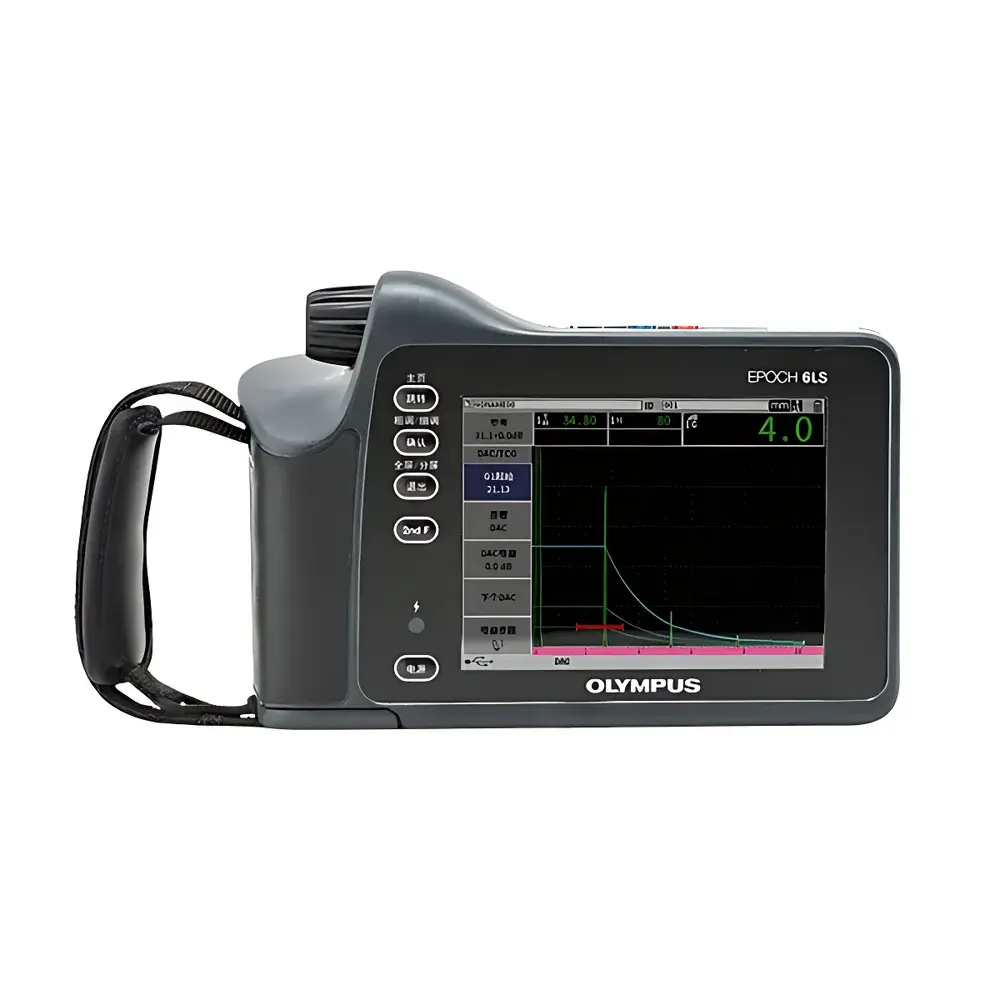
Olympus EPOCH 6LS Digital Ultrasonic Flaw Detector
| Brand | Olympus |
|---|---|
| Origin | Japan |
| Model | EPOCH 6LS |
| Instrument Type | Digital |
| Inspection Method | Pulse-Echo |
| Waveform Type | Pulsed Ultrasonic |
| Compliance Standard | NB/T 47013.3–2015 |
| IP Rating | IP65/IP67 |
| Operating Temperature | –10 °C to 50 °C |
| Weight | 890 g (with Li-ion battery) |
| Display | Full VGA (640 × 480), Transflective Color LCD |
| Battery Life | Up to 6 hours |
| PRF Range | 10–2000 Hz |
| Pulse Voltage | Up to 400 V |
| Receiver Bandwidth | DC–26.5 MHz (–3 dB) |
| Digital Filters | 8 preset configurations |
| Gate Count | 2 independent measurement gates |
| DAC Points | Up to 50, 110 dB dynamic range |
| Data Storage | 100,000 waveforms with ID tags |
| Interface | Dual USB (Host + Client), Digital Video Output |
Overview
The Olympus EPOCH 6LS Digital Ultrasonic Flaw Detector is an industrial-grade, field-optimized pulse-echo ultrasonic testing (UT) instrument engineered for high-reliability non-destructive evaluation in demanding outdoor and maintenance environments. Built on the proven architecture of the EPOCH 650 platform, the 6LS delivers laboratory-grade signal fidelity and measurement repeatability in a compact, ergonomic form factor. Its core measurement principle relies on time-of-flight (TOF) analysis of high-voltage pulsed ultrasonic waves—generated via a sharp-rise spike pulse transmitter—and their reflections from material discontinuities or boundaries. The instrument supports standard UT configurations including pulse-echo, pitch-catch (reception-only), and through-transmission modes, enabling detection and sizing of volumetric flaws such as voids, inclusions, lack of fusion, and cracking in metallic and composite structures. Designed specifically for infrastructure integrity verification, it meets the technical requirements of aerospace component inspection workflows where portability, environmental resilience, and regulatory traceability are critical.
Key Features
- Compact, lightweight chassis (209 × 128 × 36 mm; 890 g with battery) optimized for extended handheld operation in field conditions.
- Full VGA (640 × 480 pixel) transflective color LCD display with 60 Hz refresh rate—engineered for legibility under direct sunlight and low-ambient lighting.
- Ergonomic rotary encoder interface with tactile feedback, supporting intuitive parameter navigation without reliance on touchscreen input.
- High-energy spike pulse generator delivering up to 400 V output across four selectable voltage levels (100/200/300/400 V), ensuring adequate penetration in coarse-grained or highly attenuating materials.
- Dual independent measurement gates with fully adjustable start position, width (0.040 µs to full screen), and amplitude threshold (2–95% FSH), enabling simultaneous monitoring of flaw echo amplitude and transit time.
- Comprehensive digital filtering suite (8 preset bandwidth configurations) and configurable receiver damping (50 Ω / 400 Ω) to maximize signal-to-noise ratio across diverse transducer types and test frequencies (0.5–25 MHz).
- Ruggedized enclosure certified to IP65 and IP67 ingress protection standards per IEC 60529–2004, and validated for mechanical shock (MIL-STD-810F Method 516.5, 15 g, 11 ms half-sine) and vibration exposure (MIL-STD-810F Method 514.5).
- Built-in automatic calibration routines for sound velocity, zero offset, and probe angle (K-value), supporting both normal-beam (single-backwall or backwall-to-backwall) and angle-beam (distance-amplitude or depth-based) setups.
Sample Compatibility & Compliance
The EPOCH 6LS is compatible with standard 50 Ω and 400 Ω LEMO 00 ultrasonic transducers across frequency ranges from 0.5 MHz to 25 MHz, including dual-element, delay-line, immersion, and phased-array probes (when used in conventional UT mode). It supports inspection of ferrous and non-ferrous metals, composites, and ceramics commonly found in aircraft fuselage skins, engine casings, landing gear components, and welded structural joints. The instrument implements DAC (Distance-Amplitude Correction) curve generation in strict accordance with China’s NB/T 47013.3–2015 standard for ultrasonic testing of pressure equipment, including support for up to 50 DAC points, 110 dB dynamic range, and custom multi-curve DAC libraries. While not pre-certified for FDA 21 CFR Part 11 or ISO 17025 accreditation out-of-the-box, its audit-ready data logging (timestamped waveform capture with operator ID tagging), password-protected configuration locks, and deterministic measurement algorithms provide foundational traceability required for GLP/GMP-aligned QA/QC programs.
Software & Data Management
All acquired waveforms—including A-scan traces, gate measurements, and calibration records—are stored onboard with full metadata (date/time stamp, probe ID, material velocity, gain setting, gate positions). The device supports storage of up to 100,000 waveform records with unique alphanumeric identifiers. Data export is facilitated via dual USB interfaces: a USB 1.1 host port (Type-A) for connecting external storage devices, and a USB 2.0 client port (Mini-B) for direct synchronization with Windows-based analysis software such as Olympus NDT’s ESBE or third-party UT data management platforms. A dedicated digital video output enables real-time display mirroring on external monitors during training or collaborative review sessions. Firmware updates are performed via USB mass-storage mode, ensuring field-deployable maintainability without proprietary service tools.
Applications
- Aerospace structural integrity verification: detection and sizing of subsurface cracks in aluminum alloy airframes, titanium fastener holes, and composite layup delaminations.
- Field-based weld inspection in oil & gas pipelines and offshore platforms, particularly where access is constrained and environmental exposure is severe.
- Maintenance, repair, and overhaul (MRO) operations requiring rapid setup, repeatable calibration, and immediate pass/fail decision support at point-of-use.
- Quality assurance in turbine blade manufacturing, where curvature correction algorithms compensate for cylindrical geometry during angle-beam inspections.
- Education and certification training labs, leveraging its bilingual UI (English/Chinese), intuitive gate manipulation, and standardized DAC implementation aligned with national inspection codes.
FAQ
Does the EPOCH 6LS support encoded scanning or motorized probe positioning?
No—the EPOCH 6LS is a manual UT instrument designed for handheld or tripod-mounted operation. It does not include built-in encoder inputs or synchronized scan data acquisition capabilities.
Can the device perform TOFD (Time-of-Flight Diffraction) measurements?
No—TOFD functionality requires specialized software algorithms, dual-channel synchronous acquisition, and specific probe arrangement logic not implemented in the EPOCH 6LS firmware.
Is battery replacement user-serviceable?
Yes—the rechargeable lithium-ion battery is accessible via a removable rear panel and can be replaced in the field without special tools.
What is the maximum measurable thickness using the EPOCH 6LS?
With appropriate probe selection and material velocity settings, the instrument supports thickness measurements from 4.31 mm up to 6700 mm (at 5900 m/s), covering most structural steel and aluminum applications.
Does the unit meet ASTM E114 or ISO 10893-11 requirements?
While not formally certified to these standards, its pulse-echo performance metrics—including horizontal linearity (±0.5% FSW), vertical linearity (0.25% FSH), and amplifier accuracy (±1 dB)—align with the measurement fidelity thresholds specified in those documents for general-purpose UT instrumentation.



