
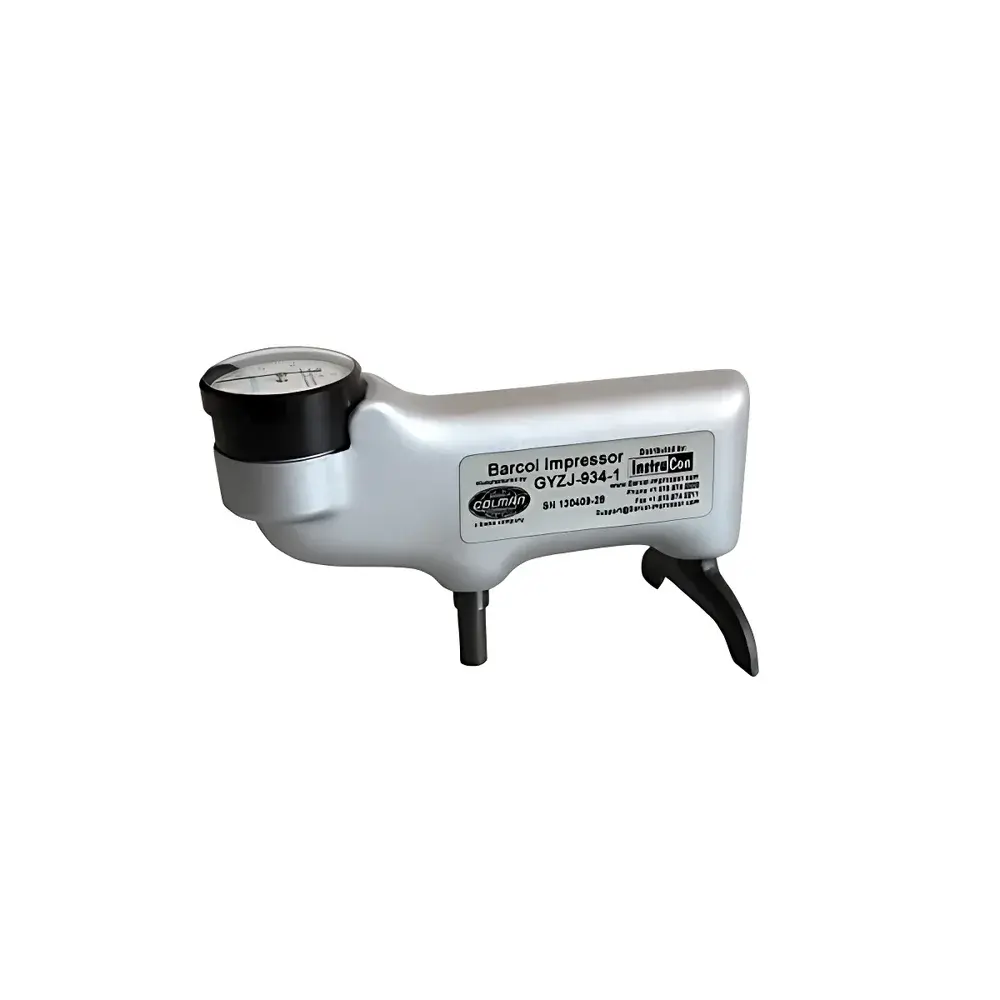
Olympus GYZJ-934-1 Barcol Hardness Tester
| Brand | Olympus |
|---|---|
| Origin | Japan |
| Manufacturer Type | Authorized Distributor |
| Origin Category | Imported |
| Model | GYZJ-934-1 |
| Pricing | Available Upon Request |
Overview
The Olympus GYZJ-934-1 Barcol Hardness Tester is a precision-engineered, portable indentation hardness instrument designed for rapid, non-destructive assessment of soft to semi-rigid materials. It operates on the Barcol principle—a standardized method based on the depth of penetration of a spring-loaded, hardened steel indentor under a fixed load (10 kgf). Unlike conventional Rockwell or Brinell testers, the Barcol system delivers immediate analog readout via a calibrated dial gauge, eliminating the need for power sources, software calibration, or operator interpretation of digital displays. This makes it especially suitable for field use, quality control checkpoints on production lines, and in-process verification where speed, repeatability, and portability are critical. The instrument is explicitly validated for aluminum alloys, fiberglass-reinforced plastics (FRP), composites, and certain thermosetting resins—materials whose low-to-moderate hardness values fall outside the optimal range of traditional metal hardness testers.
Key Features
- Direct-reading analog scale with 0–100 Barcol units (Bc), resolution of 0.5 Bc, and factory-certified traceability to NIST-traceable reference standards;
- Spring-loaded indentor assembly with controlled 10 kgf test force, compliant with ASTM B648-10 “Standard Test Method for Indentation Hardness of Aluminum Alloys by Means of a Barcol Impressor”;
- Compact, ergonomic aluminum alloy housing with integrated support foot and pressure-sensitive trigger mechanism ensuring consistent loading geometry;
- No batteries or external power required—fully mechanical operation ensures long-term reliability and zero drift across temperature ranges from 10 °C to 40 °C;
- Calibration verification kit included (certified reference hardness blocks for 35 Bc and 70 Bc), supporting daily verification per ISO/IEC 17025 and internal QA protocols;
- Conforms to JJG 610–2013 “Verification Regulation for Type A Barcol Hardness Tester”, enabling metrological acceptance in China-based GLP and aerospace manufacturing facilities.
Sample Compatibility & Compliance
The GYZJ-934-1 is optimized for planar, smooth-surfaced specimens ≥1.5 mm thick and exhibiting minimal surface curvature (radius >50 mm). It delivers high reproducibility on wrought and cast aluminum alloys (e.g., 2024, 6061, 7075), pultruded and hand-laid fiberglass laminates, phenolic and polyester matrix composites, and cured epoxy tooling boards. Surface preparation requires only light cleaning—no polishing or etching. The tester is not suitable for thin foils (<0.8 mm), highly elastic polymers (e.g., TPU, silicone), or substrates with surface coatings thicker than 0.1 mm unless validated per ASTM D7263. All measurements comply with the geometric and environmental conditions specified in ASTM B648-10, including ambient humidity ≤80% RH and stable thermal equilibrium between specimen and instrument prior to testing.
Software & Data Management
As a fully analog, non-digital instrument, the GYZJ-934-1 does not incorporate embedded firmware, Bluetooth connectivity, or data logging capabilities. This design choice prioritizes operational robustness, eliminates cybersecurity concerns, and ensures uninterrupted compliance in regulated environments where electronic record integrity must adhere to FDA 21 CFR Part 11 or EU Annex 11 requirements. Hard-copy records—including operator ID, sample lot number, test location, date/time, and observed Barcol value—are manually entered into QC logbooks or LIMS-compatible paper forms. For laboratories requiring digital traceability, Olympus recommends pairing the GYZJ-934-1 with a validated document imaging system and controlled electronic signature workflows aligned with ALCOA+ principles (Attributable, Legible, Contemporaneous, Original, Accurate, Complete, Consistent, Enduring, Available).
Applications
- In-line hardness verification of extruded aluminum profiles prior to anodizing or painting;
- Final inspection of composite aircraft fairings and helicopter rotor blades per MIL-STD-401;
- Quality assurance of marine-grade FRP hull sections during layup and post-cure validation;
- Supplier audit checks for automotive battery enclosure materials (e.g., glass-filled PP composites);
- Educational laboratory demonstrations of indentation mechanics and material property correlation;
- Field service evaluation of aging effects in historic architectural aluminum cladding systems.
FAQ
What materials are appropriate for testing with the GYZJ-934-1?
Aluminum and magnesium alloys, fiber-reinforced polymer laminates (e.g., GFRP, CFRP), rigid thermosets (epoxy, phenolic), and cured elastomeric tooling compounds.
Is periodic recalibration required—and how often?
Yes. Annual recalibration by an ISO/IEC 17025-accredited laboratory is recommended; daily verification using certified reference blocks is mandatory per JJG 610–2013.
Can the GYZJ-934-1 be used on curved surfaces?
Only on gently curved surfaces with radius ≥50 mm; concave geometries or sharp edges introduce measurement error exceeding ±2 Bc.
Does this model meet ASTM B648-10 requirements for reporting uncertainty?
Yes—the instrument’s certified measurement uncertainty (k=2) is ±1.2 Bc at 50 Bc, as documented in its出厂 calibration certificate issued by Olympus Japan.
Is operator training required for ISO 9001-compliant use?
Yes. Olympus provides a manufacturer-issued competency checklist covering proper support foot placement, perpendicular loading technique, and block verification protocol—required for internal audit readiness.



