
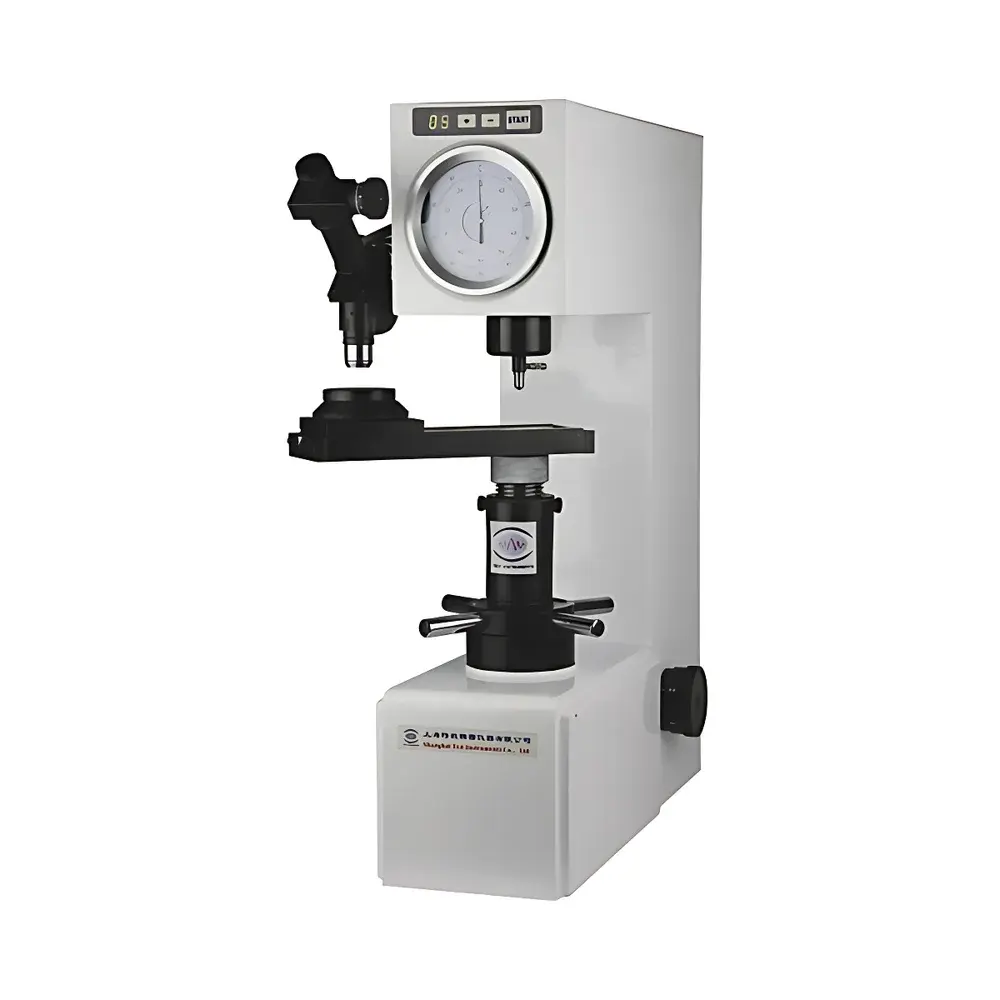
OLYMPUS HBRV-187.5 Electric Brinell-Rockwell-Vickers Hardness Tester
| Brand | OLYMPUS |
|---|---|
| Origin | Japan |
| Model | HBRV-187.5 |
| Type | Combined Brinell, Rockwell & Vickers Hardness Tester |
| Drive | Motorized Load Application |
| Compliance | ASTM E10, ASTM E18, ASTM E92, ISO 6506, ISO 6508, ISO 6507 |
| Application Scope | Ferrous & Non-ferrous Metals, Heat-Treated Surfaces, Thin Hardened Sheets, Cast Iron, Carbides, Annealed & Tempered Steels |
Overview
The OLYMPUS HBRV-187.5 Electric Brinell-Rockwell-Vickers Hardness Tester is a fully motorized, tri-mode hardness testing system engineered for precision, repeatability, and operational efficiency in industrial quality control and materials research laboratories. It integrates three standardized indentation hardness measurement principles—Brinell (using tungsten carbide ball indenters), Rockwell (based on depth differential under major/minor loads), and Vickers (employing diamond pyramid indenter with geometrically defined apex angle)—into a single, unified platform. The instrument applies test loads automatically via an electromechanical actuation system, eliminating manual lever operation and minimizing operator-induced variability. Designed to meet the metrological requirements of international standards—including ASTM E10 (Brinell), ASTM E18 (Rockwell), ASTM E92 (Vickers), ISO 6506, ISO 6508, and ISO 6507—the HBRV-187.5 ensures traceable, auditable hardness data suitable for ISO/IEC 17025-accredited testing environments and GMP-compliant production facilities.
Key Features
- Motorized load application with programmable dwell time (typically 10–60 s per test) and automatic load sequencing across Brinell (up to 3000 kgf), Rockwell (60–150 kgf depending on scale), and Vickers (10–100 kgf) configurations.
- Integrated optical measurement system featuring calibrated eyepiece or optional digital CCD camera for precise indentation dimension capture—critical for Brinell diameter measurement and Vickers diagonal evaluation.
- Rigid C-frame construction with hardened steel loading column and vibration-damped base, ensuring mechanical stability during high-load indentation and minimizing deflection-induced measurement error.
- Standardized indenter holder compatibility with certified Brinell tungsten carbide balls (e.g., 1 mm, 2.5 mm, 5 mm, 10 mm), Rockwell diamond cone (120° apex) and steel balls (1/16″, 1/8″, 1/4″), and Vickers diamond pyramid (136° included angle).
- Manual or semi-automatic test cycle control via front-panel interface; supports user-defined test protocols including multi-point mapping and sequential scale switching without repositioning the specimen.
- Compliance-ready architecture: Load verification traceable to national standards (e.g., JIS Z 2243), indenter certification documentation provided, and mechanical design aligned with ISO 20458 (hardness testing machines — verification requirements).
Sample Compatibility & Compliance
The HBRV-187.5 accommodates a broad spectrum of metallic specimens—from bulk cast iron and through-hardened tool steels to thin-section hardened sheets (≥1.5 mm thickness recommended for Rockwell superficial scales) and surface-modified components (e.g., nitrided, carburized, or induction-hardened layers). Its dual-scale Rockwell capability (A, B, C, F, G, K, 15N, 30N, 45N) enables evaluation of both soft aluminum alloys and ultra-hard cemented carbides. For Brinell testing, the system supports standard load/diameter combinations (e.g., 3000 kgf / 10 mm ball for castings) and small-ball variants (e.g., 500 kgf / 5 mm) for medium-strength steels. Vickers testing extends to microhardness-level assessments when paired with low-force attachments (not included in base configuration). All test methods conform to regulatory expectations for materials qualification in automotive, aerospace, and energy sectors—fully supporting audit trails required under AS9100, IATF 16949, and FDA 21 CFR Part 11–aligned documentation systems.
Software & Data Management
While the base HBRV-187.5 operates via embedded hardware controls, it is compatible with OLYMPUS-certified PC-based hardness analysis software (optional add-on). This software enables automated indentation image capture, real-time diagonal/area calculation, statistical process control (SPC) charting, and export of hardness values in CSV, PDF, or XML formats. Audit trail functionality records operator ID, timestamp, test parameters, calibration status, and raw measurement data—satisfying GLP/GMP data integrity requirements. Raw hardness values are calculated per standard equations (e.g., HV = 0.1891·F/d² for Vickers; HR = 100 − h/0.002 for Rockwell C scale), with uncertainty estimation based on ISO/IEC 17025 Annex A.3 guidelines.
Applications
- Verification of heat treatment efficacy in quenched & tempered structural steels used in pressure vessels and transmission components.
- Quality assurance of surface-hardened gears, bearing races, and camshafts via Rockwell superficial scales (e.g., 45N, 30T) and micro-Vickers cross-section analysis.
- Batch acceptance testing of sintered carbide inserts and wear-resistant coatings using Brinell (HBW) and Vickers (HV) correlation protocols.
- Failure analysis laboratories assessing case depth uniformity, decarburization zones, and intermetallic phase hardness differentials in aluminum and titanium alloys.
- Academic metallurgy programs conducting comparative hardness studies across alloy families, aging conditions, and thermo-mechanical processing routes.
FAQ
Does the HBRV-187.5 support automatic hardness scale conversion?
No—scale conversion (e.g., HB to HRC) is not performed internally. Users must apply standardized conversion tables (e.g., ASTM E140) externally, as direct mathematical conversion violates metrological best practices due to material- and microstructure-dependent nonlinearity.
Is periodic verification required, and what standards apply?
Yes—annual verification against certified reference blocks (e.g., NIST-traceable hardness standards) is mandated by ISO 6506-2, ISO 6507-2, and ISO 6508-2. Load accuracy must be confirmed within ±1.0% tolerance; indenter geometry verified per ISO 6506-3.
Can the instrument test cylindrical or irregularly shaped samples?
Yes—when used with optional V-block or custom fixture kits, the HBRV-187.5 maintains perpendicular load alignment for curved surfaces, provided minimum sample stability and support rigidity are ensured per ASTM E10 Section 7.3.
What maintenance intervals are recommended for the motorized loading system?
OLYMPUS recommends lubrication of lead screws and inspection of drive belt tension every 12 months or after 5,000 test cycles, whichever occurs first. Load cell recalibration is advised biannually under continuous operation.
Is the HBRV-187.5 compliant with FDA 21 CFR Part 11 for electronic records?
The standalone unit is not Part 11–compliant; however, when integrated with validated OLYMPUS hardness management software (v3.2+), full electronic signature, audit trail, and data integrity controls are available under configured user roles and password-protected access levels.



