
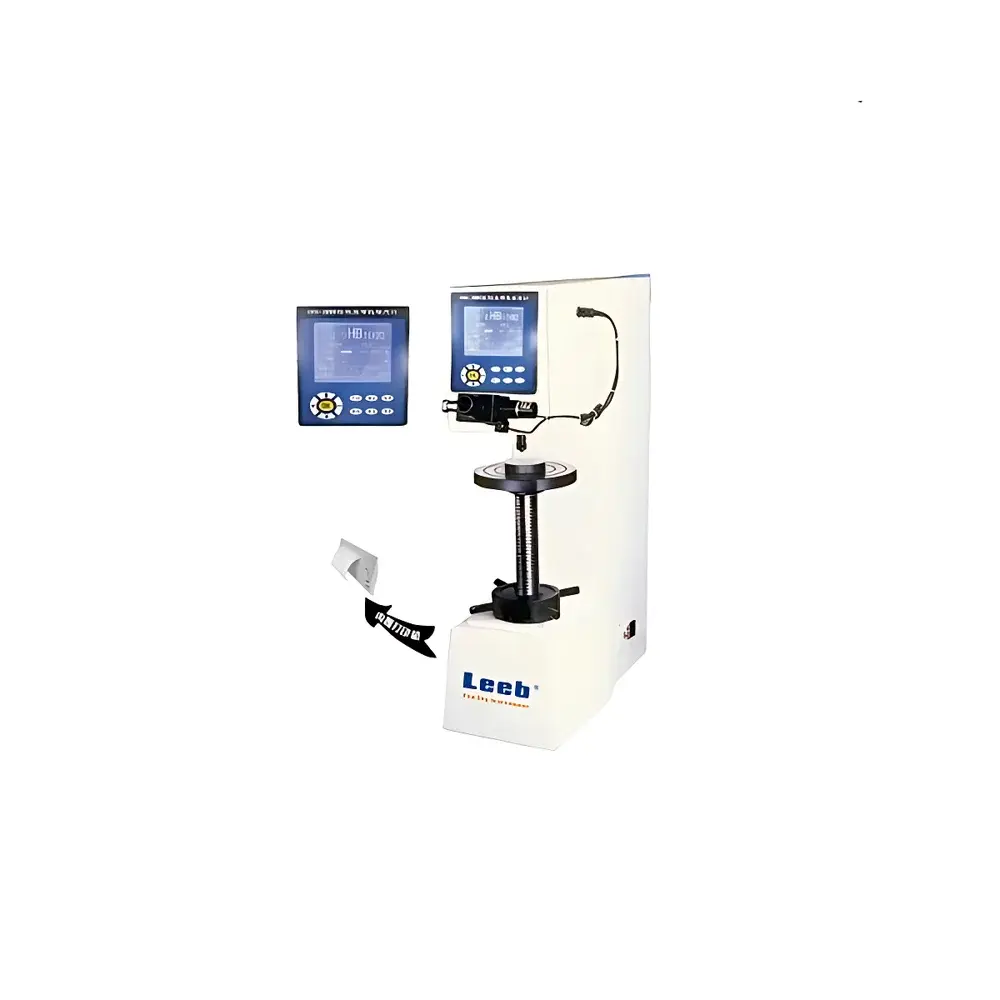
OLYMPUS HBS-3000 Digital Brinell Hardness Tester
| Brand | OLYMPUS |
|---|---|
| Origin | Japan |
| Model | HBS-3000 |
| Hardness Scale | HBW (Brinell, tungsten carbide ball indenter) |
| Test Force Range | 187.5 kgf to 3000 kgf (standard Brinell load range per ISO 6506-1) |
| Indenter | 10 mm hardened steel or tungsten carbide ball |
| Optical Measurement System | High-magnification eyepiece with calibrated scale or digital image capture (optional) |
| Display | Large LCD screen with real-time test parameter and result visualization |
| Data Output | RS-232 or USB interface for printer or PC connectivity |
| Compliance | Designed to meet ISO 6506-1, ASTM E10, and JIS Z 2243 requirements |
Overview
The OLYMPUS HBS-3000 Digital Brinell Hardness Tester is a precision-engineered instrument designed for reliable, repeatable Brinell hardness measurements on bulk metallic materials. Based on the classical Brinell principle—applying a defined spherical indenter under controlled static load and measuring the resulting permanent indentation diameter—the HBS-3000 delivers high reproducibility for macro-scale hardness assessment. Its fully electronic load application system eliminates mechanical lever variability, ensuring strict adherence to force ramping profiles specified in ISO 6506-1. The unit integrates a high-resolution optical measurement path with calibrated reticule or optional digital imaging, enabling accurate determination of indentation diameter (d) to ±0.5% uncertainty under standard laboratory conditions. As a dedicated Brinell platform—not a hybrid or multi-scale tester—the HBS-3000 maintains metrological integrity through mechanical stability, thermal mass design, and rigid C-frame architecture optimized for loads up to 3000 kgf.
Key Features
- Electronic closed-loop loading system with programmable force application and dwell time (1–60 s adjustable), compliant with ISO 6506-1 timing tolerances
- Dual-mode optical measurement: manual high-magnification eyepiece (20×) with precision micrometer scale, plus optional digital camera module for automated d-value extraction and traceable image archiving
- Integrated large-format LCD display showing real-time load curve, dwell status, indentation diameter, calculated HBW value, and test sequence ID
- Onboard memory storing ≥500 test records with timestamp, operator ID, material code, and load/indenter configuration metadata
- Standard RS-232 and USB-B interfaces supporting direct connection to thermal printers or Windows-based data acquisition software for CSV export and statistical analysis (e.g., Cp/Cpk, histogram generation)
- Rigid cast-iron base with vibration-damping feet and hardened anvil surface (HRC 60+) to minimize deflection during high-load testing
Sample Compatibility & Compliance
The HBS-3000 is validated for use on homogeneous, isotropic metallic specimens ≥10 mm thick, with surface roughness Ra ≤3.2 µm. It accommodates flat, convex (R ≥100 mm), and cylindrical samples (min. Ø 10 mm) using standard anvil accessories. Typical applications include cast iron (gray, ductile), aluminum alloys (e.g., 3003, 6061-T6), copper and brass, annealed and normalized carbon steels, and heavy-section weldments. The instrument conforms to the essential metrological requirements of ISO 6506-1:2023 (Metallic materials — Brinell hardness test — Part 1: Test method), ASTM E10-23 (Standard Test Method for Brinell Hardness of Metallic Materials), and JIS Z 2243:2019. Routine verification follows certified reference blocks (HBW 10/3000, HBW 5/750, etc.) traceable to NMIJ (Japan) or NIST SRMs.
Software & Data Management
The HBS-3000 supports optional PC-based control and reporting software compliant with FDA 21 CFR Part 11 requirements—including electronic signatures, audit trail logging, and user role-based access control (operator, supervisor, administrator). Data files retain raw pixel coordinates of indentation boundaries, load-time stamps, environmental temperature logs (via external probe input), and calibration certificate expiry dates. Export formats include ASTM E140-compliant hardness conversion tables (HBW ↔ HV ↔ HRB), SPC-ready .csv, and PDF reports with embedded digital signatures and QR-coded test record IDs for GLP/GMP traceability.
Applications
- Quality assurance of raw material batches in foundries and metal service centers
- Verification of heat treatment efficacy (annealing, normalizing, tempering) in forging and rolling mills
- Hardness mapping across weld joints and HAZ regions in pressure vessel fabrication
- Research-grade mechanical property correlation studies (e.g., HBW vs. tensile strength σUTS in aluminum alloys per ISO 6506-4)
- Educational laboratories for teaching fundamental hardness concepts and ISO-standardized testing methodology
FAQ
Does the HBS-3000 support automatic hardness calculation and unit conversion?
Yes—HBW values are computed in real time using the standardized formula HBW = 0.102 × (2F) / [πD(D − √(D² − d²))], with F in kgf, D and d in mm. Conversion to HV, HRB, or HRC is available via ASTM E140 lookup tables embedded in firmware.
Can the instrument be used for thin-sheet materials?
No—Brinell testing requires minimum specimen thickness ≥8× indentation depth. For sheets <6 mm thick, Vickers (HV) or Rockwell superficial (HR15N) methods are recommended per ISO 6507-1 and ASTM E384.
Is third-party calibration certification included with delivery?
A factory calibration report with uncertainty budget (k=2) is supplied. Full ISO/IEC 17025-accredited calibration by an ILAC-member lab is available as an optional service.
What maintenance intervals are recommended for long-term accuracy?
Annual verification of load cell linearity and optical scale calibration is advised. Daily cleaning of indenter and anvil surfaces with isopropyl alcohol and lint-free cloth is required per operating procedure.



