
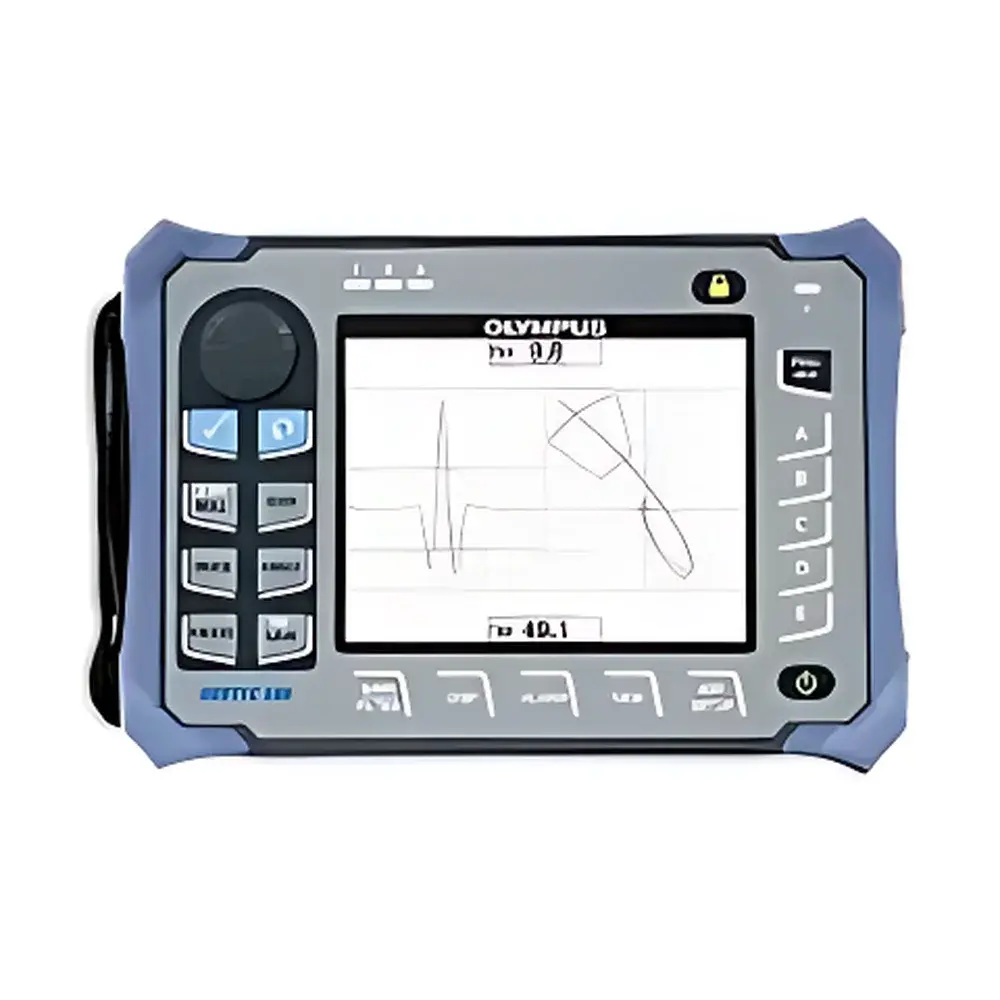
Olympus NORTEC 600 Advanced Portable Eddy Current Testing Instrument
| Brand | Olympus |
|---|---|
| Origin | Japan |
| Model | NORTEC 600 |
| Design | Portable |
| Frequency Range | 10 Hz to 12 MHz (standard operation at 60 kHz or 480 kHz for conductivity/coating applications) |
| Display | 5.7-inch VGA (640 × 480), color transflective LCD |
| IP Rating | IP66 |
| Operating Temperature | –10 °C to +50 °C |
| Battery Life | Up to 10 hours (standard mode), 6–8 hours (with rotary scanner) |
| Weight | 1.6 kg (with integrated wrist strap) |
| Compliance | EN 15548, CE, FCC, IC, RoHS, RCM, WEEE |
| Data Storage | 500 files (programs + data) |
| Interface | Dual probe ports — 16-pin LEMO (PowerLink-enabled) and BNC (auto-balancing) |
| Software | NORTEC PC (USB 2.0 connectivity, PDF report export, full-file preview, audit-ready file management) |
Overview
The Olympus NORTEC 600 is a high-performance, portable eddy current testing (ECT) instrument engineered for precision, reliability, and operational efficiency in demanding industrial NDT environments. Based on the fundamental principle of electromagnetic induction, the NORTEC 600 generates alternating magnetic fields via probe excitation across a broad frequency spectrum (10 Hz to 12 MHz), inducing eddy currents in conductive materials. Disruptions caused by surface or near-surface discontinuities—such as cracks, corrosion, pitting, or material variations—alter the impedance response of the probe coil, which is detected, processed, and visualized in real time. Designed for field-deployable integrity assessment, the instrument integrates advanced digital signal processing, robust hardware architecture, and intuitive human-machine interaction to support consistent, repeatable inspections under variable ambient conditions—including outdoor daylight, low-light hangar settings, or confined structural access points.
Key Features
- 5.7-inch full-VGA (640 × 480) color transflective LCD display with eight user-selectable color palettes and true full-screen mode across all display types—ensuring optimal signal visibility in direct sunlight or dimly lit enclosures.
- Dual probe interface architecture: 16-pin LEMO connector supporting Olympus PowerLink technology (automatic probe recognition, preloaded setup configurations) and BNC connector with built-in auto-balance circuitry—eliminating manual nulling for conventional probes.
- Four configurable models (N600, N600C, N600S, N600D) offering scalable functionality—from basic flaw detection to dual-frequency analysis, conductivity measurement (0.9–110% IACS), non-conductive coating thickness evaluation (up to 0.64 mm), and rotary scanner integration (e.g., PS-5, SpitFire, RA-2000).
- Real-time dual-parameter readout: simultaneous display of up to two dynamically updated measurements—including peak-to-peak amplitude (horizontal/vertical/magnitude), distance from reference point, or phase angle—enabling rapid signal interpretation without menu navigation.
- Enhanced signal conditioning: programmable low-pass (10 Hz–2 kHz) and high-pass (5 Hz–1 kHz) filters; persistent balance filter (0.2/0.5/1.0 Hz); sweep rate adjustment (0.005 s–10 s per segment); and “digital 6” or “digital 8” filter response presets optimized for bolt-hole inspection.
- Ruggedized enclosure certified to IP66 ingress protection, operating temperature range of –10 °C to +50 °C, and shock-tested mechanical design validated for extended use in offshore, aerospace, power generation, and rail infrastructure applications.
Sample Compatibility & Compliance
The NORTEC 600 is compatible with a wide range of eddy current probes—including absolute, differential, reflection, and bridge-configured units—as well as third-party rotary scanners and legacy transducers via optional adapters (e.g., 12-pin LEMO, 11-pin Fischer). It supports ASTM E309, E566, E1004, and ISO 15548-1/2/3 standards for instrument performance verification and system calibration. Its digital conductivity mode meets or exceeds BAC 5651 specifications, while its coating thickness measurement capability adheres to ASTM D7091 and ISO 2178 requirements for non-magnetic, non-conductive layers on non-ferrous substrates. The device’s firmware and file management structure support GLP/GMP-aligned documentation practices, including timestamped data capture, operator ID tagging, and traceable configuration logs—facilitating regulatory audits under FAA AC 150/5370-10, EN 9100, or ASME Section V, Article 8.
Software & Data Management
NORTEC PC software provides seamless bidirectional data exchange over USB 2.0, enabling real-time review of acquired signals, batch export to PDF reports (including the “PDF All” one-click compilation function), and clipboard-based image capture. Onboard storage accommodates up to 500 files—each containing both instrument configuration (program) and raw signal data—organized via an intuitive file manager with thumbnail preview, in-device renaming, annotation, and selective deletion. The embedded text editor allows field-editable metadata entry (e.g., inspection ID, technician name, location notes). All saved files retain full traceability: date/time stamps, gain/phase/frequency parameters, probe type, and display mode are embedded in the native .nct format. NORTEC PC also supports trend analysis across multiple inspections and cross-platform compatibility with common NDT data viewers used in enterprise-level asset integrity management systems.
Applications
The NORTEC 600 delivers proven performance across critical NDT workflows: surface crack detection in aluminum airframes and turbine blades; heat exchanger tube inspection using dual-frequency mixing (F1−F2) to suppress support plate noise; bolt-hole scanning in wing spar structures with adaptive filter tuning; weld seam evaluation under paint or thin cladding; conductivity sorting of wrought alloys; and non-conductive coating thickness verification on aircraft skins. Its lightweight form factor (1.6 kg) and chest-mount compatibility make it ideal for rope-access inspections, while its extended battery life and IP66-rated housing ensure uninterrupted operation during multi-shift refinery turnarounds or remote wind-turbine blade assessments. The instrument’s modular architecture enables retrofitting into automated scanning rigs via its 15-pin I/O port (6 analog outputs, 3 alarm triggers, digital inputs), supporting integration with PLC-controlled motion stages or robotic arms in factory-floor QA/QC cells.
FAQ
What frequency options are available for conductivity and coating thickness measurements?
Conductivity and non-conductive coating thickness modes operate at fixed frequencies of 60 kHz or 480 kHz—selected based on material thickness, conductivity range, and required depth of penetration.
Does the NORTEC 600 support remote firmware updates or feature unlocking?
Yes—additional capabilities (e.g., dual-frequency mixing, advanced scanner synchronization, or expanded data logging) can be remotely enabled via licensed activation keys applied through NORTEC PC software.
Is the instrument compliant with FDA 21 CFR Part 11 for electronic records?
While the NORTEC 600 itself does not include electronic signature or audit-trail encryption features, its structured file metadata, immutable timestamping, and integration-ready API enable compliance when deployed within validated laboratory information management systems (LIMS) that meet Part 11 requirements.
Can legacy NORTEC programs be loaded directly into the NORTEC 600?
Yes—the instrument maintains backward compatibility with configuration files and display layouts from prior NORTEC generations, ensuring continuity in established inspection procedures without requalification.
What is the maximum supported rotational speed for compatible scanners?
The NORTEC 600 supports rotary scanners operating from 120 RPM to 3000 RPM, with automatic filter adaptation triggered by encoder input or user-defined sweep velocity profiles.



