OLYMPUS Offline Programming & Simulation Platform for Robotic Manipulators
| Brand | OLYMPUS |
|---|---|
| Origin | Shanghai, China |
| Manufacturer Type | Authorized Distributor |
| Regional Classification | Domestic (PRC) |
| Model | N/A |
| Pricing | Available Upon Request |
Overview
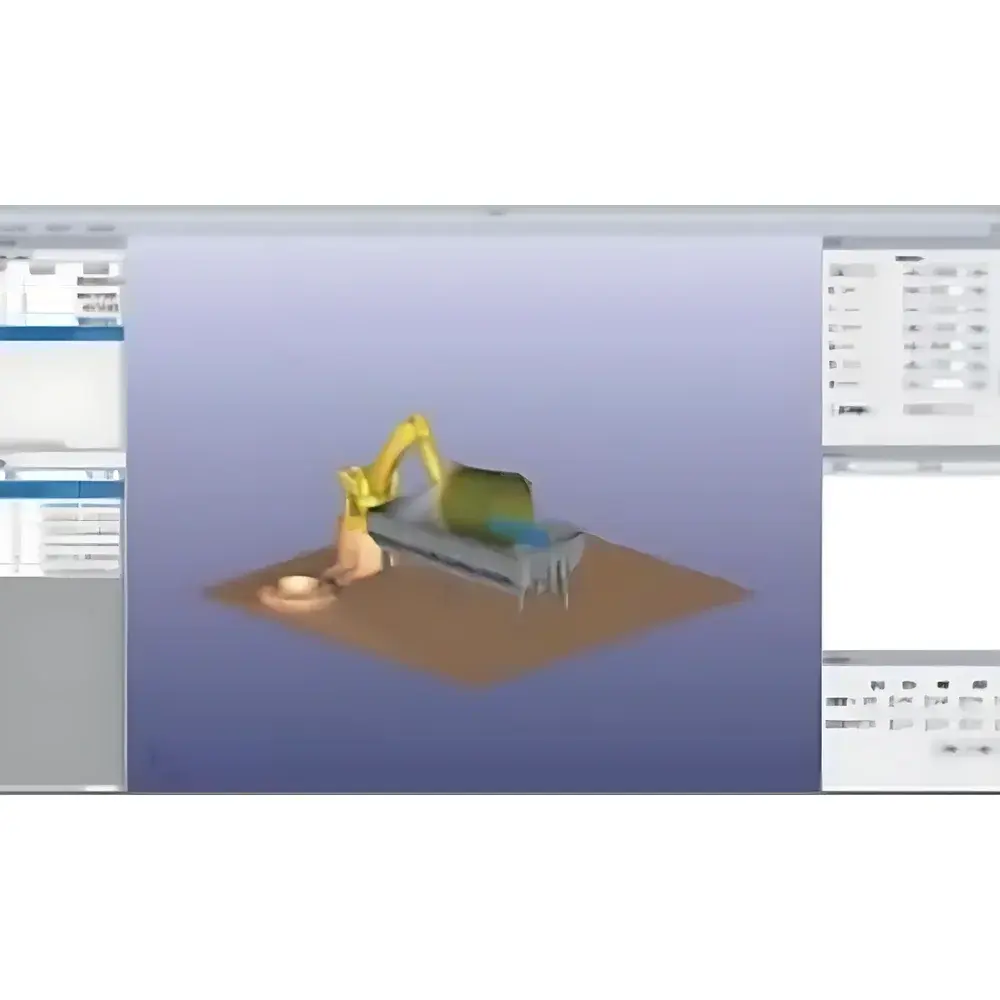
The OLYMPUS Offline Programming & Simulation Platform is a specialized engineering software system designed for the kinematic modeling, path planning, and dynamic simulation of industrial robotic manipulators. Built upon foundational principles of forward and inverse kinematics, collision-free trajectory generation, and real-time 3D scene rendering, the platform enables engineers to develop, validate, and optimize robot programs without interrupting production line operations. It supports multi-axis articulated arms, SCARA, and Cartesian configurations commonly deployed in precision manufacturing environments. The core architecture integrates geometric modeling engines with physics-based motion interpolation algorithms—ensuring that simulated tool-center-point (TCP) trajectories reflect real-world joint limits, acceleration constraints, and payload-dependent dynamics. This capability is critical for mission-critical applications where physical trial-and-error programming poses safety risks, process downtime, or hardware wear.
Key Features
- Fully parametric 3D virtual cell construction—including CAD import (STEP, IGES, STL), custom fixture modeling, and configurable workpiece positioning
- Robot-specific kinematic solver supporting DH (Denavit–Hartenberg) parameter definition and user-defined joint axis constraints
- Collision detection engine with configurable tolerance thresholds for robot links, end-effectors, fixtures, and environmental geometry
- Offline teach pendant emulation with point-to-point (PTP), linear (LIN), and circular (CIRC) motion instruction generation
- Integrated cycle time estimator based on joint velocity/acceleration profiles and servo loop response models
- Support for industry-standard robot controller interfaces including ABB RAPID, Fanuc KAREL/TP, Yaskawa INFORM, and KUKA KRL export formats
Sample Compatibility & Compliance
The platform accommodates mechanical handling systems equipped with standard TCP interfaces and compliant with ISO 9787 (Industrial robots — Coordinate systems and motion nomenclature) and ISO 10218-1 (Robots and robotic devices — Safety requirements for industrial robots). It is validated for integration with ultrasonic non-destructive testing (NDT) scanning systems conforming to ASTM E273, ASME BPVC Section V, and EN 13660. For welding applications, generated paths comply with ISO 15609-1 (Welding procedure specifications) and AWS D1.1 structural welding code requirements when used in conjunction with certified torch orientation logic. The software environment itself operates under Windows 10/11 (64-bit) and meets IEC 62443-3-3 cybersecurity baseline requirements for industrial control system components.
Software & Data Management
Data integrity and traceability are maintained through built-in version control, audit logging, and XML-based project serialization. All simulation sessions record timestamps, user IDs, configuration parameters, and exported program metadata—supporting GLP/GMP-aligned documentation workflows. Exported robot programs include embedded comments, safety interlock annotations, and calibrated tool frame definitions. While native support for FDA 21 CFR Part 11 electronic signature functionality is not implemented, the platform exports structured logs compatible with third-party validation modules used in regulated manufacturing (e.g., pharmaceutical equipment qualification or aerospace component inspection).
Applications
- Ultrasonic phased array (PAUT) and time-of-flight diffraction (TOFD) probe path planning for complex weld geometries and curved surfaces
- Robotic arc welding trajectory optimization for automotive chassis and pressure vessel fabrication
- High-precision abrasive waterjet cutting path generation with kerf compensation and lead-in/lead-out logic
- Automated spray coating simulation for aerospace composite layup tools and turbine blade refurbishment
- Material handling sequence validation for palletizing cells operating under ISO/TS 16949 quality management frameworks
FAQ
Does this platform support real-time hardware-in-the-loop (HIL) testing?
No—this is a strictly offline simulation and programming environment. Real-time synchronization with physical controllers requires external interface modules not included in the base software package.
Can imported CAD models retain GD&T annotations for tolerance-aware path planning?
Yes—geometric dimensioning and tolerancing (GD&T) data from native CAD formats (e.g., Creo, SolidWorks, NX) is preserved during STEP AP242 import and can inform fixture alignment logic and probing strategy generation.
Is source code or API access available for custom plugin development?
The platform provides a documented COM-based automation interface for C#/VB.NET integration and limited Python bindings via pywin32; full SDK licensing is subject to separate agreement with OLYMPUS Industrial Solutions Division.
What level of robot controller firmware compatibility is guaranteed?
Compatibility is verified against specific controller firmware versions listed in the official Release Notes document; backward compatibility beyond two major revision cycles is not assured.
Are training courses and certification exams offered for this software?
Yes—OLYMPUS delivers instructor-led technical workshops covering simulation methodology, path validation protocols, and regulatory documentation best practices; course completion certificates are issued per ISO/IEC 17024 requirements.