
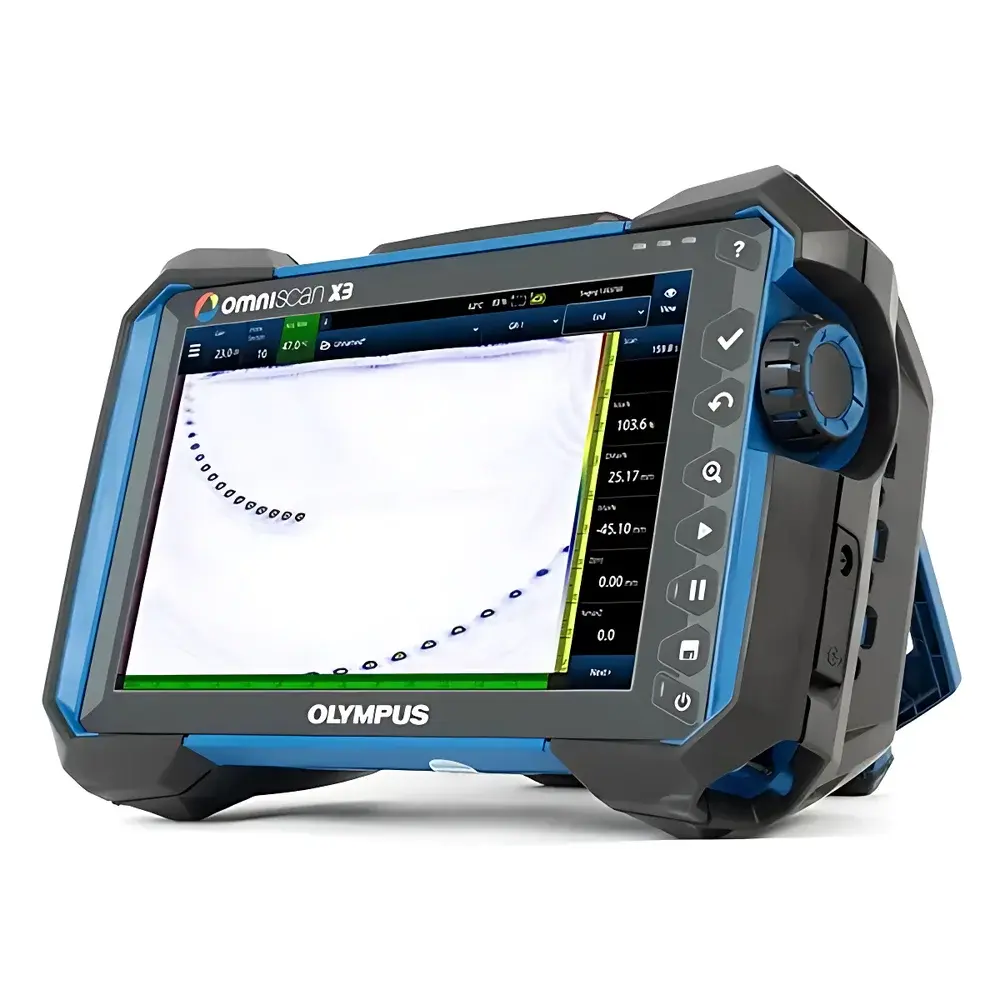
Olympus OmniScan X3 Phased Array Ultrasonic Flaw Detector with TFM and TOFD Capabilities
| Brand | Olympus |
|---|---|
| Origin | USA |
| Model | OmniScan X3 |
| Detection Principle | Phased Array Ultrasonics (PAUT), Total Focusing Method (TFM), Time-of-Flight Diffraction (TOFD) |
| Maximum Aperture Support | 128 elements (64-element PA probe + synthetic aperture for TFM) |
| Pulse Repetition Frequency (PRF) | Up to 3× higher than OmniScan MX2 |
| Dynamic Range | 800 dB (A-scan amplitude range) |
| Probe Compatibility | Dual-element linear and matrix arrays, encoded PA and TOFD probes |
| Software Platform | OmniPC-compatible, supports ASTM E2700, ISO 13588, EN 12668-1/3, ASME BPVC Section V Article 4 & 5 compliance workflows |
| Data Management | Onboard acquisition with full A/SA/B/C-scan export, GLP/GMP-compliant audit trail (via optional software license), FDA 21 CFR Part 11 ready |
Overview
The Olympus OmniScan X3 is a high-performance portable phased array ultrasonic testing (PAUT) instrument engineered for precision, reliability, and regulatory readiness in industrial non-destructive evaluation (NDE). Built upon the proven ruggedized architecture of the OmniScan platform, the X3 integrates three complementary ultrasonic modalities—phased array beamforming, total focusing method (TFM), and time-of-flight diffraction (TOFD)—within a single hardware platform. Its core measurement principle relies on coherent synthesis of ultrasonic wavefronts from multi-element transducers, enabling real-time sectorial scanning, dynamic depth focusing, and pixel-level TFM reconstruction across volumetric regions of interest. Designed for demanding applications in power generation, oil & gas, aerospace, and heavy fabrication, the OmniScan X3 delivers consistent sensitivity in thick-section or highly attenuative materials—including welds in carbon steel, stainless cladding, and dissimilar metal joints—while maintaining full traceability under GLP, GMP, and ASME BPVC Section V requirements.
Key Features
- Simultaneous PAUT, TFM, and TOFD operation with dedicated, context-aware menus—eliminating mode-switching latency and reducing setup time by up to 800% during TOFD calibration.
- 128-element synthetic aperture support for TFM imaging, leveraging 64-element PA probes to achieve full-matrix capture (FMC) and post-processed TFM reconstruction with sub-wavelength spatial resolution.
- Acoustic Influence Map (AIM) tool: a physics-based modeling engine that visualizes expected signal amplitude distribution across the inspection volume based on probe geometry, wedge delay, material velocity, and reflector type—enabling predictive scan planning and sensitivity validation prior to field deployment.
- Dual-element linear and matrix array compatibility for rapid corrosion mapping, including automated C-scan generation with thickness interpolation and remaining-wall-thickness reporting per API RP 579/ASME FFS-1.
- Onboard TCG (Time-Corrected Gain) and gate-synchronized A-scan processing for immediate amplitude normalization and defect sizing without external post-processing.
- Rugged IP65-rated magnesium alloy enclosure, drop-tested to MIL-STD-810G, with sunlight-readable 10.1″ capacitive touchscreen and hot-swappable dual-battery system for uninterrupted 8+ hour operation.
Sample Compatibility & Compliance
The OmniScan X3 accommodates a broad spectrum of industrial test specimens—from pipe girth welds (DN25–DN1200) and pressure vessel nozzles to turbine disk forgings and composite-overwrapped pressure vessels (COPVs). It supports immersion, contact, and wedge-coupled configurations using standard 0.5–10 MHz PA probes, dual-element corrosion arrays, and TOFD probe pairs (typically 2–10 MHz, 2–6 mm element pitch). The instrument conforms to essential NDT standards including ASTM E2700 (PAUT), ISO 13588 (TOFD), EN 12668-1 (instrument performance), EN 12668-3 (system performance), and ASME BPVC Section V Articles 4 (PAUT) and 5 (TOFD). Optional software modules enable full 21 CFR Part 11 compliance with electronic signatures, audit trails, and role-based access control for regulated environments.
Software & Data Management
Data acquisition and analysis are unified through the OmniPC software ecosystem, supporting seamless import/export of .ctf, .udx, and .csv formats. All scans include embedded metadata—probe ID, calibration date, operator ID, UTC timestamps, and environmental conditions—for full chain-of-custody documentation. Advanced reporting tools generate ASME-compliant PDF reports with embedded A/SA/B/C-scan images, gate statistics, and dimensional annotations. For enterprise integration, the instrument supports OPC UA connectivity and RESTful API endpoints for automated data ingestion into LIMS or CMMS platforms. Audit logs record every parameter change, file export, and user login—retained for configurable durations and exportable as encrypted ZIP archives meeting GLP archival requirements.
Applications
- Weld inspection in piping systems and structural steel, including root pass assessment and lack-of-fusion detection using TFM-enhanced lateral wave separation.
- Critical component screening in nuclear primary circuit piping per EPRI guidelines, utilizing dual-mode PAUT+TOFD for volumetric flaw characterization and sizing uncertainty quantification.
- Corrosion monitoring of storage tank floors and offshore platform legs via encoded raster scans with automatic thickness averaging and pit-depth extrapolation.
- Aerospace fastener hole inspection using matrix array probes and sectorial TFM to resolve tight crack networks adjacent to rivet shanks.
- Manufacturing QA of additive manufactured (AM) parts, where TFM’s enhanced resolution detects lack-of-fusion porosity and unmelted powder clusters below 0.3 mm in diameter.
FAQ
Does the OmniScan X3 support both PAUT and TOFD in the same scan sequence?
Yes—the instrument allows synchronized dual-channel acquisition, enabling concurrent PAUT sectorial scanning and TOFD B-scan collection within a single encoded sweep.
Can TFM data be processed onboard, or is PC-based software required?
Full TFM reconstruction—including all standard modes (L-, P-, S-wave; single- and dual-sided) and AIM simulation—is performed in real time on the device without external computation.
Is the OmniScan X3 certified for use in intrinsically safe (IS) environments?
While the base unit is not IS-certified, it may be deployed in Zone 2/Class I Div 2 areas when used with approved isolation barriers and non-incendive probe cabling per IEC 60079-11.
What probe types are validated for corrosion mapping?
Olympus-certified dual-element linear arrays (e.g., 5L16-A32, 10L16-A32) and matrix arrays (e.g., M2M Panther series) are fully supported with automated setup wizards and thickness interpolation algorithms.
How does the AIM tool improve inspection reliability?
AIM eliminates empirical guesswork by computing and rendering the theoretical signal-to-noise ratio (SNR) distribution across the entire inspection volume—allowing users to adjust probe indexing, wedge angle, or focal law before physical scanning begins.



