
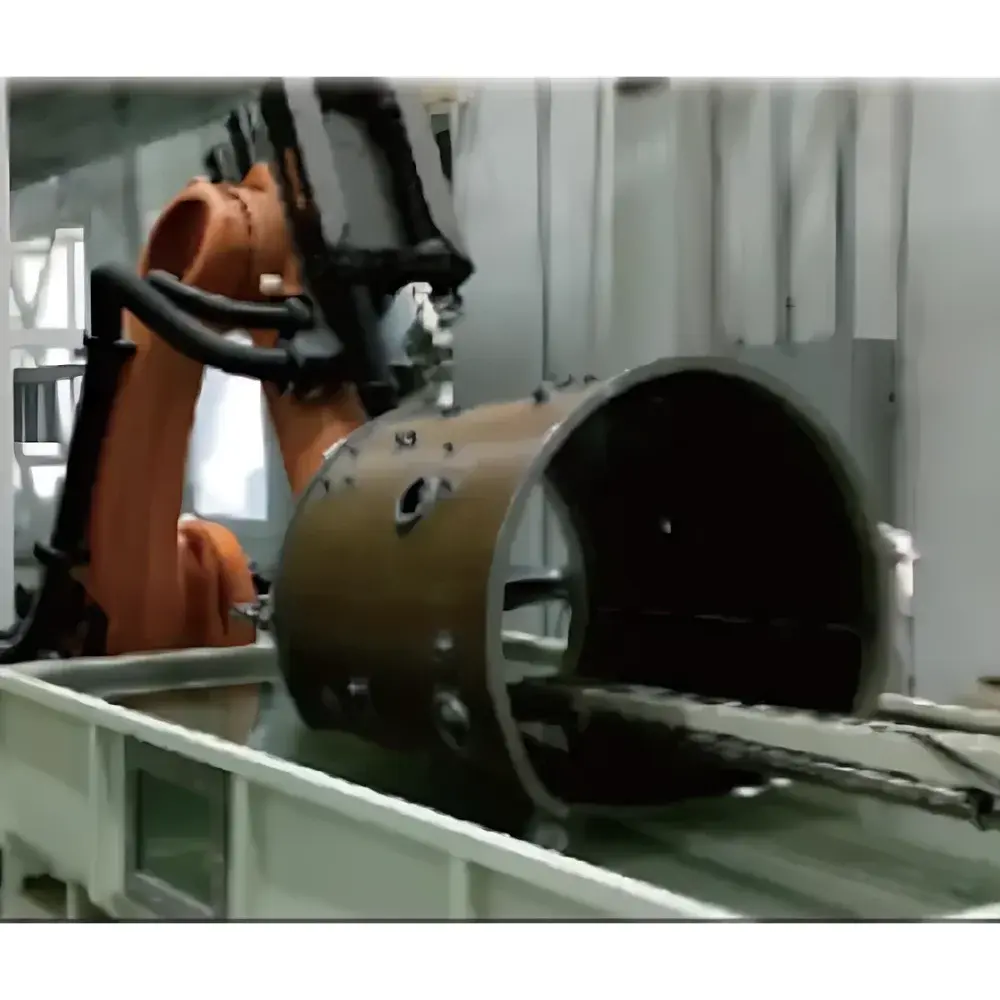
Olympus PAUT-TOFD Cone Composite Inspection System
| Brand | Olympus |
|---|---|
| Origin | Shanghai, China |
| Manufacturer Type | Authorized Distributor |
| Product Origin | Domestic (China) |
| Model | PAUT-TOFD-CONE-S6 |
| Quotation | Available Upon Request |
| Application Domain | Aerospace Composite Structures, Hybrid Metal-Fiber Joints |
Overview
The Olympus PAUT-TOFD Cone Composite Inspection System is an integrated automated ultrasonic testing platform engineered for high-fidelity volumetric assessment of conical composite components—specifically carbon fiber reinforced polymer (CFRP) structures with metallic fasteners (e.g., rivets, bolts). Unlike conventional manual or fixed-angle ultrasonic setups, this system combines mechanical precision with electronic beam steering to address the geometric and acoustic challenges inherent in curved, layered, and hybrid-material geometries. It operates on the dual principles of phased array ultrasonic testing (PAUT) and time-of-flight diffraction (TOFD), enabling simultaneous detection of planar discontinuities (e.g., delaminations, disbonds) and volumetric anomalies (e.g., porosity, fiber breakage induced by fastener insertion) within CFRP laminates and at metal-composite interfaces. The system’s architecture is purpose-built for repeatable, traceable, and auditable inspection workflows compliant with aerospace NDT standards including ASTM E2700, ASTM E2491, and ISO 16810.
Key Features
- Six-axis robotic manipulator with ±0.05 mm repeatability, enabling precise positioning and orientation control of complex conical workpieces during scanning.
- Multi-axis probe carriage system accommodating up to 128-element linear or matrix phased array probes, supporting dynamic focal law generation for adaptive focusing across variable curvature surfaces.
- Real-time PAUT/TOFD fusion imaging with full matrix capture (FMC) and total focusing method (TFM) reconstruction, delivering high-resolution C-scan, B-scan, and sectorial S-scan visualization.
- Automated loading/unloading interface compatible with standard aerospace fixture pallets; cycle time reduction of >85% compared to manual PAUT deployment on equivalent cone geometries.
- Embedded calibration verification module compliant with EN 1330-4 and ISO 2400, supporting daily sensitivity checks using reference reflectors embedded in ASTM E2491-compliant calibration blocks.
- Rugged industrial enclosure rated IP54, designed for integration into production cell environments with electromagnetic noise suppression per IEC 61000-6-2.
Sample Compatibility & Compliance
The system accommodates conical CFRP specimens with base diameters from 150 mm to 800 mm and apex angles ranging from 15° to 60°, including those incorporating titanium or aluminum fasteners with diameters ≥3 mm. It supports inspection of layup configurations up to 48-ply thickness (≈12 mm nominal) and is validated for detecting artificial defects per ASTM E2700 Annex A1: flat-bottom holes (FBH) ≥0.5 mm diameter at depths ≥1 mm, and simulated delaminations ≥2 mm² area with ≤0.1 mm separation. All inspection procedures are fully documentable for GLP/GMP-aligned quality systems and support audit-ready reporting per AS9100 Rev D clause 8.5.2.
Software & Data Management
Powered by Olympus NDT Studio™ v4.2 firmware suite, the system delivers full traceability through built-in electronic signature support, 21 CFR Part 11–compliant user access controls, and immutable audit trails for all parameter changes, calibration events, and report generations. Raw FMC datasets are stored in HDF5 format with embedded metadata (probe ID, wedge angle, gain settings, mechanical position logs), ensuring interoperability with third-party analysis tools such as CIVA and ParaView. Automated report generation includes customizable templates aligned with customer-specific NDT procedure specifications (NAS 410, EN 4179), with export options for PDF/A-2, XML, and CSV.
Applications
- Aerospace structural components: Engine nacelle cones, winglet root joints, and thrust reverser ducts with CFRP-metal hybrid construction.
- Defense rotorcraft systems: Main rotor hub fairings and tail boom transition cones requiring fatigue-critical defect mapping.
- Research & development labs validating novel fastening methods (e.g., self-piercing rivets, adhesive-metal hybrid joints) in thermoset and thermoplastic CFRP matrices.
- Production line QA/QC for OEM Tier-1 suppliers performing 100% incoming inspection of conical subassemblies prior to final assembly.
FAQ
Does the system support custom focal laws for non-standard cone geometries?
Yes—users can define geometry-specific focal laws via CAD import (STEP/IGES) or direct coordinate input, with automatic wedge delay compensation and surface normal vector correction.
Is TOFD mode validated for quantitative sizing of delaminations in CFRP?
TOFD provides reliable depth and lateral extent estimation for planar flaws ≥0.3 mm open height; however, absolute sizing accuracy requires correlation with reference standards per ASTM E2700 Section 8.3.
Can the system integrate with existing factory MES or QMS platforms?
Yes—via OPC UA server interface and RESTful API endpoints, enabling bidirectional data exchange with Siemens Opcenter, PTC ThingWorx, or ETQ Reliance QMS.
What level of operator certification is required to operate this system?
Personnel must hold NAS 410 Level II certification in UT/PAUT with documented experience in composite inspection; Olympus provides application-specific training and procedure qualification support.
Is hardware calibration traceable to national metrology institutes?
All ultrasonic pulser-receivers and motion encoders are calibrated annually against NIST-traceable standards, with certificates provided upon delivery and renewal.
Related Products



