
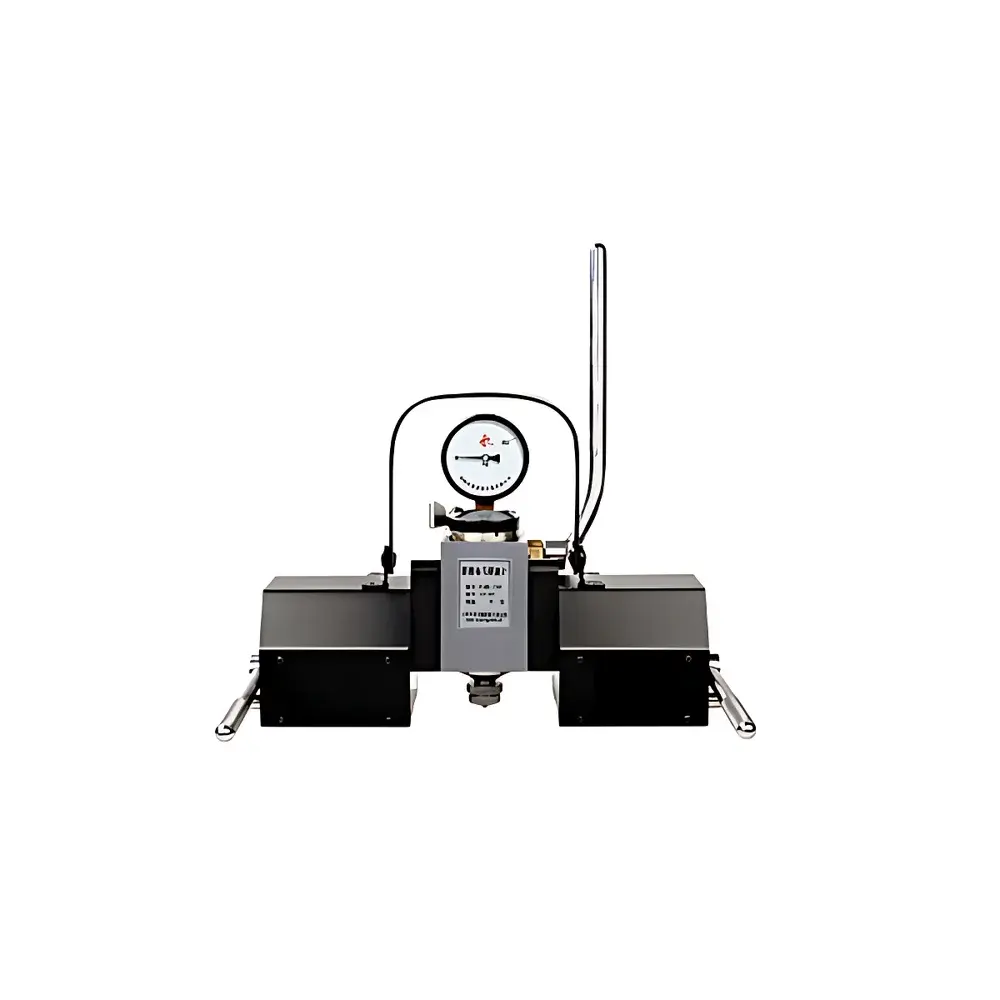
OLYMPUS PHB-750 Magnetic Hydraulic Brinell Hardness Tester
| Brand | OLYMPUS |
|---|---|
| Origin | Japan |
| Model | PHB-750 |
| Applicable Standard | ASTM E110, GB/T 4285 |
| Test Force | 750 kgf (fixed) |
| Force Application Method | Manual lever-driven hydraulic system with pressure-relief control valve |
| Indentation Hold Equivalent | 10–15 s via 3–4 repeated pressure peaks to 750 kgf |
| Mounting Method | Permanent magnet base for ferromagnetic substrates |
Overview
The OLYMPUS PHB-750 Magnetic Hydraulic Brinell Hardness Tester is a portable, non-destructive hardness verification instrument engineered for field and shop-floor assessment of large, immovable ferrous components—such as castings, forgings, structural steel plates, pipelines, and heavy machinery frames. Unlike conventional benchtop Brinell testers requiring specimen removal and precise surface preparation, the PHB-750 employs a self-contained hydraulic actuation mechanism coupled with a high-strength permanent magnet base to secure the unit directly onto vertical, overhead, or curved ferromagnetic surfaces. Its operational principle aligns with the fundamental mechanics of Brinell hardness testing: a hardened steel ball indenter (typically 10 mm diameter) is pressed into the test surface under a defined static load, and the resulting spherical impression diameter is measured optically to calculate hardness according to HBW = 0.102 × (2F) / [πD(D − √(D² − d²))], where F is applied force (N), D is indenter diameter (mm), and d is impression diameter (mm). The PHB-750 delivers a calibrated, repeatable 750 kgf (≈7.35 kN) test force through a manually operated lever-driven hydraulic pump, incorporating an integrated pressure-relief control valve that ensures consistent peak-force delivery across multiple cycles.
Key Features
- Magnetic base assembly with ≥1,200 N holding force on clean, flat carbon steel surfaces (≥6 mm thickness, minimum surface roughness Ra ≤ 6.3 µm)
- Hydraulic force generation system with dual-stage manual lever—designed for ergonomic operation and minimal operator fatigue during repetitive testing
- Integrated analog pressure gauge with 0–1,000 kgf scale, calibrated traceable to JIS Z 2243 and ISO 6506-1 reference standards
- Force stabilization protocol compliant with ASTM E110 Section 7.3 and GB/T 4285 Clause 5.2: three to four controlled pressure surges to 750 kgf replicate the 10–15 s dwell time required by standard Brinell methodology
- Modular indenter carrier accommodating standardized 10 mm tungsten carbide balls (HBW 10/3000 configuration); optional 5 mm ball available for thin-section applications
- Corrosion-resistant aluminum alloy housing with IP54-rated enclosure for industrial workshop environments
Sample Compatibility & Compliance
The PHB-750 is validated for use on homogeneous, non-alloyed or low-alloy ferrous materials with minimum thickness ≥10× indentation depth (typically ≥25 mm for 750 kgf/10 mm ball). It is not suitable for austenitic stainless steels, non-ferrous metals (e.g., aluminum, copper), or case-hardened surfaces without prior validation per ASTM E10–23 Annex A2. All test procedures conform to the scope and procedural constraints defined in ASTM E110 “Standard Test Method for Indentation Hardness of Metallic Materials by Portable Hardness Testers” and GB/T 4285 “Magnetic Portable Brinell Hardness Tester—Technical Conditions”. Calibration verification must be performed quarterly using certified Brinell hardness reference blocks (e.g., NIST SRM 2829 series or equivalent national metrology institute traceable standards).
Software & Data Management
The PHB-750 operates as a standalone mechanical instrument with no embedded electronics or digital connectivity. Hardness values are derived manually: operators measure the indentation diameter (d) using the supplied 10× precision optical microscope eyepiece graticule or external digital image analysis software (e.g., OLYMPUS Stream or open-source ImageJ with Brinell calibration plugin). Measurement records—including location ID, surface condition notes, d₁/d₂ orthogonal diameters, calculated HBW value, and date/time stamp—must be documented in accordance with internal QA/QC protocols aligned with ISO/IEC 17025 clause 7.8. For regulated environments (e.g., API 5L pipe mills or ASME Section VIII fabricators), handwritten logs may be supplemented with scanned entries into LIMS platforms supporting 21 CFR Part 11-compliant electronic signatures when paired with approved tablet-based documentation workflows.
Applications
- In-service inspection of welded joints and heat-affected zones (HAZ) in offshore platform structural members
- On-site verification of hardness uniformity across large-diameter seamless steel tubes prior to hydrostatic testing
- Quality surveillance of forged crankshafts, gear blanks, and rail components during final machining stages
- Post-weld heat treatment (PWHT) validation in refinery pressure vessel fabrication per ASME BPVC Section IX requirements
- Root-cause analysis of brittle fracture incidents in cast iron infrastructure components
- Supplier audit support for Tier-1 automotive and energy equipment manufacturers requiring third-party hardness traceability
FAQ
Can the PHB-750 be used on painted or coated steel surfaces?
No. Surface coatings must be fully removed to expose bare, clean metal; paint, rust, scale, or thermal spray layers introduce uncontrolled compliance and invalidate indentation geometry.
Is the 750 kgf test force adjustable?
No. The hydraulic control valve is factory-set for fixed 750 kgf output only. Alternative forces require different models (e.g., PHB-300 or PHB-1000) or laboratory-based universal hardness testers.
What is the recommended maintenance interval for the hydraulic system?
Hydraulic oil must be replaced every 24 months or after 500 test cycles, using ISO VG 32 mineral oil meeting DIN 51524 Part 2 specifications. Valve calibration requires annual verification by an OLYMPUS-authorized service center.
Does this instrument meet GLP or GMP requirements?
While the PHB-750 itself is not GLP/GMP-certified, its use within a documented, validated testing procedure—including operator training records, equipment calibration logs, and raw data retention per ISO 17025—supports compliance in regulated manufacturing environments.
How is measurement uncertainty estimated for field Brinell testing?
Per ISO/IEC Guide 98-3 (GUM), combined uncertainty typically ranges from ±3.5% to ±5.2% HBW, dominated by indentation diameter measurement repeatability (±0.02 mm), surface flatness deviation, and operator-induced lever stroke variability.



