
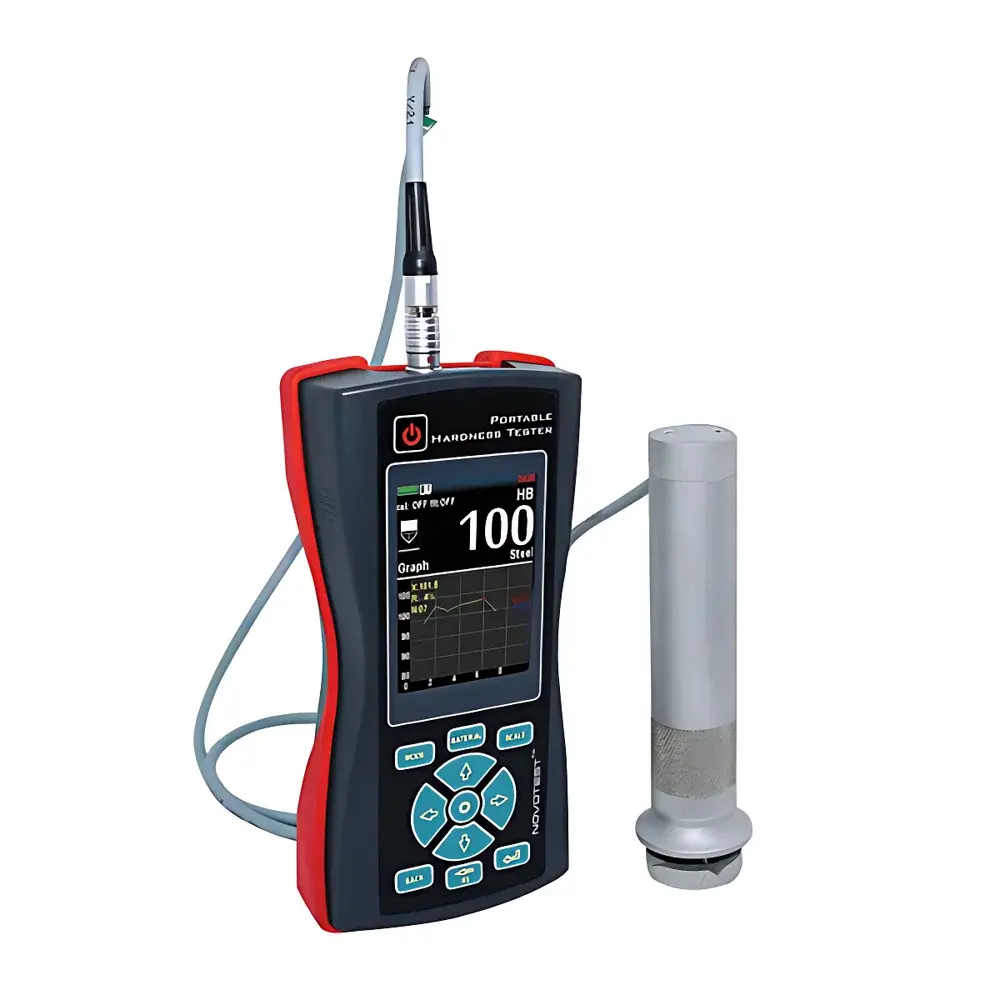
Olympus T-U3 Portable Ultrasonic Contact Impedance Hardness Tester
| Brand | Olympus |
|---|---|
| Origin | Japan |
| Model | T-U3 |
| Measurement Principle | Ultrasonic Contact Impedance (UCI) |
| Portability | Handheld, Battery-Powered |
| Compliance | ISO 17673, ASTM A1038, DIN 50159-2 |
| Hardness Scales | HV, HB, HRC, HRB (converted) |
| Indentation Load | 10 N (standard), optional 3 N / 5 N / 20 N |
| Probe Frequency | 10 MHz |
| Resolution | 1 HV |
| Repeatability | ≤ ±1.5 HV (per ISO 17673) |
| Operating Temperature | 0–40 °C |
| Battery Life | ≥ 12 hours (Li-ion, rechargeable) |
| Data Storage | Internal memory for ≥ 2,000 readings with timestamp, location tag (optional GPS), and operator ID |
Overview
The Olympus T-U3 is a handheld ultrasonic contact impedance (UCI) hardness tester engineered for high-precision, non-destructive hardness evaluation of metallic materials in field, workshop, and laboratory environments. Unlike conventional indentation methods (e.g., Vickers or Rockwell), the T-U3 operates on the physical principle of ultrasonic resonance frequency shift: a diamond-tipped probe applies a precisely controlled static load (typically 10 N) to the surface, inducing a microscopic indentation; a piezoelectric transducer simultaneously excites the probe at its natural resonant frequency (~10 MHz). The change in resonance frequency—directly correlated to the contact stiffness between indenter and material—is converted into hardness values via calibrated algorithms traceable to national metrology institutes. This method eliminates plastic deformation artifacts common in dynamic impact testers and avoids surface preparation requirements, enabling reliable measurement on as-received surfaces—including rough castings, unfinished forgings, thin-walled components, and heat-treated layers.
Key Features
- True portability: Weighing under 1.2 kg with integrated Li-ion battery supporting >12 hours of continuous operation and rapid charging via USB-C.
- Multi-scale conversion: Real-time calculation and display of HV, HB, HRC, and HRB values per ISO 17673 Annex B, with user-selectable calibration curves for steel, stainless steel, aluminum, titanium, and copper alloys.
- Adaptive probe interface: Interchangeable UCI probes (10 N standard; optional 3 N/5 N/20 N) with automatic load recognition and thermal drift compensation.
- Rugged industrial design: IP54-rated enclosure, shock-absorbing rubber overmold, and scratch-resistant sapphire window for the LCD display.
- On-device statistical analysis: Mean, standard deviation, min/max, histogram, and pass/fail threshold alerts with configurable tolerance bands.
Sample Compatibility & Compliance
The T-U3 accommodates geometrically complex and dimensionally constrained samples without fixture dependency—ideal for curved surfaces (radius ≥ 5 mm), gear teeth, turbine blades, weld seams, electroplated coatings (>50 µm thick), and sheet metal down to 0.5 mm thickness. Surface roughness up to Ra 6.3 µm is supported without polishing. All hardness measurements comply with ISO 17673 (Ultrasonic Contact Impedance Method), ASTM A1038 (Standard Test Method for Ultrasonic Hardness Testing), and DIN 50159-2 (Hardness Testing – Ultrasonic Hardness Testing). Instrument validation includes factory-certified traceability to PTB (Physikalisch-Technische Bundesanstalt) reference blocks, and full audit trails meet GLP/GMP documentation requirements when paired with Olympus’ optional PC software.
Software & Data Management
Olympus Hardness Manager (v3.2+) enables secure bidirectional data transfer via Bluetooth 5.0 or USB. Raw UCI waveforms, indentation depth estimates, temperature logs, and operator metadata are stored with SHA-256 hashing for integrity verification. Reports export in PDF/A-1b and CSV formats, embeddable in LIMS or ERP systems. For regulated environments, the software supports 21 CFR Part 11-compliant electronic signatures, role-based access control, and immutable audit trails—including all parameter changes, calibration events, and result modifications.
Applications
- Quality assurance of heat-treated components (e.g., case-hardened gears, induction-hardened shafts) directly on production lines.
- In-service inspection of aerospace structural parts where destructive sampling is prohibited.
- Verification of coating adhesion integrity and substrate hardness beneath chromium or nickel plating.
- Rapid screening of incoming raw materials (billets, bars, tubes) prior to machining.
- Research-grade hardness profiling across phase boundaries in multiphase alloys using grid-based automated scanning (with optional motorized stage).
FAQ
Does the T-U3 require surface polishing before measurement?
No. The UCI method is validated for use on as-received machined, ground, or even lightly sandblasted surfaces (Ra ≤ 6.3 µm); no polishing or etching is necessary.
Can it measure hardness on curved surfaces?
Yes—provided the radius of curvature exceeds 5 mm. The spherical probe tip automatically compensates for minor topographic deviations.
Is calibration traceable to international standards?
Yes. Each instrument ships with a calibration certificate referencing PTB-traceable hardness blocks, and annual recalibration services are available through Olympus Authorized Service Centers.
What hardness scales does it support natively?
The T-U3 calculates and displays HV (Vickers), HB (Brinell), HRC (Rockwell C), and HRB (Rockwell B) in real time, based on material-specific conversion algorithms compliant with ISO 18265.
How is measurement repeatability verified?
Per ISO 17673 Section 8.2, repeatability is assessed using ≥10 indentations on a certified reference block; the T-U3 achieves ≤ ±1.5 HV under controlled conditions (23 ± 2 °C, stable mounting).



