
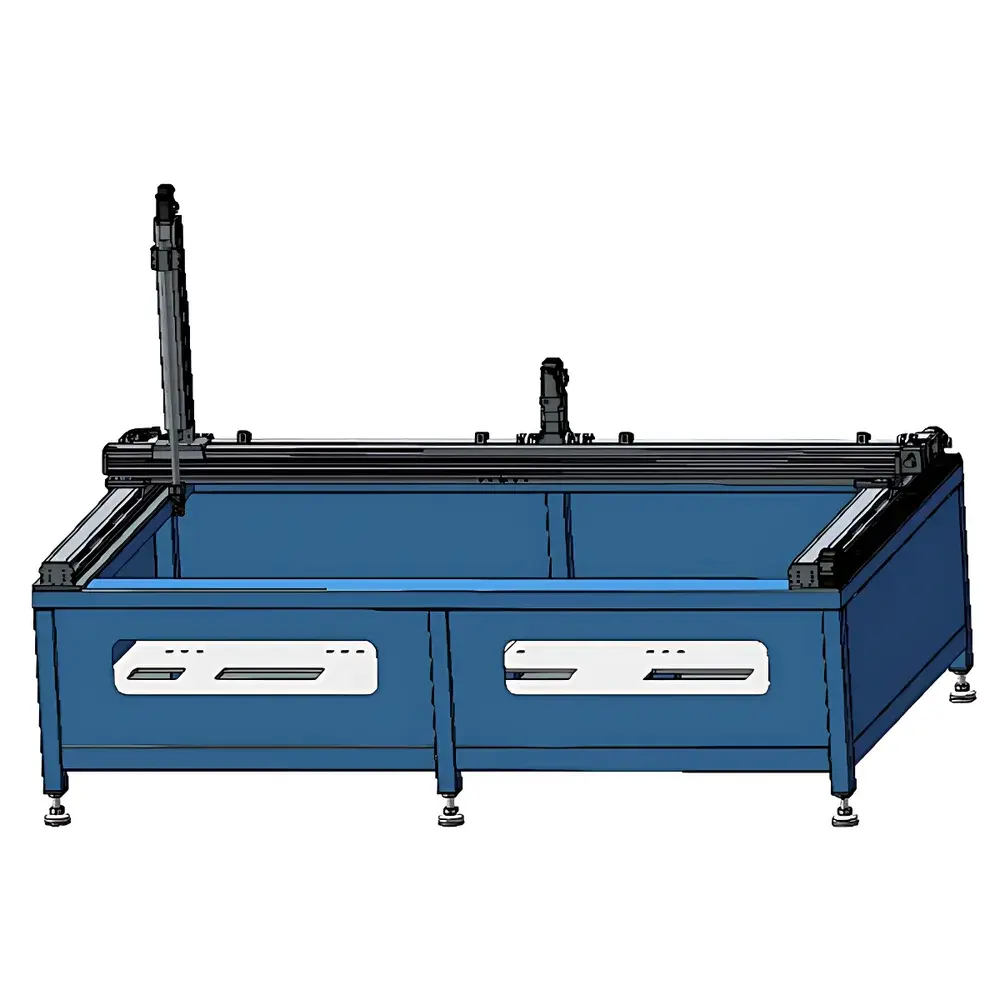
Olympus Water-Coupled Phased Array Ultrasonic Testing System
| Brand | Olympus |
|---|---|
| Origin | Shanghai, China |
| Manufacturer Type | Authorized Distributor |
| Product Origin | Domestic (China) |
| Model | Not Specified |
| Pricing | Available Upon Request |
| Application Scope | General Industrial NDT |
Overview
The Olympus Water-Coupled Phased Array Ultrasonic Testing System is an engineered solution for high-precision, automated non-destructive evaluation (NDE) of metallic and composite components in industrial quality assurance and structural integrity programs. This system operates on the principle of phased array ultrasonics (PAUT), where electronic beam steering, focusing, and scanning are achieved by applying controlled time delays across multiple piezoelectric elements within a single probe assembly. Unlike conventional single-element UT, PAUT enables dynamic control of acoustic beam parameters—such as angle, focal depth, and aperture—without mechanical repositioning. When integrated with water immersion coupling, the system eliminates variability associated with manual couplant application and ensures consistent acoustic impedance matching between transducer and test object. This configuration is particularly suited for inspecting complex geometries, curved surfaces, and large-area welds where contact-based methods suffer from coupling instability or limited coverage.
Key Features
- Water-immersion coupling architecture for stable, repeatable acoustic transmission and reduced surface interference;
- Multi-axis programmable motion system (X-Y-Z ± tilt/rotation) enabling full volumetric scanning of irregular or large-format components;
- Phased array probe support with customizable sectorial scans (S-scans), linear scans (L-scans), and depth-focused inspections;
- Integrated TOFD (Time-of-Flight Diffraction) capability for accurate sizing and characterization of planar flaws—including lack of fusion, cracks, and laminations—per ASTM E2734 and ISO 10863;
- Real-time A-scan, B-scan, C-scan, and S-scan imaging with synchronized data logging and traceable acquisition parameters;
- Ruggedized hardware platform compliant with IP54 environmental rating for shop-floor deployment;
- Support for dual-mode operation: PAUT + TOFD simultaneously or independently, facilitating multi-method verification per ASME BPVC Section V, Article 4 and EN 13588.
Sample Compatibility & Compliance
This system accommodates a broad range of industrial specimens, including but not limited to pressure vessel welds, aerospace turbine disks, railway axle forgings, and nuclear piping components. Material compatibility extends across carbon steel, stainless alloys, titanium, aluminum, and fiber-reinforced composites—provided acoustic attenuation remains within detectable limits (< 15 dB/m at 5 MHz). All inspection procedures are designed to align with international NDT standards: ISO 23278 (phased array equipment qualification), ISO 16810 (general UT principles), and ISO 16828 (TOFD methodology). The system supports audit-ready documentation required under AS9100D, ISO 9001:2015, and regulatory frameworks governing safety-critical infrastructure.
Software & Data Management
Operation is managed via Olympus’ industry-standard NDT software suite, which provides full waveform capture, post-processing analysis, and report generation with embedded metadata (operator ID, calibration timestamp, gain settings, probe ID, and scan path coordinates). Data files conform to ASTM E3177-compliant binary formats and are exportable to common engineering viewers (e.g., GageView, WinDDT, or third-party CAE platforms). Software features include automatic flaw detection thresholds, depth-gated amplitude analysis, and compliance tracking for calibration intervals per ISO/IEC 17025 requirements. Audit trails record all user actions—including parameter edits and report approvals—in accordance with FDA 21 CFR Part 11 and GLP/GMP traceability mandates.
Applications
- Automated weld inspection in pipeline girth welds and offshore structural joints;
- In-service inspection of rotating equipment components (e.g., compressor blades, pump casings);
- Manufacturing QA of thick-section castings and rolled plates in heavy machinery fabrication;
- Research-grade microstructural characterization using high-resolution sectorial scans at variable focal depths;
- Validation of additive manufacturing (AM) parts for internal porosity, lack of fusion, and layer delamination;
- Periodic in-service monitoring of aging infrastructure, including steam generator tubing and reactor pressure vessel nozzles.
FAQ
What types of probes are compatible with this system?
Standard Olympus 32- to 128-element linear or matrix phased array probes, plus dual-element TOFD transmitter/receiver pairs operating in the 2–10 MHz range.
Is calibration traceable to national standards?
Yes—system calibration follows ISO 16063-21 for ultrasonic transducers and includes annual verification against NIST-traceable reference blocks (IIW, ASME, or DAC sets).
Can the system be integrated into an existing factory automation network?
It supports Ethernet/IP, Modbus TCP, and OPC UA protocols for bidirectional communication with MES/SCADA systems and robotic handling cells.
Does it meet requirements for nuclear-grade NDT certification?
The platform complies with ASME Section XI Appendix VIII and NEI 009 guidelines when operated under qualified procedures and personnel certified to ISO 9712 Level II/III.
What is the maximum immersion tank size supported?
Configurable for custom-built tanks up to 3 m × 2 m × 1.5 m (L × W × H); standard OEM options include 1.2 m × 1.0 m × 0.8 m modular units with recirculating deionized water filtration.
Related Products



