
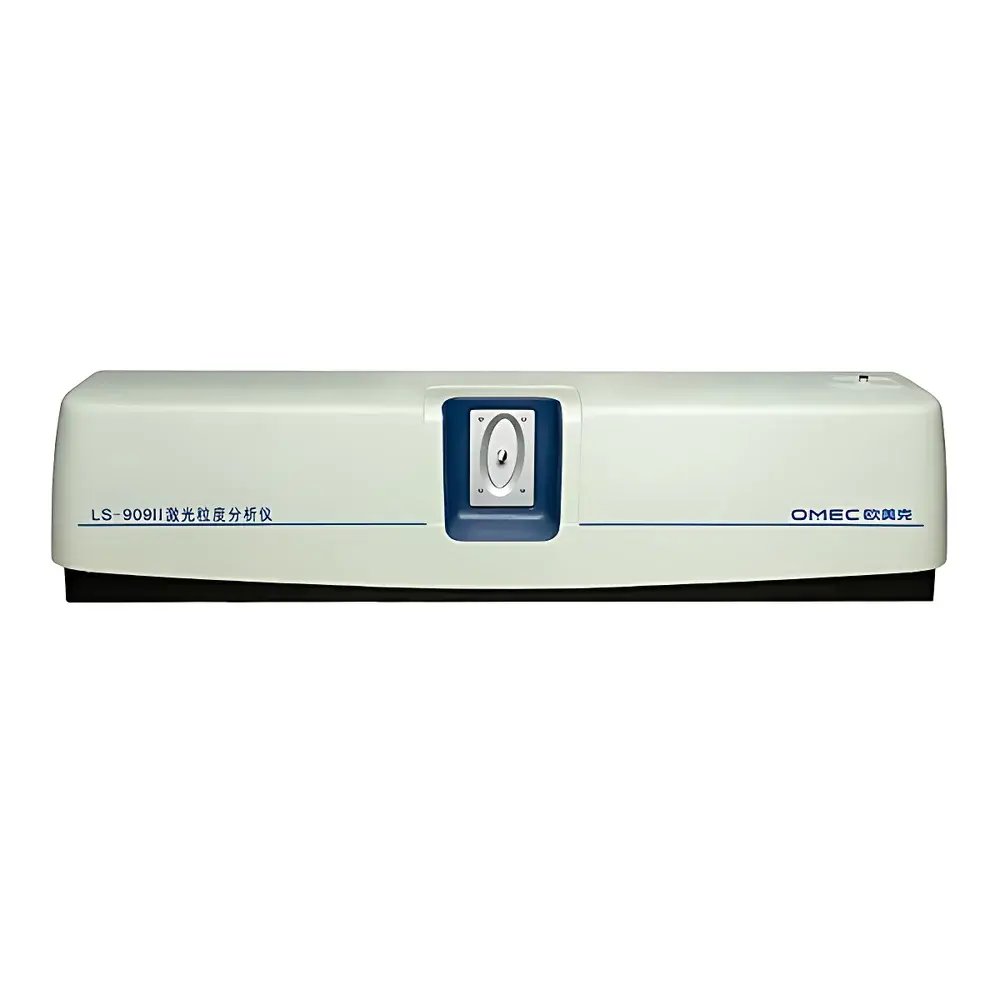
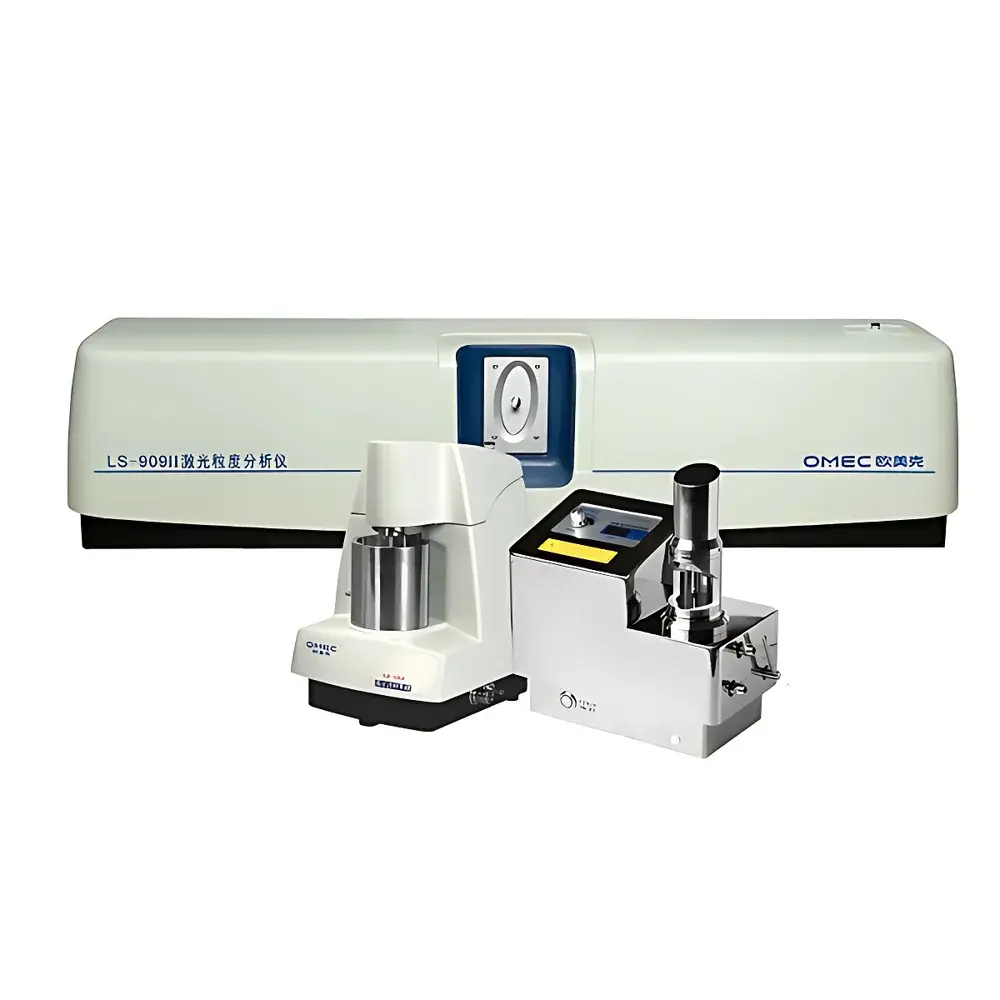
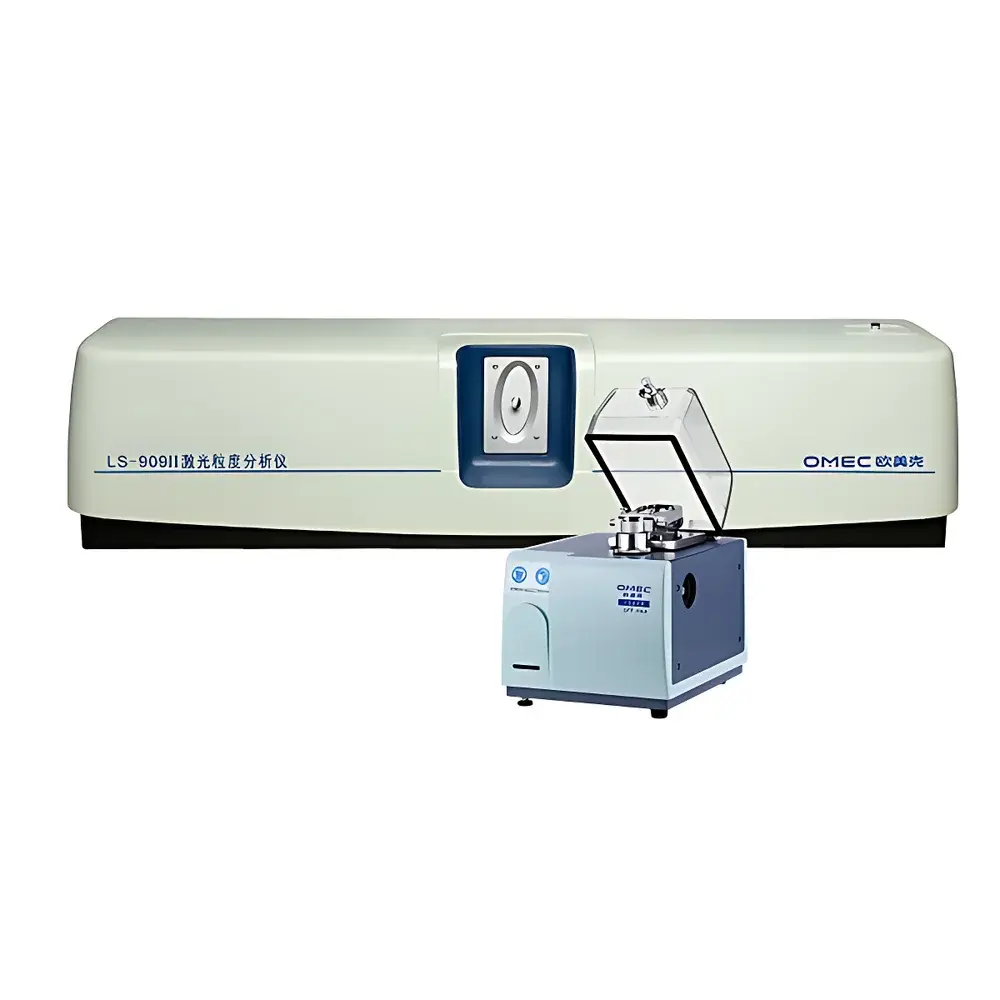
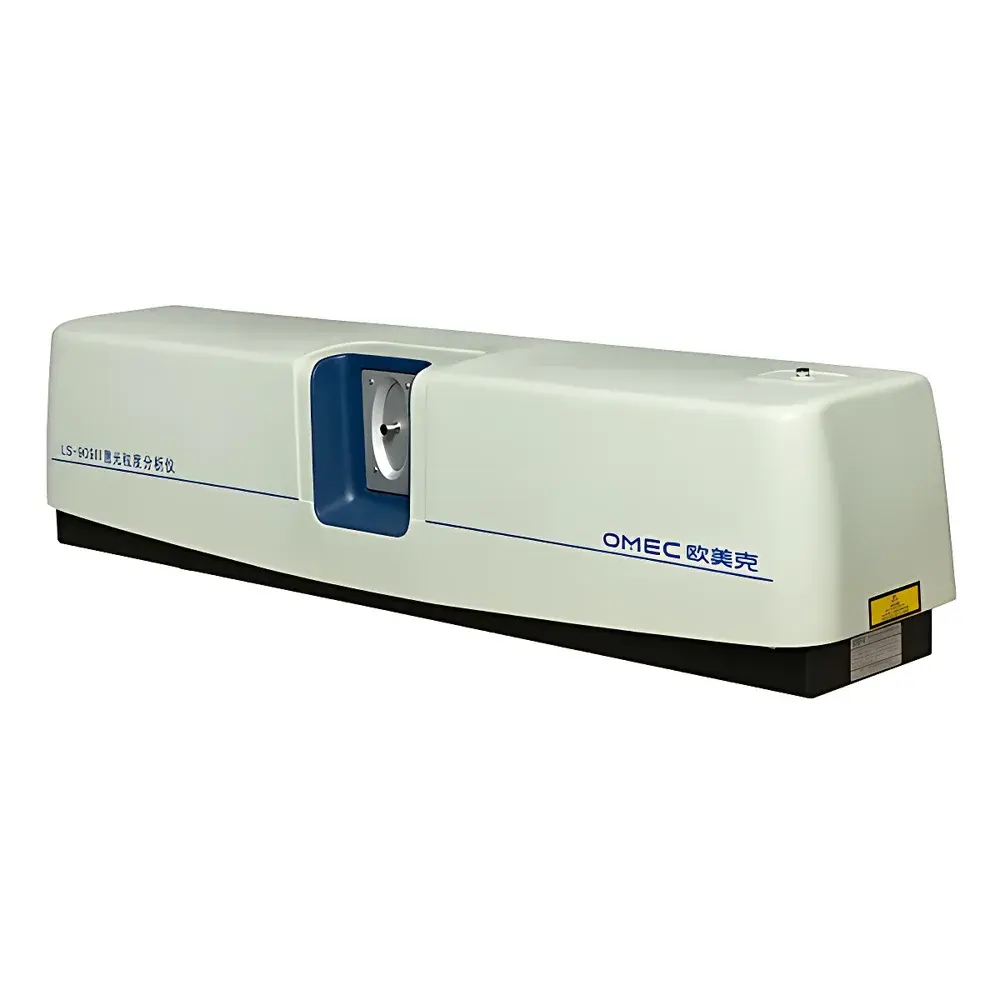
OMEC LS-909 II Dry/Wet Laser Particle Size Analyzer
| Brand | OMEC |
|---|---|
| Origin | Guangdong, China |
| Manufacturer Type | Manufacturer |
| Product Category | Domestic Instrument |
| Model | LS-909 II |
| Dispersion Method | Dry & Wet Dispersion |
| Instrument Type | Laboratory Laser Particle Size Analyzer |
| Measurement Range | 0.02–3000 μm (wet method, sample-dependent) |
| Repeatability | ≤ 0.5% (D50 deviation of certified reference material) |
| Measurement Time | 1–2 minutes per sample (including system preparation and cleaning) |
Overview
The OMEC LS-909 II Dry/Wet Laser Particle Size Analyzer is a high-performance, dual-mode laboratory instrument engineered for precision particle size distribution (PSD) analysis across an exceptionally broad dynamic range—from sub-100 nm nanoparticles to coarse particles up to 3000 μm. It operates on the physical principle of static light scattering (SLS), applying Mie scattering theory across the full measurement range and Fraunhofer diffraction theory where appropriate—enabling rigorous, first-principles-based inversion of angular light intensity distributions into volumetric PSDs. The system integrates a 560 mm focal-length Fourier lens, a high-stability imported He-Ne gas laser (632.8 nm, ≥2.0 mW, linewidth ≤0.1 nm), and a 91-channel + central zero-ring photodetector array with optimized 3D spatial coverage—including forward, side, large-angle, dual backward, and inverse-scattering detection zones. This optical architecture ensures high signal fidelity, minimal background noise, and exceptional angular resolution (down to 0.016°), supporting accurate quantification of both ultrafine and coarse fractions within polydisperse samples without optical reconfiguration.
Key Features
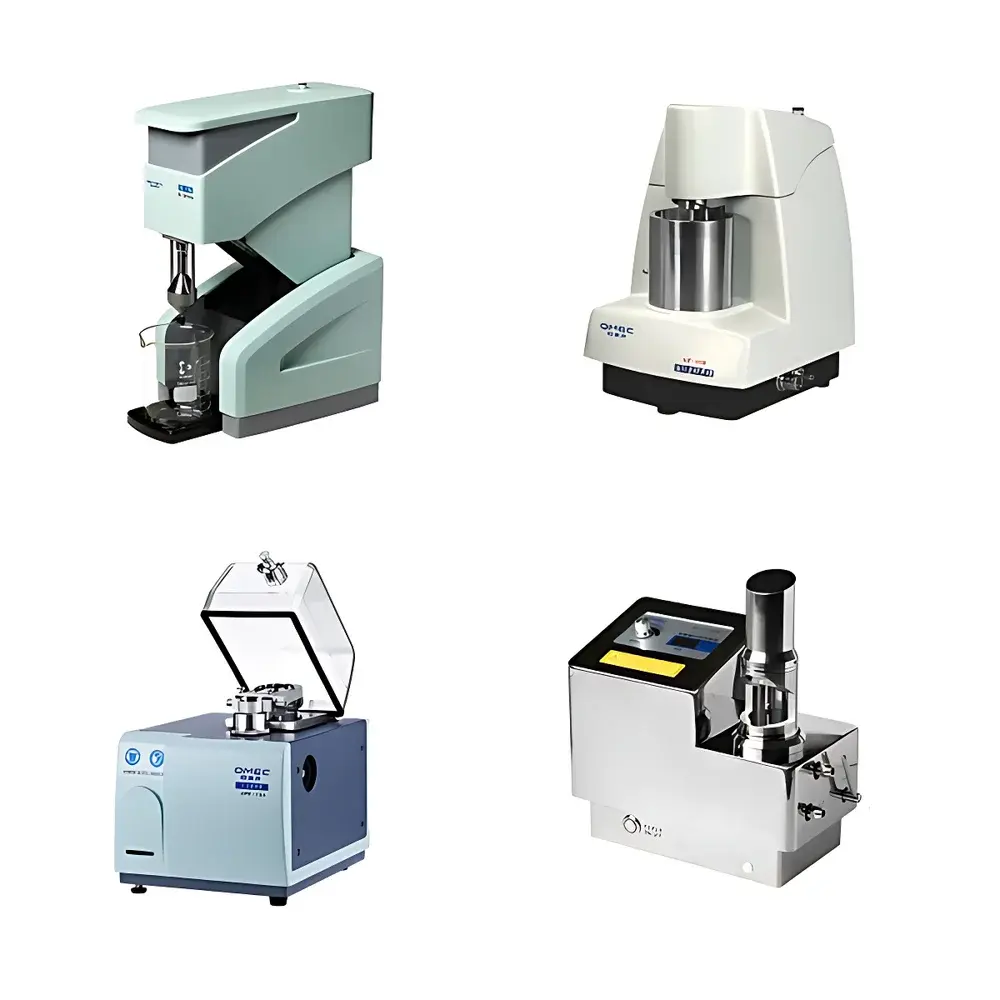
- Integrated dry/wet dual dispersion capability with simultaneous dual-port interface—enables rapid, software-controlled switching between SCF-105B wet circulation and DPF-110A dry dispersion systems
- Advanced optical platform: monolithic aluminum base, sealed enclosure, and precision-machined detector alignment fixtures—delivering long-term stability, dust/moisture resistance, and immunity to ambient stray light
- Single-lens Fourier-transform optical path with post-lens configuration—eliminates pupil limitations and captures scattered light from 0.016° to >160°, maximizing signal capture consistency and SNR
- Imported He-Ne gas laser with hermetic hard-seal packaging—ensures lifetime wavelength stability, negligible power drift, and zero calibration requirement over instrument service life
- Optimized spatial filter and integrated laser emission module—suppresses diffraction ring artifacts and stabilizes beam profile via real-time output power monitoring and smoothing
- High-sensitivity photodetector array: low-noise, large-area detectors for backward and inverse angles—extends lower detection limit to 0.02 μm (wet) and 0.1 μm (dry)
- Intelligent auto-alignment system with 0.2 μm positional accuracy—performed automatically or manually via GUI, eliminating operator-induced misalignment errors
- 18-bit parallel 8-channel ADC acquisition at 10 kHz sampling rate—coupled with electronic background compensation and ultra-low-leakage sample-and-hold circuitry
- Adaptive noise suppression algorithm—enhances matrix inversion fidelity for fine-particle signals under low-SNR conditions, improving reproducibility in sub-100 nm measurements
- Compliance-ready software architecture—supports 21 CFR Part 11, Annex 11, and GMP-compliant audit trails, role-based access control, electronic signatures, and data integrity logging
Sample Compatibility & Compliance
The LS-909 II accommodates diverse particulate materials across pharmaceuticals, advanced ceramics, battery cathode/anode powders, catalysts, pigments, cement, soils, and food-grade excipients. Its dual dispersion design supports aqueous and organic suspensions (via SCF-105B/SCF-108A/SCF-126B wet modules) as well as free-flowing, cohesive, or electrostatically charged dry powders (via DPF-110A with ceramic dispersion nozzle and pressure-controlled airflow). All wet modules feature 316L stainless-steel sample cells, ultrasonic dispersion (0–50 W, adjustable), and automated fill/drain/purge cycles. Dry modules incorporate oil-water filtration, quiet air compressors, and HEPA-rated dust extraction. The instrument conforms to ISO 13320:2020 and GB/T 19077–2024 (equivalent to ISO 13320) for laser diffraction particle sizing. Optical calibration is traceable to NIST-traceable PSL standards; no routine recalibration is required due to laser and detector stability.
Software & Data Management
OMEC’s proprietary Particle Analysis Software (v5.x) provides modular, workflow-driven operation with real-time instrument status visualization and guided SOP execution. Key capabilities include: automated background subtraction prior to each measurement; multi-model PSD inversion (Mie, Fraunhofer, user-defined complex refractive index); conversion between volume-, surface-, number-, and length-based distributions; customizable reporting with industry-specific templates (e.g., USP , ASTM C618, ISO 9276); export to PDF, Excel, Word, CSV, and XML; side-by-side graphical comparison of up to 32 datasets; statistical trend analysis by date, batch, or parameter; and comprehensive database management for optical constants (200+ preloaded materials, editable complex refractive index). The software undergoes Scrum-based iterative development to maintain regulatory alignment—fully supporting FDA 21 CFR Part 11, EU Annex 11, and PIC/S GMP requirements for electronic records and signatures.
Applications
The LS-909 II serves critical quality control and R&D functions in regulated and industrial environments. In pharmaceutical manufacturing, it verifies API particle size for dissolution performance and blend uniformity—supporting QbD initiatives and regulatory submissions. For lithium-ion battery producers, it characterizes cathode (NMC, LFP) and anode (graphite, silicon) powders to optimize slurry rheology and electrode density. In cement and mineral processing, it monitors grinding efficiency and fineness compliance against ASTM C150 and EN 196-6. Nanomaterial researchers rely on its sub-100 nm sensitivity for colloidal silica, quantum dots, and metal oxides. Its wide dynamic range also enables characterization of spray-dried granules, foundry sands, and agricultural micronutrients—without sample fractionation or method revalidation.
FAQ
What particle size ranges does the LS-909 II support under wet and dry dispersion modes?
The instrument measures 0.02–3000 μm in wet dispersion (with optimized surfactant and sonication) and 0.1–3000 μm in dry dispersion—both ranges are sample-dependent and validated using NIST-traceable standards.
Is the He-Ne laser user-replaceable, and what is its expected operational lifetime?
No—the laser is permanently sealed and requires no maintenance or replacement over the instrument’s service life (>10 years typical), eliminating downtime and calibration drift associated with semiconductor lasers.
How does the LS-909 II ensure measurement repeatability across laboratories?
Through hardware-level stability (rigid optical bench, thermal mass design), software-enforced SOPs, automatic background correction, intelligent auto-alignment, and compliance with ISO 13320 procedural validation protocols.
Can the system be integrated into a networked QC lab environment with centralized data archiving?
Yes—software supports SQL database connectivity, LDAP/Active Directory authentication, and secure HTTPS-based remote monitoring and data export for LIMS integration.
Does the instrument meet regulatory requirements for pharmaceutical process validation?
Yes—its software includes full 21 CFR Part 11 functionality (audit trail, e-signature, permission tiers), and hardware design complies with IEC 61010-1 safety standards and Class I laser classification per IEC 60825-1.
Related Products



