
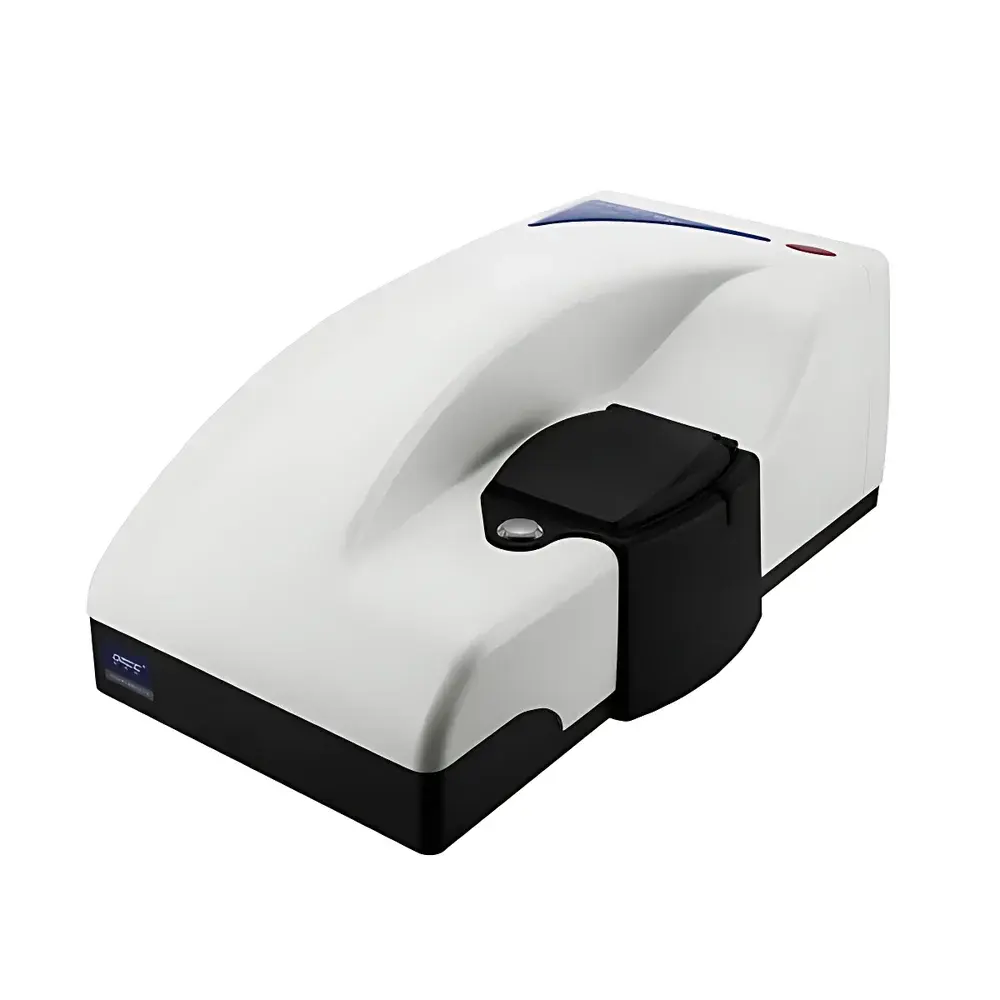
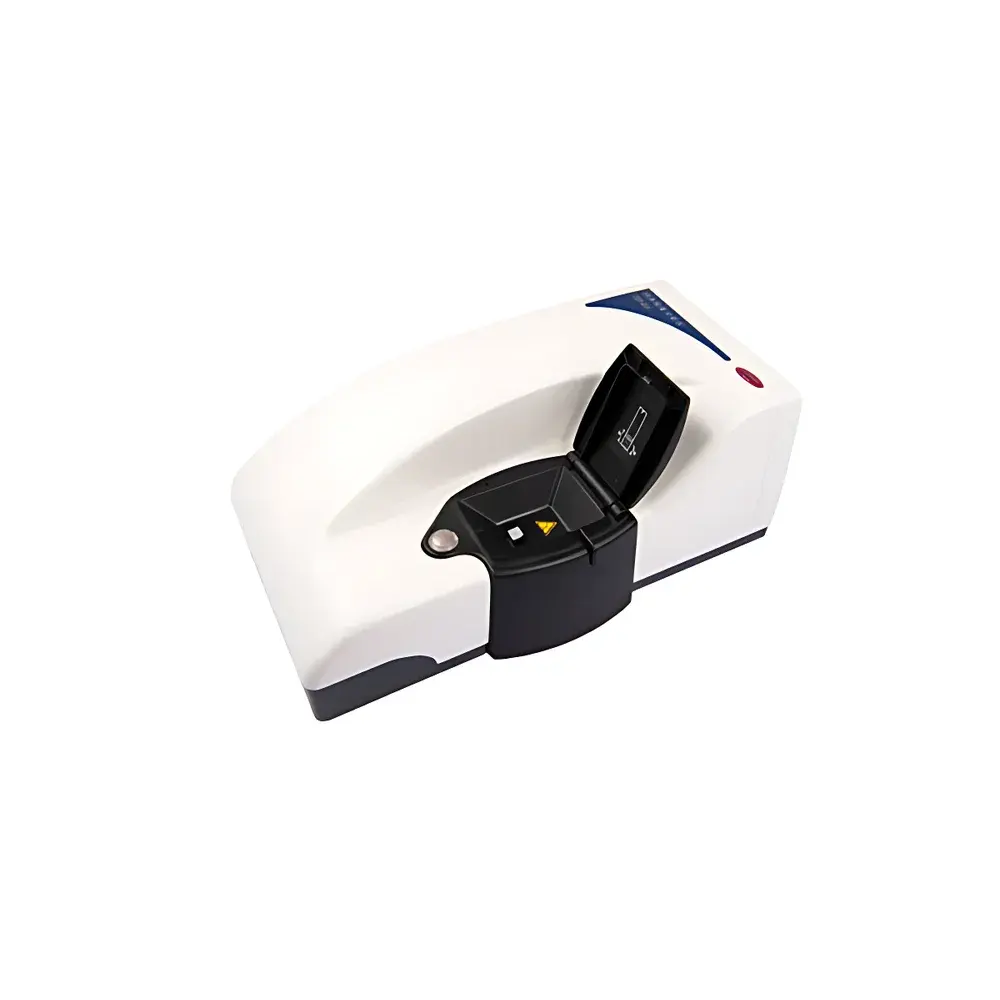
OMEC NS-90 Nanoparticle Size and Molecular Weight Analyzer
| Brand | OMEC |
|---|---|
| Origin | Guangdong, China |
| Manufacturer Type | Direct Manufacturer |
| Product Origin | Domestic (China) |
| Model | NS-90 |
| Price | Upon Request |
| Particle Size Range | 0.3 – 5000 nm |
| Size Measurement Repeatability | ≤ ±1% (NIST-traceable latex standards) |
| Temperature Control Range | 0–90°C (optional 120°C thermostatic cell) |
| Temperature Stability | ±0.1°C |
| Correlator Sampling Time | 25 ns – 8000 s |
| Number of Autocorrelation Channels | >4000 |
| Primary Measurement Principle | Dynamic Light Scattering (DLS) at 90° scattering angle |
| Secondary Measurement Principle | Static Light Scattering (SLS) |
| Sample Volume Requirement | 0.3–5000 nm (size range) |
| Zeta Potential Measurement Capability | Not integrated (ALL = N/A in this model) |
| Typical Measurement Duration | ~10 seconds per run |
| Molecular Weight Range | <1000 Da – 2×10⁷ Da |
Overview
The OMEC NS-90 Nanoparticle Size and Molecular Weight Analyzer is a dual-mode light scattering instrument engineered for precision characterization of colloidal dispersions, proteins, synthetic polymers, and nanomaterials in solution. It implements two complementary optical techniques—90° angle Dynamic Light Scattering (DLS), also known as Photon Correlation Spectroscopy (PCS), and Static Light Scattering (SLS)—within a single, thermally stabilized platform. DLS quantifies hydrodynamic diameter by analyzing temporal fluctuations in scattered laser intensity arising from Brownian motion; particle diffusion coefficients are derived from the autocorrelation function and converted to size via the Stokes–Einstein equation. SLS, in contrast, measures time-averaged scattered intensity across multiple concentrations to construct Debye plots, enabling absolute determination of weight-average molecular weight (Mw) and second virial coefficient (A2). The system operates at a fixed 633 nm He–Ne laser wavelength (4 mW nominal output; optional 532 nm solid-state laser available), with a sealed optical path, APD-based detection, and high-speed digital correlator architecture—features collectively supporting sub-nanometer resolution down to 0.3 nm and measurement repeatability ≤±1% against NIST-traceable standards.
Key Features
- Integrated dual-mode operation: Simultaneous or independent DLS and SLS measurements on one platform
- High-sensitivity avalanche photodiode (APD) detector: Delivers superior signal-to-noise ratio over conventional PMT systems, critical for low-concentration or weakly scattering samples
- Research-grade digital correlator: >4000 channels with adjustable sampling interval from 25 ns to 8000 s, enabling robust correlation analysis across broad dynamic ranges
- Thermally regulated measurement chamber: Independent Peltier-controlled circulation bath with ±0.1°C stability over 0–90°C (upgradeable to 120°C)
- Optimized optical design: Hermetically sealed beam path minimizes dust contamination and thermal drift; full-range Mie theory algorithm applied for polydisperse and non-spherical particle analysis
- Laser flexibility: Standard 633 nm He–Ne source (4 mW); optional 532 nm diode-pumped solid-state laser (50 mW) for enhanced sensitivity with UV-absorbing or highly absorbing samples
- Automated attenuation: Laser power dynamically adjusted across 300,000:1 range to prevent detector saturation without manual intervention
Sample Compatibility & Compliance
The NS-90 accommodates aqueous and organic dispersions including protein solutions, liposomes, polymeric micelles, metal colloids, pigment suspensions, and emulsions. Minimum sample concentration is ≥0.1 mg/mL for reliable DLS signal acquisition; typical volume requirement is 40–60 µL in standard quartz cuvettes. All measurements comply with ISO 22412:2017 (DLS) and ISO 13321:2022 (SLS) standards. Software supports audit trail generation and user-access controls aligned with GLP and GMP documentation requirements. While the instrument itself does not perform zeta potential analysis, its DLS-derived polydispersity index (PdI) and size distribution profiles serve as key quality indicators referenced in USP , EP 2.9.31, and ICH Q5A guidelines for biopharmaceutical formulation development and stability assessment.
Software & Data Management
OMECSizer™ software provides an intuitive, workflow-driven interface compliant with FDA 21 CFR Part 11 requirements—including electronic signatures, role-based permissions, and immutable audit logs. It supports fully automated SOP execution: users define instrument parameters, temperature ramping, number of runs, and data acceptance criteria once; subsequent analyses execute identically without operator input. Real-time quality assessment flags outliers based on correlation curve fit residuals, baseline noise, and count rate stability. Reports are customizable via drag-and-drop report designer—users embed histograms, intensity/number/volume distributions, Debye plots, and trend charts (temperature-, time-, or parameter-based). All raw correlator data, metadata, and processed results are embedded in proprietary .omec files for traceability and cross-instrument comparability. Batch processing enables statistical comparison across sample sets, with export options for CSV, PDF, and XML formats compatible with LIMS integration.
Applications
- Biopharmaceutical development: Monitoring aggregation kinetics of monoclonal antibodies, immunoglobulins, and vaccine candidates under thermal stress or pH variation
- Polymer science: Determining Mw, dispersity (Đ), and conformational behavior of synthetic and natural macromolecules in solvent screening studies
- Nanomedicine: Characterizing liposomal drug carriers, polymeric nanoparticles, and exosome preparations for size uniformity and batch-to-batch consistency
- Materials chemistry: Quantifying growth dynamics of silica sols, metal oxide colloids, and quantum dot dispersions during synthesis
- Food & cosmetic R&D: Assessing physical stability of emulsions (e.g., mayonnaise, lotions) through droplet size evolution during storage
- Quality control labs: Validating raw material specifications for pigment dispersions, toners, and ceramic slurries per internal QC protocols
FAQ
What scattering angle does the NS-90 use for DLS measurements?
The NS-90 employs a fixed 90° scattering geometry optimized for high signal-to-noise ratio in low-viscosity media and compatibility with standard cuvette formats.
Can the NS-90 measure zeta potential?
No—the NS-90 is dedicated to size and molecular weight analysis via DLS and SLS. Zeta potential requires electrophoretic light scattering (ELS), which is not implemented in this model.
Is the instrument compliant with regulatory data integrity requirements?
Yes—OMECSizer™ software includes 21 CFR Part 11-compliant features: electronic signatures, audit trails, user authentication, and data immutability controls.
What is the minimum detectable particle size?
The validated lower limit is 0.3 nm hydrodynamic diameter using NIST-traceable polystyrene latex standards under optimal conditions (clean optics, stable temperature, appropriate concentration).
Does the system support multi-angle SLS for improved molecular weight accuracy?
No—it performs single-angle (90°) SLS. For enhanced angular dependence, users should consider dedicated multi-angle light scattering (MALS) platforms.
How is temperature control achieved during long-duration measurements?
A recirculating Peltier-based thermostat maintains setpoint stability within ±0.1°C over durations exceeding 2 hours, minimizing thermal drift-induced artifacts in correlation decay profiles.



