
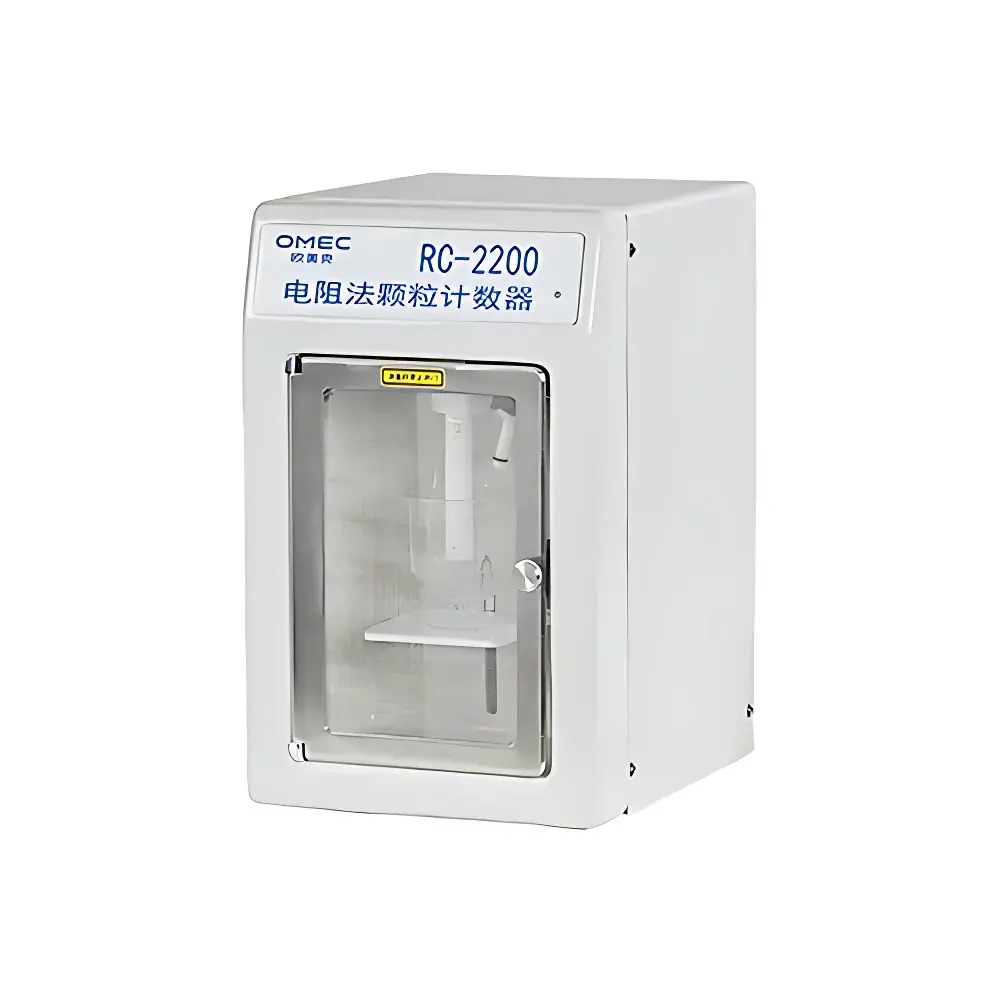
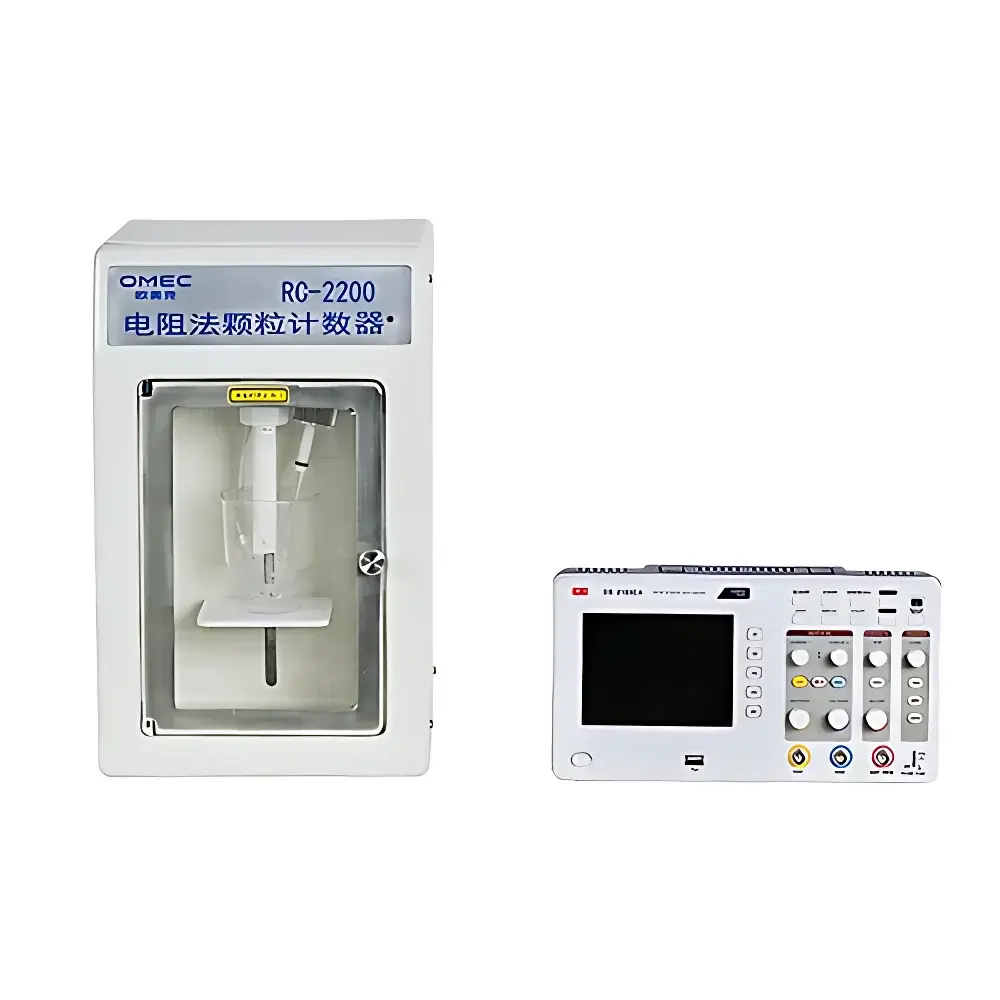
OMEC RC-2200 Coulter Principle Electrical Resistance Particle Counter
| Brand | OMEC |
|---|---|
| Origin | Guangdong, China |
| Manufacturer Type | Manufacturer |
| Product Category | Domestic |
| Model | RC-2200 |
| Instrument Type | Electrical Resistance (Coulter) Particle Counter |
| Standard Compliance | GB/T 29025–2012, ISO 13319-1:2021 |
| Measurement Principle | Aperture Impedance (Coulter Principle) |
| Dynamic Range | 0.6–256 µm (down to 0.4 µm under optimal conditions) |
| Channel Resolution | 8192 detection channels |
| Repeatability | ≤1% (D₅₀ deviation on certified reference material) |
| Pulse Latency | 5 µs |
| Signal-to-Noise Ratio | 140 dB |
| Sample Introduction | Electrolyte-diluted suspension, stir-or-static mode |
| Sampling Control Modes | Fixed time / Fixed volume / Fixed particle count |
| Test Duration | ~15 s (typical) |
| Data Output | Size distribution table & curve, D₁₀/D₅₀/D₉₀, mean diameter, standard deviation, coefficient of variation, specific surface area, total particle count, frequency histogram |
| Power Supply | 200–240 V AC, 50 Hz |
| Dimensions (W×D×H) | 300 × 370 × 450 mm |
Overview
The OMEC RC-2200 Coulter Principle Electrical Resistance Particle Counter is a high-resolution, single-particle sensing instrument engineered for precise volumetric sizing and absolute counting of dispersed particles in electrolyte media. It operates on the well-established aperture impedance principle—commonly known as the Coulter principle—in which individual particles suspended in a conductive solution traverse a micro-aperture under hydrodynamic pressure, causing transient changes in electrical resistance proportional to their displaced volume. This fundamental physical relationship enables direct, shape- and density-independent quantification of particle volume equivalent spherical diameter (VESD), with calibration traceable to NIST-traceable or ISO-certified reference standards. Designed for laboratories requiring rigorous compliance with international metrological standards—including GB/T 29025–2012 and ISO 13319-1:2021—the RC-2200 delivers robust performance across demanding industrial QC environments, particularly where narrow-distribution powders, low-concentration suspensions, or sub-micron particulates demand exceptional resolution and statistical fidelity.
Key Features
- Upgraded 140 dB signal-to-noise ratio circuit platform with enhanced common-mode rejection (CMRR), reducing system noise by >36% versus prior-generation models—critical for reliable detection and sizing of particles below 1.0 µm.
- Integrated electromagnetic shielding around electrode sensor assemblies minimizes susceptibility to ambient EMI, ensuring data integrity in shared laboratory or production-floor settings.
- 5 µs single-pulse latency architecture supports high-throughput analysis at elevated particle concentrations while preserving pulse fidelity for non-spherical or irregularly shaped particles via dual-edge triggering and full-pulse waveform capture.
- Modular aperture tube selection (30, 50, 100, 200, 280, and 400 µm nominal diameters) enables seamless coverage from 0.6 µm to 256 µm; newly engineered 30 µm tubes incorporate optimized flow dynamics to suppress bubble nucleation and improve repeatability.
- Hydraulic blockage clearance system replaces pneumatic methods—using controlled electrolyte infusion directly from the reservoir—to eliminate air entrapment near the aperture and prevent measurement interruption or artifact generation.
- Precision-machined, fixture-referenced stirring assembly ensures consistent shear history and dispersion homogeneity across instrument units and over extended maintenance cycles, improving reproducibility of outlier particle counts.
- Automated SOP-driven workflow engine supports programmable test sequences including agitation protocol, dilution factor, sampling duration, and aperture selection—reducing operator dependency and enhancing inter-laboratory comparability.
Sample Compatibility & Compliance
The RC-2200 is validated for use with electrically stable, non-agglomerating particles dispersible in aqueous electrolytes (e.g., isotonic saline). It is routinely applied to abrasive micro-powders (e.g., silicon carbide, aluminum oxide), toner formulations, pharmaceutical excipients, catalyst supports, and injection water particulate monitoring per USP . Its resistance-based detection mechanism renders it insensitive to optical properties, refractive index, or particle density—making it uniquely suitable for heterogeneous mixtures containing metallic, ceramic, polymeric, or biological particulates. All hardware and firmware comply with ISO/IEC 17025 requirements for testing laboratories, and software functionality aligns with FDA 21 CFR Part 11 expectations for audit trail, electronic signature, and data integrity when configured with optional secure user authentication and version-controlled SOP libraries.
Software & Data Management
The embedded control and analysis suite provides real-time pulse acquisition, adaptive baseline correction, and configurable thresholding algorithms for accurate event discrimination. Raw pulse data are stored in binary format with full metadata (timestamp, aperture ID, gain setting, temperature, conductivity) for retrospective reprocessing. Statistical outputs include ISO-defined distribution descriptors (D₁₀, D₅₀, D₉₀), geometric standard deviation, coefficient of variation, specific surface area (calculated via volume-surface equivalence), and cumulative/differential histograms. Customizable reporting templates support industry-specific formats—including dedicated aluminum oxide production dashboards with segmented counting per size bin—and export to CSV, Excel (.xlsx), PDF, and Word (.docx) with embedded graphs and metadata footers. Audit logs record all user actions, parameter modifications, and calibration events with timestamps and operator IDs.
Applications
- Quality control of narrow-distribution industrial abrasives and polishing compounds where D₉₀ specification limits dictate product performance.
- Quantitative assessment of residual particulates in reclaimed process water (e.g., oilfield reinjection streams) to meet API RP 14B or ISO 13319-compliant cleanliness thresholds.
- Batch release testing of electrostatic toner powders, evaluating both median size and fine-fraction (<2 µm) content that governs print quality and developer life.
- Process monitoring of Bayer-process aluminum hydroxide precipitates, leveraging automated size-bin counting to correlate crystallite morphology with calcination behavior.
- Validation of membrane filtration efficiency via pre- and post-filter particle counts in ultrapure water systems compliant with ASTM D5127 or SEMI F63.
- Research-grade characterization of colloidal dispersions, nanocellulose suspensions, and microencapsulated APIs where absolute number concentration and volumetric size distribution are required inputs for dissolution modeling.
FAQ
What particle size range can the RC-2200 reliably measure?
The RC-2200 achieves routine operation from 0.6 µm to 256 µm using appropriate aperture tubes; with optimized 30 µm tubing and calibrated electrolyte conditions, verified performance extends down to 0.4 µm for monodisperse standards.
Does the instrument require calibration with traceable reference materials?
Yes—calibration must be performed using ISO 13319-1 compliant, certified particle size standards (e.g., polystyrene latex spheres) to establish the voltage-to-diameter conversion factor; OMEC provides NIST-traceable calibration kits with documented uncertainty budgets.
How does the RC-2200 handle sample aggregation or air bubbles during analysis?
The hydraulic purge system actively removes occlusions without introducing air; combined with precision-stirred sample introduction and bubble-suppressing aperture tube geometry, it minimizes false negatives caused by transient flow disruption.
Is the software compliant with regulatory data integrity requirements?
When deployed with optional security modules, the software supports 21 CFR Part 11 compliance features including role-based access control, electronic signatures, immutable audit trails, and automated backup of raw pulse files and processed reports.
Can the RC-2200 integrate with LIMS or MES platforms?
Yes—via standardized OPC UA or TCP/IP protocols, the instrument supports structured data export (XML/JSON) of key metrics and full report packages, enabling automated ingestion into enterprise quality management systems.



