
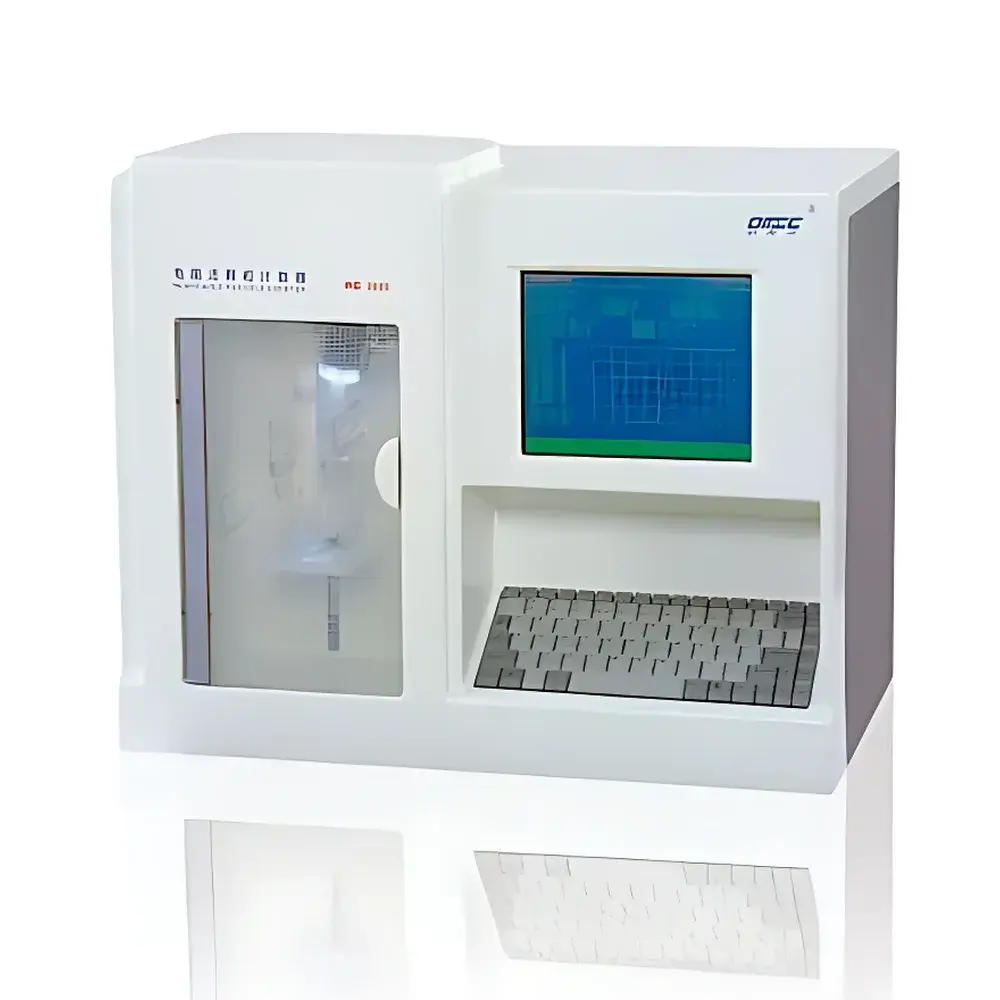
OMEC RC-3000 Coulter Principle Electrical Resistance Particle Counter
| Brand | OMEC |
|---|---|
| Origin | Guangdong, China |
| Manufacturer Type | Direct Manufacturer |
| Instrument Type | Electrical Resistance (Coulter) Particle Counter |
| Model | RC-3000 |
| Measurement Principle | Coulter principle (electrical sensing zone) |
| Particle Size Range | 1–256 µm |
| Repeatability Error | <2% |
| Analysis Time | 15 s per sample |
| Channel Resolution | 8192 channels |
| Output Parameters | Particle size distribution table & curve, D10/D50/D90, mean diameter, standard deviation, coefficient of variation, specific surface area, total particle count |
| Key Hardware | ARM-based integrated architecture, precision pulse peak detection circuitry, digital pressure sensor for vacuum control, optoelectronic liquid level sensing, automated aperture clearing system, auto-balancing conductivity compensation circuit |
Overview
The OMEC RC-3000 Coulter Principle Electrical Resistance Particle Counter is a high-resolution, single-particle sensing instrument engineered for precise quantification and sizing of suspended particles in electrolyte solutions. It operates on the well-established Coulter principle—also known as the electrical sensing zone (ESZ) method—in which particles suspended in a conductive fluid pass one-by-one through a micro-aperture separating two electrodes. Each particle displaces its own volume of electrolyte, generating a transient voltage pulse proportional to its volume. By digitizing and analyzing over 8,000 discrete pulse amplitude channels, the RC-3000 delivers statistically robust, number-based particle size distributions with exceptional resolution across a 1–256 µm range. Unlike ensemble-averaging techniques (e.g., laser diffraction), this method provides absolute particle count, true volumetric sizing, and sensitivity to trace-level populations—making it indispensable for quality control in fine powders, pharmaceutical suspensions, battery electrode slurries, and calibration standards where population heterogeneity or low-concentration outliers must be resolved.
Key Features
- ARM-based embedded architecture integrating measurement electronics, data acquisition, real-time signal processing, and GUI into a single compact unit—eliminating external PCs and reducing electromagnetic interference.
- High-fidelity pulse peak detection circuitry enabling full utilization of 8192-channel resolution, ensuring accurate binning of sub-micron to coarse particle events without interpolation or smoothing artifacts.
- Digital pressure sensing system replacing legacy mercury manometers—delivering ±0.1 kPa vacuum control accuracy during aspiration, critical for maintaining consistent hydrodynamic flow and minimizing aperture clogging.
- Optoelectronic liquid level monitoring for precise electrolyte volume tracking, supporting automatic dilution factor correction and traceable volumetric reporting per ISO 13322-1.
- Intelligent aperture clearance protocol: real-time impedance monitoring triggers brief reverse-pressure pulses upon initial resistance rise—reducing manual intervention and improving uptime in routine QC labs.
- Auto-balancing conductivity compensation: adaptive baseline adjustment minimizes sensitivity to electrolyte conductivity drift (e.g., due to temperature or salt concentration changes), enhancing measurement stability across multi-shift operations.
Sample Compatibility & Compliance
The RC-3000 is validated for use with non-agglomerating, electrically non-conductive, or semi-conductive particles dispersed in aqueous or low-conductivity organic electrolytes (e.g., ammonium nitrate, sodium chloride, or isotonic sucrose solutions). Compatible sample matrices include toner powders, silicon carbide abrasives, ceramic precursors, catalyst supports, and micronized APIs. The instrument meets core requirements of ASTM F2149–22 (Standard Test Method for Determining Particle Size Distribution of Micronized Powders Using the Electrical Sensing Zone Technique) and aligns with ISO 13322-1:2020 for resistive pulse sensing. Its firmware supports audit-trail-enabled operation compliant with FDA 21 CFR Part 11 when deployed with validated networked software modules—suitable for GLP/GMP-regulated environments requiring electronic record integrity and user access control.
Software & Data Management
The RC-3000 runs OMEC’s proprietary ParticleSight™ v4.x analysis suite, providing raw pulse waveform visualization, interactive channel gating, batch statistical comparison (t-test, ANOVA), and export-ready reports in CSV, PDF, and XML formats. All data files embed metadata including operator ID, timestamp, aperture ID, electrolyte conductivity, temperature, and vacuum setpoint—enabling full traceability. The software supports IQ/OQ documentation templates and integrates with LIMS via HL7 or RESTful API endpoints. Raw pulse archives are stored in HDF5 format for long-term reproducibility and third-party reanalysis—ensuring compliance with ALCOA+ data integrity principles.
Applications
- Quality assurance of narrow-distribution grinding products (e.g., Al₂O₃ polishing slurries, diamond microabrasives) where D90–D10 span <15% is required.
- Counting and sizing rare-event particles in cell culture media or viral vector suspensions—leveraging number-weighted statistics unavailable in intensity-based methods.
- Verification of filter integrity and pore size distribution using challenge particles in pharmaceutical manufacturing.
- Characterization of electrochemical active materials (e.g., LiFePO₄, graphite anodes) prior to slurry formulation—correlating particle count distribution with electrode coating uniformity.
- Reference material certification per ISO Guide 35, serving as a primary method for NIST-traceable particle size standards.
FAQ
What particle types are incompatible with the RC-3000?
Particles that are highly conductive (e.g., metals without insulating coatings), strongly aggregating in electrolyte, or prone to surface adsorption on the aperture membrane (e.g., certain proteins or surfactant-stabilized emulsions) may yield inaccurate counts or frequent blockages.
Can the RC-3000 measure particles below 1 µm?
No—the lower detection limit is defined by aperture geometry and electronic noise floor; 1 µm represents the validated lower bound per ASTM F2149–22 for standard 50-µm apertures. Submicron analysis requires specialized sub-10-µm apertures and enhanced signal-to-noise conditioning.
Is calibration traceable to national standards?
Yes—aperture diameter verification uses NIST-traceable microsphere standards (e.g., Duke Scientific 6.00 ± 0.03 µm polystyrene), and pulse amplitude calibration is performed against certified voltage step generators per IEC 61000-4-5.
Does the system support 21 CFR Part 11 compliance out-of-the-box?
The base hardware and firmware support audit trails, electronic signatures, and role-based access control; however, full Part 11 validation requires site-specific IQ/OQ protocols and configuration-controlled software deployment managed by the end-user’s QA team.
How often does the aperture require cleaning or replacement?
Under typical usage (≤50 samples/day), apertures last 3–6 months; automated clearing extends service life. Cleaning follows ASTM F2149 Annex A3 procedures using ultrasonic baths and certified aperture cleaners—no disassembly required.



