
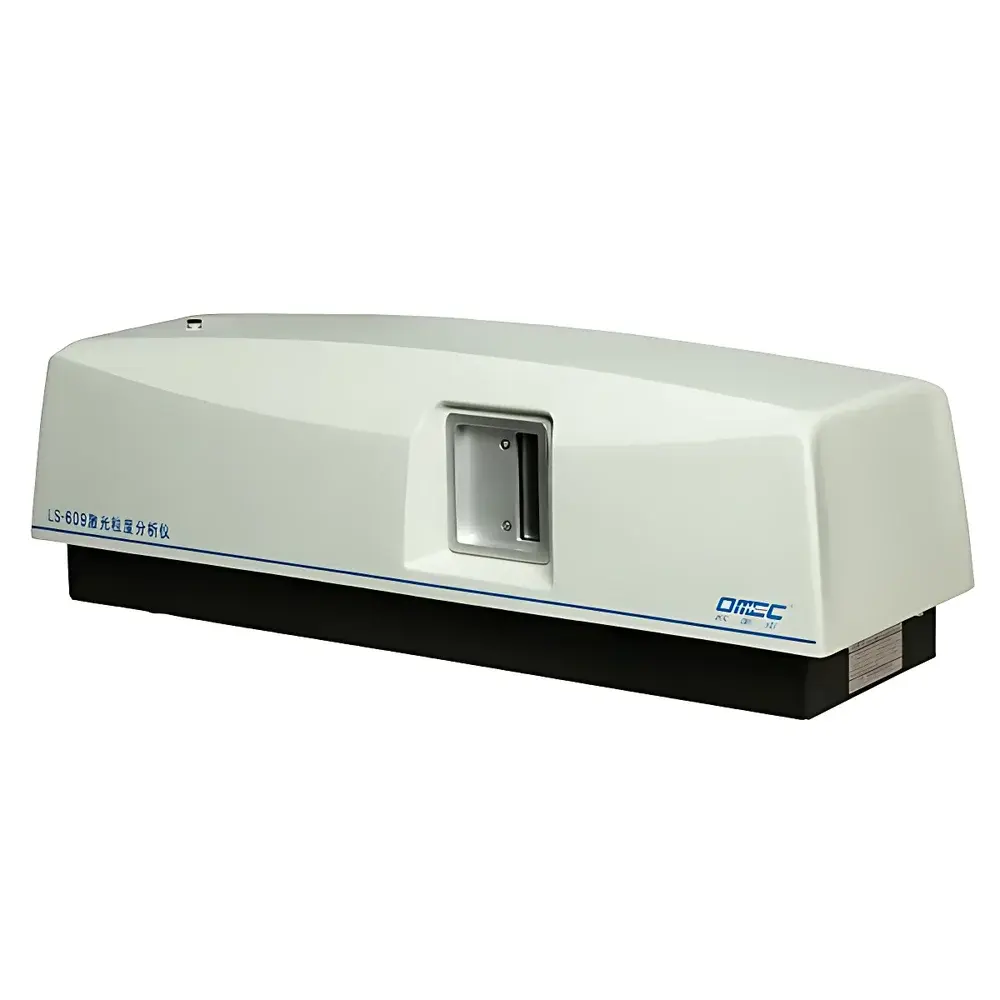
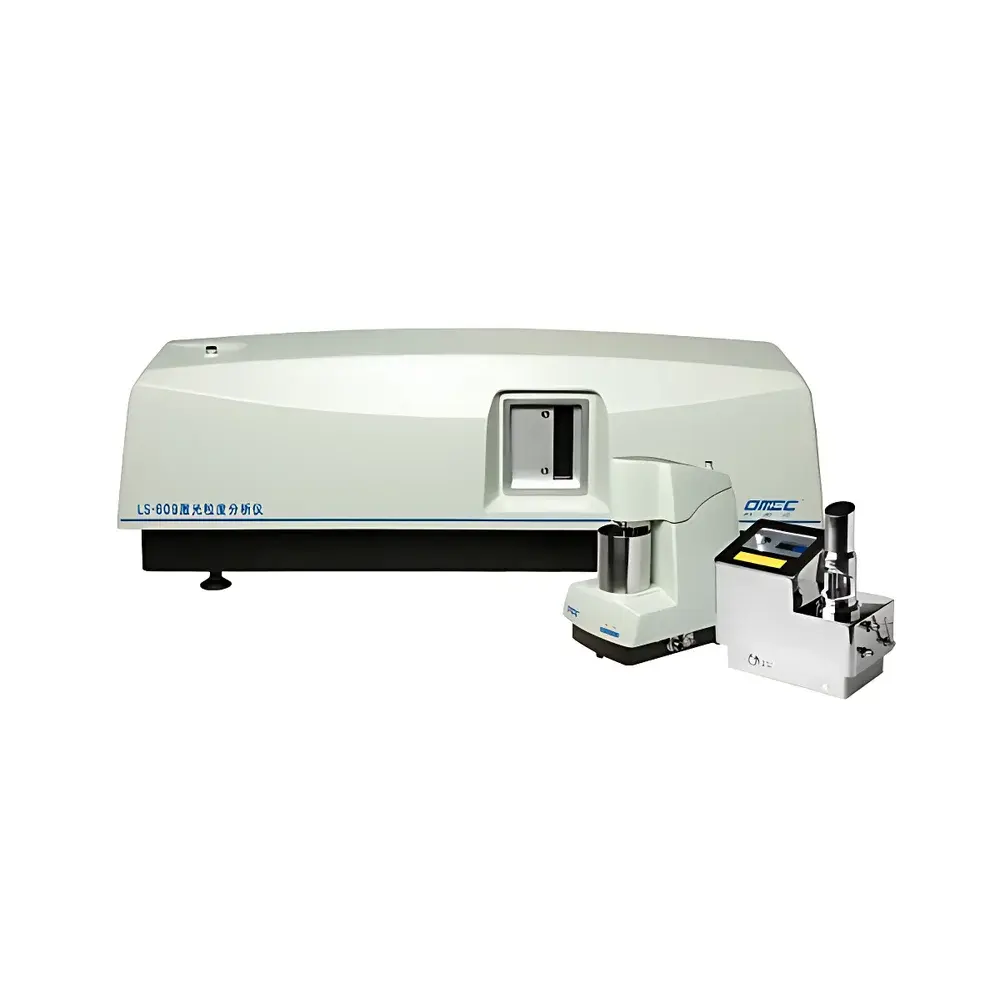
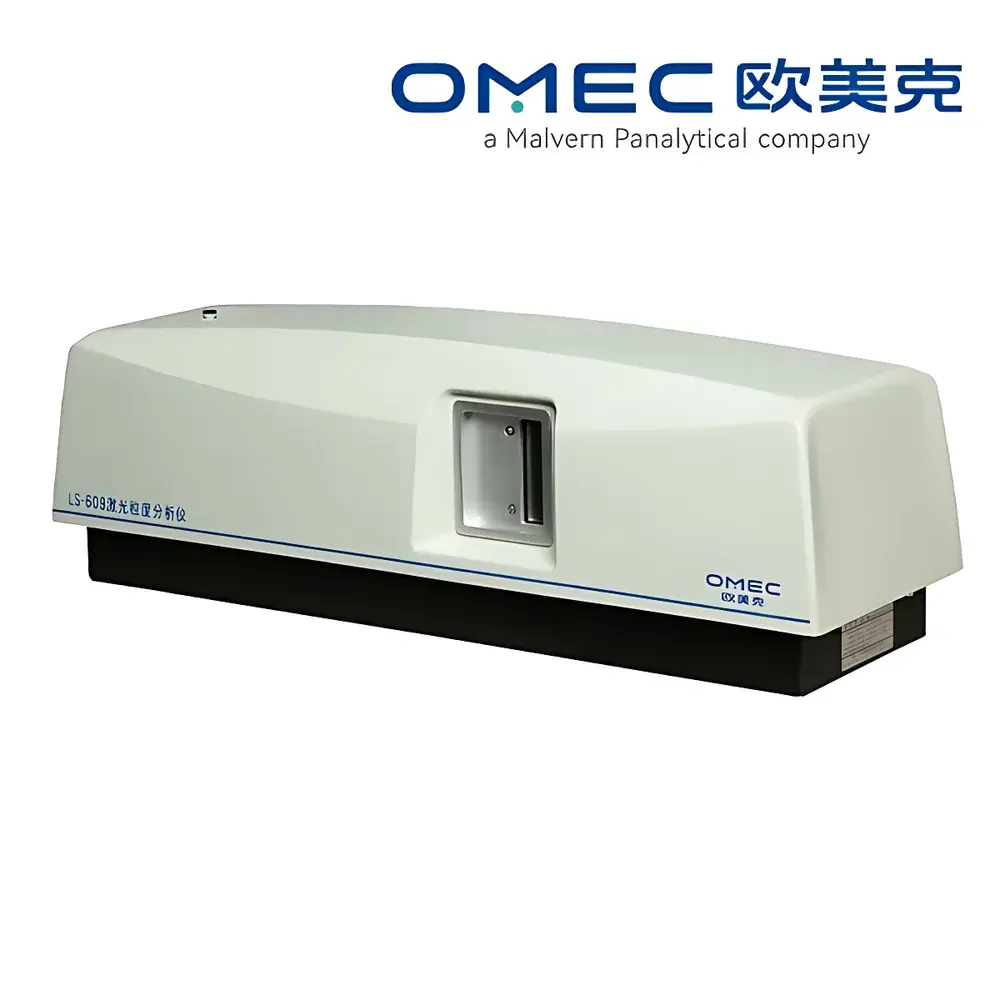
OMECC LS-609 Laser Particle Size Analyzer
| Brand | OMECC |
|---|---|
| Origin | Guangdong, China |
| Manufacturer Type | Manufacturer |
| Product Category | Domestic |
| Model | LS-609 |
| Pricing | Upon Request |
| Dispersion Method | Wet Dispersion |
| Instrument Type | Laboratory Laser Particle Size Analyzer |
| Measurement Range | 0.1–1000 µm |
| Repeatability | <1% (D50 deviation of certified reference material) |
| Measurement Time | 1–2 minutes |
| Light Source | Imported He-Ne laser, λ = 632.8 nm, output power >2.0 mW |
| Detection Channels | 49 independent photodetectors |
| Scanning Frequency | 1 kHz |
| Alignment Accuracy | ±0.5 µm (intelligent auto-alignment) |
| Environmental Operating Conditions | 5–35 °C, RH <85% |
| Data Output | Particle size distribution table & curve, D10/D50/D90, specific surface area, span, etc. |
| Dimensions (L×W×H) | 838×265×295 mm (main unit) |
Overview
The OMECC LS-609 Laser Particle Size Analyzer is a fully automated, high-precision laboratory instrument engineered for reliable and reproducible particle size distribution (PSD) analysis of solid powders and liquid dispersions. It operates on the principle of Mie scattering theory across the full measurement range, enabling rigorous quantification of scattered light intensity as a function of scattering angle. When a collimated He-Ne laser beam (632.8 nm) interacts with particles suspended in a dispersion medium, angularly resolved scattering patterns are generated—where smaller particles produce wider-angle scattering and larger particles scatter predominantly at narrower angles. These patterns are captured by a 49-channel photodetector array, including forward, side, and extended backward detection zones enabled by a Fourier-transform optical design with rear auxiliary detectors. The system’s horizontal straight-line optical path eliminates reflective prisms, ensuring long-term mechanical and optical stability under routine laboratory conditions. Designed for compliance with ISO 13320:2020 (Particle size analysis — Laser diffraction methods), the LS-609 delivers traceable, standards-aligned results suitable for QC, R&D, and regulatory documentation workflows.
Key Features
- Stable He-Ne laser source (>2.0 mW, 632.8 nm) with integrated power stability monitoring and thermal deformation compensation to minimize drift during extended operation.
- Patented spherical-focusing detector geometry: symmetrical fan-shaped main detector + arc-distributed side detectors aligned on the focal plane, maximizing signal capture efficiency for both submicron and coarse particles.
- Intelligent auto-alignment mechanism with ±0.5 µm precision and real-time software validation—eliminating manual alignment errors and reducing operator dependency.
- Sealed, dust- and light-proof optical enclosure compliant with GB/T 4857.18 for transport shock resistance; laser module potted with protective resin for enhanced moisture resistance and electrical reliability.
- Modular hardware architecture facilitating field serviceability—optical components, pump modules, and fluidic manifolds are independently replaceable without system recalibration.
- Low-noise signal acquisition using 8-channel simultaneous-sampling 16-bit ADCs and 64-channel parallel sampling circuitry, achieving full-scale accuracy of ±0.15% and EMI/ESD immunity per IEC 61000-4-2/-4 and EN 61326-1:2006.
Sample Compatibility & Compliance
The LS-609 supports wet dispersion of a broad spectrum of materials—including pharmaceutical actives, catalysts, pigments, ceramics, battery electrode slurries, and polymer emulsions—using its SCF-105B fully integrated circulation system. The 500 mL sample chamber, 2.5 L/min flow rate, and 0–4000 rpm adjustable centrifugal pump (Swiss DC motor, belt-driven) ensure homogeneous suspension and minimal particle settling. Built-in 50 W ultrasonic probe enables programmable amplitude and duration control for effective deagglomeration. Optical parameter database includes refractive index values for over 200 common materials (real and imaginary components), supporting accurate Mie-based inversion. The system meets ISO 13320 requirements for instrument validation and is compatible with GLP/GMP environments when configured with audit-trail-enabled software logging (optional). All electronic subsystems comply with CE marking directives for electromagnetic compatibility and safety.
Software & Data Management
OMECC’s proprietary LS-609 Control & Analysis Software provides SOP-driven workflow management, multi-language UI (English/Chinese), and configurable reporting templates aligned with industry-specific needs (e.g., USP , ASTM E799, or internal QA protocols). Real-time monitoring of pump speed, ultrasonication parameters, degassing status, and fluid level ensures process transparency. Data processing includes three inversion models (General, Enhanced General, Unimodal), dual cumulative distribution modes (ascending/descending), and statistical comparison tools for batch-to-batch or inter-instrument evaluation. Export formats include PDF, Excel (.xlsx), Word (.docx), and plain-text CSV—with direct right-click image export for publication-ready graphics. Firmware updates and configuration files are deployed in-field via USB or network interface without requiring factory service intervention.
Applications
The LS-609 is routinely deployed in quality control laboratories for raw material verification (e.g., TiO₂ pigment grading, lactose excipient characterization), formulation development (e.g., nanoparticle drug delivery systems), and manufacturing release testing (e.g., lithium cobalt oxide cathode powders). Its 0.1 µm lower detection limit—enabled by extended backward scattering detection—supports nanomaterial assessment in compliance with ISO/TS 80004 definitions. In academic research, it serves for colloidal stability studies, crystallization kinetics monitoring, and milling process optimization. The instrument’s repeatability (<1% D50 CV on NIST-traceable latex standards) and robustness across varying environmental conditions (5–35 °C, ≤85% RH) make it suitable for both centralized core facilities and decentralized production labs.
FAQ
What scattering theory does the LS-609 employ for data inversion?
It uses full-range Mie scattering theory, with user-adjustable complex refractive index inputs (real and imaginary parts) to optimize accuracy for absorbing or anisotropic particles.
Is the instrument compliant with FDA 21 CFR Part 11 requirements?
Out-of-the-box functionality supports ALCOA+ data integrity principles; Part 11 compliance can be achieved through optional validated software configuration with electronic signatures, audit trails, and role-based access control.
Can the LS-609 measure dry powders directly?
No—it is configured exclusively for wet dispersion analysis. Dry powder measurement requires optional pneumatic dispersion accessories not included in the standard LS-609 package.
How often does the optical system require maintenance or recalibration?
Under normal use and proper cleaning protocols, annual verification against NIST-traceable standards is recommended; no routine recalibration is needed due to the stable monolithic optical platform and auto-alignment system.
Does the software support automated report generation for regulatory submissions?
Yes—customizable templates support inclusion of instrument ID, operator name, date/time stamps, environmental logs, and statistical summaries required for regulatory dossiers (e.g., CMC sections in IND/NDA filings).



