
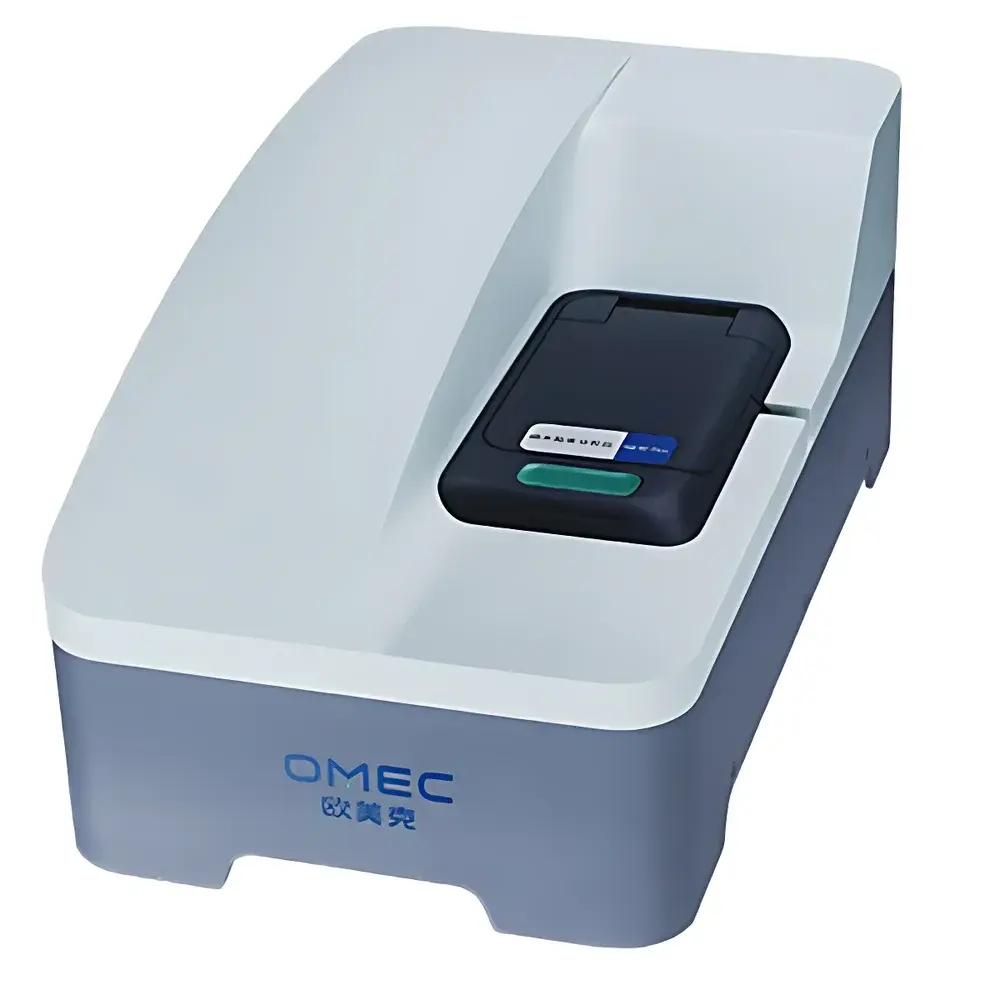
OMECK NS-90 Plus Nanoparticle Size & Molecular Weight Analyzer
| Brand | OMECK |
|---|---|
| Origin | Guangdong, China |
| Manufacturer Type | Original Equipment Manufacturer (OEM) |
| Model | NS-90 Plus |
| Particle Size Range | 0.3 nm – 10 µm |
| Size Measurement Repeatability | ≤ 1% (NIST-traceable latex standards) |
| Temperature Control Range | 0 – 120 °C |
| Temperature Stability | ±0.1 °C |
| Detection Angle | 90° |
| Measurement Principle | Dynamic Light Scattering (DLS) and Static Light Scattering (SLS) |
| Minimum Sample Volume | 20 µL |
| Sample Concentration Range | ≤ 1 mg/mL (sample-dependent) |
| Measurement Time (per sub-run) | 1.68 s |
| Molecular Weight Range (DLS-derived) | 980 – 2×10⁷ Da |
| Molecular Weight Range (SLS Debye plot) | 342 – 2×10⁷ Da |
| Laser Source | He-Ne gas laser, 632.8 nm, 4 mW |
| Detector | Avalanche Photodiode (APD), QE ≥ 80% @ 632.8 nm |
| Correlator | >4000 channels, 10¹¹ linear dynamic range, minimum sampling interval: 25 ns |
| Compliance | CFDA GMP Annex on Computerized Systems (audit trail, role-based access control, electronic signature) |
Overview
The OMECK NS-90 Plus Nanoparticle Size & Molecular Weight Analyzer is a dual-mode benchtop instrument engineered for precision characterization of nanoscale colloids, proteins, polymers, and complex dispersions. It integrates two complementary light scattering techniques—Dynamic Light Scattering (DLS) and Static Light Scattering (SLS)—within a single, compact optical platform. DLS measures hydrodynamic diameter by analyzing temporal fluctuations in scattered light intensity arising from Brownian motion; particle diffusion coefficients are derived from the autocorrelation function, then converted to size via the Stokes–Einstein equation. SLS, implemented using the Debye plot method, determines weight-average molecular weight (Mw) by quantifying angular- and concentration-independent Rayleigh scattering intensity across dilution series. The system operates at a fixed 90° detection angle, optimized for high signal-to-noise ratio and minimal multiple-scattering artifacts in moderately concentrated samples. Its design reflects technology transfer and iterative refinement from Malvern Panalytical’s legacy nanoparticle characterization architecture, adapted for robustness, regulatory readiness, and broad applicability across R&D, QC, and manufacturing environments.
Key Features
- High-fidelity optical architecture: Sealed fiber-coupled beam path minimizes stray light and environmental contamination; eliminates routine optical alignment or recalibration.
- Stable He-Ne gas laser (632.8 nm, 4 mW): Offers superior coherence length, spectral purity, and long-term power stability (>10-year tube lifetime) compared to solid-state alternatives—critical for reproducible correlation decay analysis.
- Avalanche photodiode (APD) detector with quantum efficiency ≥80% at 632.8 nm: Delivers higher sensitivity and lower dark noise than PMT-based systems, enabling reliable detection of weak scattering signals from dilute or low-refractive-index samples.
- Research-grade digital correlator: >4000 hardware channels, 10¹¹ linear dynamic range, and 25 ns minimum sampling interval support rapid, high-resolution correlation analysis—even for polydisperse or aggregation-prone systems.
- Peltier-based temperature control: Precise regulation from 0 to 120 °C with ±0.1 °C stability ensures thermal equilibrium during kinetic studies, temperature ramping, or viscosity-dependent sizing.
- Adaptive laser attenuation: Automatic intensity adjustment over a 330,000:1 dynamic range prevents detector saturation across diverse sample opacities without manual intervention.
Sample Compatibility & Compliance
The NS-90 Plus accommodates aqueous and organic dispersions—including proteins, liposomes, polymer nanoparticles, electrode slurries, pigment suspensions, and pharmaceutical colloids—using interchangeable cuvettes: standard 12 mm polystyrene (DTS0012), borosilicate glass (PCS8501), or micro-capillary cells (ZSU1002, 3 µL minimum volume). Sample volume requirements range from 20 µL (standard mode) to 3 µL (capillary mode), supporting precious or low-yield formulations. The instrument meets key regulatory expectations for analytical instrumentation used in GMP-regulated environments: full audit trail logging, role-based user permissions (administrator, operator, reviewer), electronic signatures compliant with CFDA GMP Annex on Computerized Systems, and 21 CFR Part 11–ready configuration options. All software modules support GLP/GMP-aligned data integrity principles—including immutable raw data storage, metadata tagging, and version-controlled SOP execution.
Software & Data Management
Powered by a modern, modular software suite developed under Scrum methodology, the NS-90 Plus provides intuitive workflow management without compromising analytical depth. Standardized Operating Procedures (SOPs) enforce consistent parameter selection, hardware configuration, and reporting templates—reducing inter-operator variability. The system automatically recommends optimal measurement settings (e.g., count rate, acquisition time, number of sub-runs) based on real-time signal quality assessment. Post-acquisition, an embedded “Data Quality Advisor” module evaluates correlation curve fit residuals, baseline stability, and polydispersity index (PdI) plausibility, then delivers actionable guidance—such as dilution recommendations, temperature adjustment, or alternative analysis models (e.g., non-negative least squares vs. CONTIN). Reports are fully customizable: users select parameters (Z-average, PdI, modal diameters, volume/number distributions calculated via Mie theory), charts (intensity-weighted, volume-weighted, cumulative), and statistical summaries. All results—including raw correlator data, instrument logs, and environmental metadata—are embedded in self-contained .omd files for traceability and reprocessing.
Applications
- Colloid and emulsion stability assessment via time-resolved DLS monitoring of size growth or aggregation onset.
- Liposome and extracellular vesicle characterization for drug delivery formulation development.
- Protein monomer–aggregate equilibrium analysis under varying pH, ionic strength, or excipient conditions.
- Molecular weight determination of synthetic polymers and biologics using SLS Debye plots—validated against SEC-MALS reference methods.
- Electrode slurry dispersion quality control in battery manufacturing, correlating particle size distribution with coating uniformity and electrochemical performance.
- Nanopigment and inkjet ink rheo-optical optimization, where colloidal stability directly impacts jetting reliability and print fidelity.
- Regulatory submission support: generation of compliant particle size distribution reports aligned with ICH Q5A(R2), USP , and ISO 22412 standards.
FAQ
What scattering angle does the NS-90 Plus use, and why is it fixed at 90°?
The NS-90 Plus employs a fixed 90° detection geometry, which balances signal intensity, reduced multiple-scattering contributions, and compatibility with standard cuvette formats—making it ideal for routine QC and comparative studies across laboratories using legacy 90° instruments.
Can the NS-90 Plus measure zeta potential?
No—zeta potential measurement is not included in the base configuration. However, electrophoretic light scattering (ELS) functionality can be added as a factory-installed upgrade module upon request.
How does the instrument handle highly concentrated or turbid samples?
The system uses adaptive laser attenuation and high-dynamic-range correlation processing to accommodate samples up to 40% w/v (depending on refractive index contrast); for opaque systems, micro-capillary cells reduce path length and mitigate multiple scattering.
Is Mie theory applied during size distribution calculation?
Yes—the software applies full-range Mie theory for both volume and number distributions, allowing accurate modeling across the entire 0.3 nm–10 µm range when particle refractive index and dispersant viscosity are specified.
Does the software support automated pass/fail criteria for release testing?
Yes—users can define configurable acceptance thresholds for Z-average, PdI, or peak width; the system flags out-of-spec results during SOP-driven runs and logs deviations in the audit trail.



