
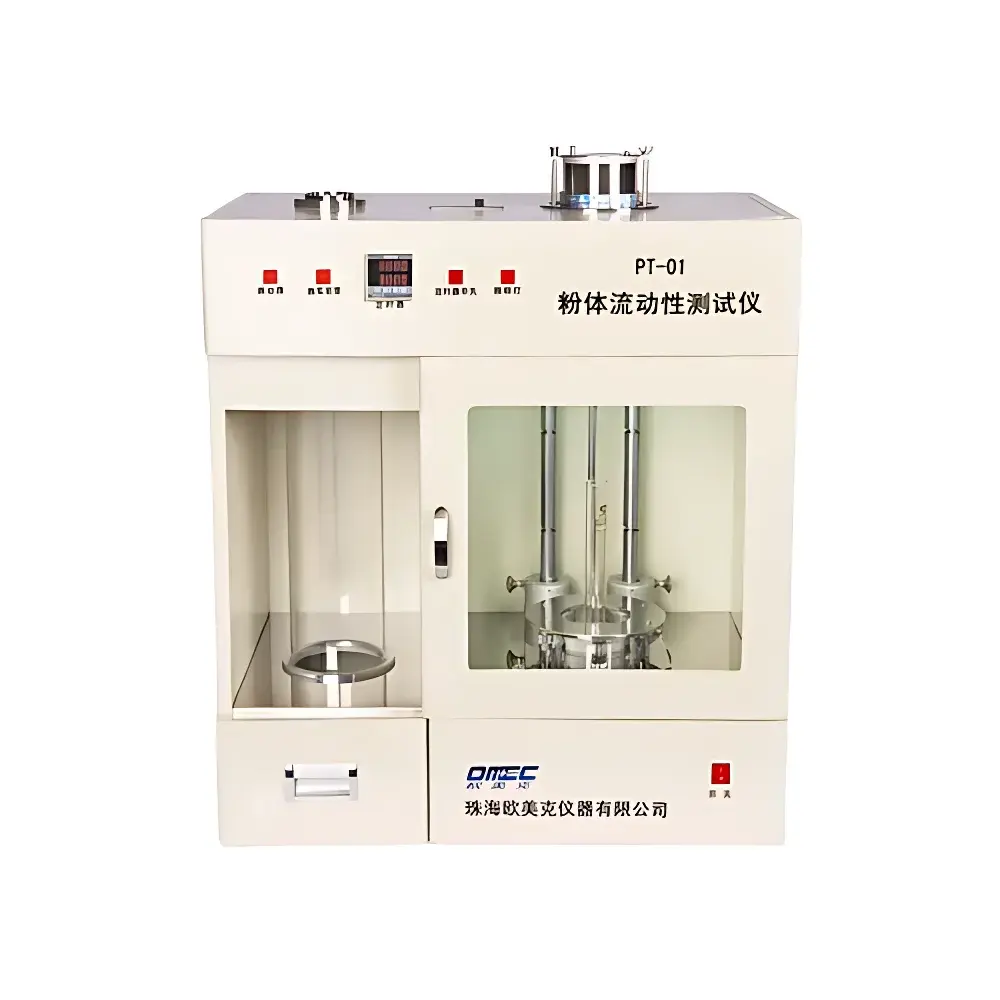
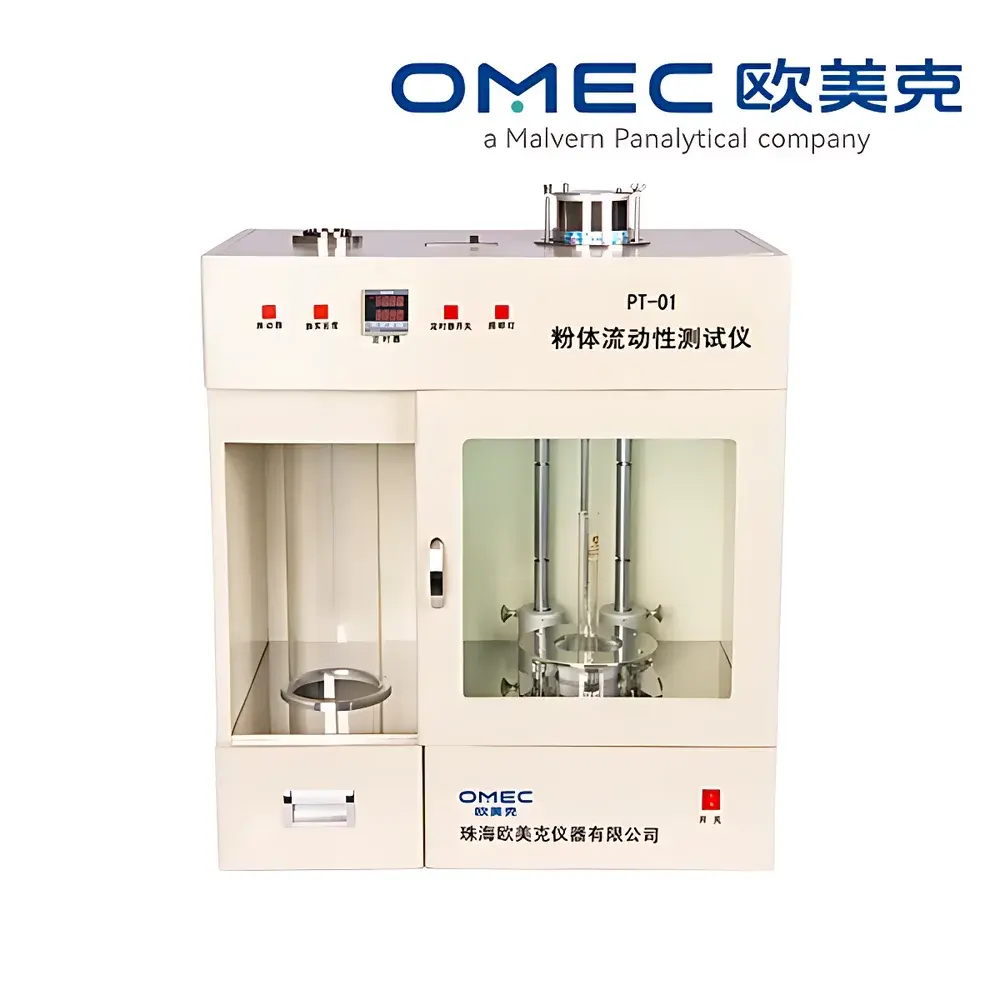
OMECK PT-01 Powder Flowability Analyzer
| Brand | OMECK/OMEC |
|---|---|
| Origin | Guangdong, China |
| Manufacturer Type | Original Equipment Manufacturer (OEM) |
| Product Origin | Domestic (China) |
| Model | PT-01 |
| Pricing | Available Upon Request |
Overview
The OMECK PT-01 Powder Flowability Analyzer is a benchtop, multi-functional instrument engineered for the quantitative characterization of bulk powder flow behavior under standardized and reproducible conditions. It operates on established gravitational and mechanical excitation principles—namely free-fall flow through calibrated orifices, controlled vibration-induced densification, and angle-of-repose formation—to deliver a comprehensive set of empirical flow indices widely adopted in pharmaceutical development, chemical manufacturing, food processing, and advanced materials R&D. Unlike single-parameter testers, the PT-01 integrates six primary physical measurement modules into one unified platform: tapped density (ASTM D6393, USP <616>), bulk density (ISO 787-11), angle of repose (ASTM D6393 Annex A1), compressibility index (Carr Index), Hausner ratio, and flow rate through standardized funnels (e.g., Hall Flowmeter per ASTM B212). These measurements collectively inform critical process design parameters—including hopper design, feeder selection, blender residence time, and die-fill consistency in tablet compression—thereby supporting both Quality by Design (QbD) frameworks and regulatory documentation under ICH Q5C and FDA Process Validation Guidance.
Key Features
- Modular stainless-steel construction using 304 grade components throughout all powder-contact surfaces—ensuring corrosion resistance, non-reactivity with APIs and excipients, and compliance with GMP cleanroom maintenance protocols.
- Adjustable tap amplitude (1–15 mm) with programmable tap count (1–999 cycles) and integrated rotational dispersion during tapping to promote uniform particle rearrangement and minimize segregation artifacts.
- Dual-mode angle measurement: automated optical detection for angle of repose (static) and collapse angle (dynamic), plus manual plate angle assessment per ISO 4762 and ASTM D6393 Annex A2.
- Interchangeable volumetric cylinders (10 mL, 25 mL, 100 mL) and calibrated flow funnels (including Hall-type and Carney-type geometries) enable method flexibility across ISO, ASTM, and pharmacopoeial standards.
- Onboard digital timer and real-time vibration monitoring ensure strict adherence to timing tolerances required by USP <616> and EP 2.9.36.
- Self-contained mechanical architecture—no external vacuum, compressed air, or PC dependency for core measurements—enhancing operational robustness in QC labs and pilot-scale facilities.
Sample Compatibility & Compliance
The PT-01 accommodates dry, free-flowing to cohesive powders ranging from 10 µm to 2 mm in median particle size, including crystalline APIs, amorphous dispersions, granules, microcrystalline cellulose, lactose monohydrate, and metal powders used in additive manufacturing. All measurement protocols align with internationally recognized standards: ASTM D6393 (Standard Test Method for Flow Properties of Powders Using the Compressibility Index and Hausner Ratio), ISO 4762 (Metallic powders — Determination of flow rate), ISO 787-11 (General methods of test for pigments and extenders), and USP <616> (Powder Flow). The instrument’s mechanical repeatability supports GLP-compliant data generation, and its passive, non-electronic measurement modules eliminate electromagnetic interference concerns during concurrent analytical workflows.
Software & Data Management
While the PT-01 operates as a stand-alone mechanical analyzer, optional USB-connected data logging firmware enables timestamped export of raw parameter sets (tapped volume, initial mass, funnel flow time, repose angle coordinates) in CSV format. This facilitates traceable integration with LIMS or electronic lab notebooks (ELN), and supports audit-ready records satisfying FDA 21 CFR Part 11 requirements when paired with user-authenticated access control on host systems. Calibration verification is performed using NIST-traceable stainless-steel density cylinders and certified glass funnels—documentation retained per internal SOPs aligned with ISO/IEC 17025 clause 6.5.
Applications
- Pharmaceutical formulation: Screening excipient compatibility, predicting die-fill variability, and establishing specification limits for Carr Index (<15 = excellent flow; 25–35 = fair; >35 = poor) and Hausner ratio (<1.2 = good; >1.4 = problematic).
- Process development: Optimizing granulation endpoint, evaluating drying-induced cohesion, and validating scale-up of high-shear mixer settings based on post-drying flow metrics.
- Quality control: Routine release testing of incoming raw materials (e.g., lactose grades) and finished blend uniformity assessments prior to compression.
- Materials science: Characterizing metal and ceramic powders for binder jetting and laser powder bed fusion processes—where flow stability directly impacts layer uniformity and part density.
- Academic research: Teaching fundamental powder mechanics concepts—including interparticle forces, arching propensity, and stress history effects—in undergraduate and graduate-level unit operations laboratories.
FAQ
Does the PT-01 require computer connectivity to perform basic measurements?
No. All primary tests—including tapped density, angle of repose, and Hall flow rate—are fully mechanical and self-timed. Optional software is available only for data logging and reporting.
Can the PT-01 be used for cohesive or electrostatically charged powders?
Yes, but supplementary conditioning (e.g., controlled humidity exposure, antistatic treatment, or mild glidant addition) may be necessary to obtain representative results. The instrument includes no built-in de-agglomeration mechanism.
Is calibration traceable to national standards?
Yes. Volumetric cylinders are calibrated against NIST-traceable standards; funnel dimensions conform to ASTM B212 specifications. Certificate of Conformance is supplied with each system.
What maintenance is required for long-term accuracy?
Monthly visual inspection of funnel orifice wear, quarterly cleaning of stainless-steel surfaces with ethanol or IPA, and annual verification of tap amplitude using a dial indicator per manufacturer’s service manual.
Does the PT-01 meet FDA 21 CFR Part 11 requirements?
The base instrument does not include electronic signature or audit trail functionality. However, when used with validated third-party ELN/LIMS systems and documented procedural controls, it supports Part 11 compliance for raw data capture and retention.



