
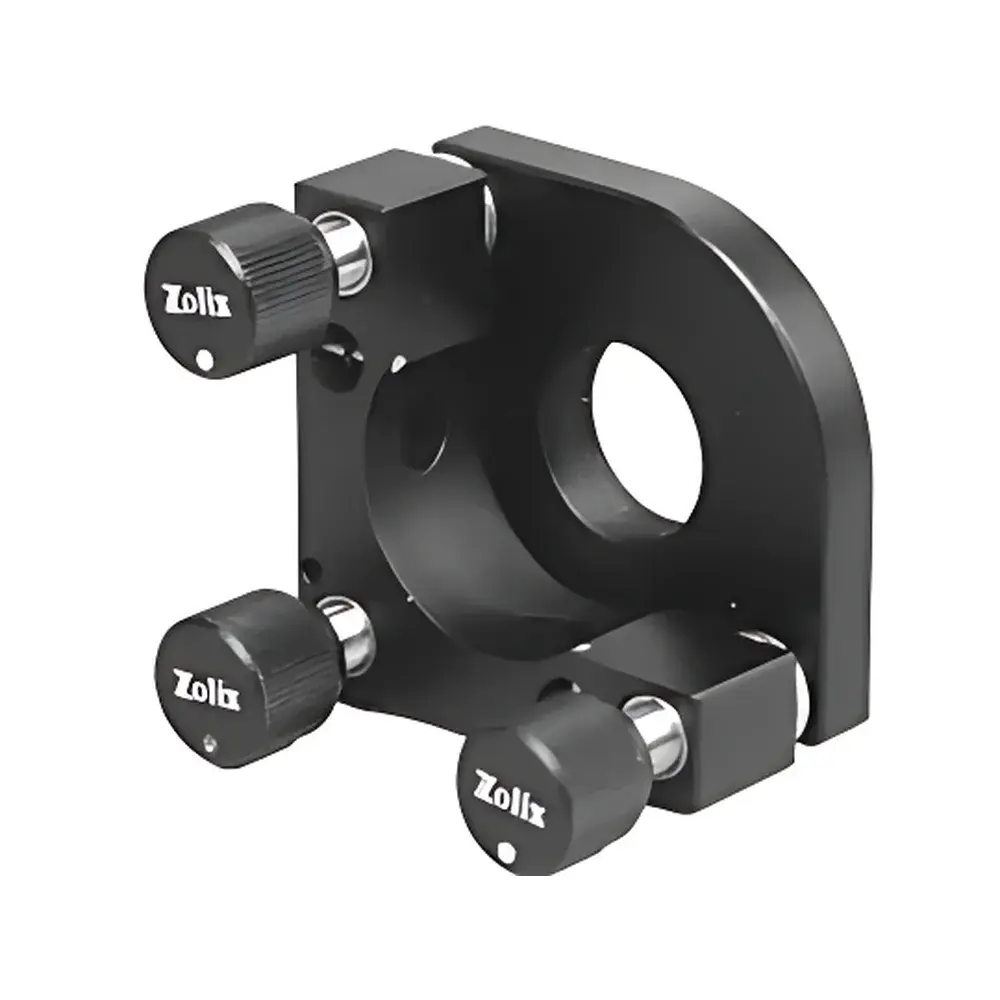
OMHS/OMRS Series Dedicated Lens Mounting Kinematic Adjusters
| Brand | ZOLIX |
|---|---|
| Origin | Beijing, China |
| Manufacturer Type | Direct Manufacturer |
| Product Origin | Domestic (China) |
| Model | OMHS / OMRS |
| Pricing | Available Upon Request |
Overview
The OMHS/OMRS Series Dedicated Lens Mounting Kinematic Adjusters are precision-engineered optical mounting solutions designed for high-stability, fine-alignment applications in research-grade optical laboratories and industrial metrology setups. These mounts operate on the principle of kinematic constraint—utilizing three-point contact geometry to eliminate over-constraint while enabling repeatable, drift-resistant positioning of optical elements. Specifically engineered for compatibility with standard laser beam expanders, microscope objectives (including RMS-threaded and M25×0.75 variants), and C-Mount imaging lenses, the series integrates micro-precision translation mechanics with mechanical self-centering and passive thermal stability. The adjusters are not general-purpose mounts; rather, they constitute a purpose-built interface system where mechanical design directly maps to optical train requirements—ensuring minimal parasitic tilt, sub-microradian angular repeatability, and long-term positional retention under vibration and thermal cycling.
Key Features
- Two-axis (OMHS) and three-axis (OMRS) orthogonal adjustment capability with independent, backlash-free micrometer-driven actuators
- M7×0.25 fine-pitch threaded translation screws—providing 0.25 mm per full revolution for high-resolution linear displacement control (typical resolution ≤1 µm per 1/100 turn)
- Integrated helical compression springs for consistent, non-binding return force—eliminating manual reset and ensuring repeatable zero-reference positioning
- Fully enclosed housing design protecting internal threads and bearing surfaces from dust, particulate ingress, and accidental impact
- Dedicated mating interfaces: RMS (0.800″-36 UNF) for microscope objectives, SM1 (1.035″-40) for beam expanders, and C-Mount (1″–32 UNF, 17.526 mm flange focal distance) for machine vision lenses
- Monolithic aluminum alloy construction (6061-T6) with black anodized finish for dimensional stability, low thermal expansion coefficient (~23.6 µm/m·K), and corrosion resistance
Sample Compatibility & Compliance
The OMHS/OMRS mounts accommodate optical components with standardized mechanical interfaces widely adopted across OEM instrumentation—including Nikon, Olympus, Thorlabs, Edmund Optics, and Newport product ecosystems. Compatibility is verified per ISO 10110-7 (optical element mounting interfaces) and aligned with ANSI/OEOSC OP1.002-2021 specifications for kinematic mount repeatability. While not certified to ISO 9001 or ISO/IEC 17025 as a standalone metrological device, the mounts support GLP-compliant optical alignment workflows when integrated into validated systems. Their mechanical stability meets the static load requirements defined in ASTM E1317 for laboratory optical support hardware (max. 2.5 kg axial load, 1.2 kg lateral load). No regulatory certification (e.g., CE, UKCA, FDA) applies, as these are passive mechanical components exempt from electromagnetic or safety directives.
Software & Data Management
As purely mechanical, non-electronic components, the OMHS/OMRS adjusters require no firmware, drivers, or software integration. However, they are fully compatible with digital alignment documentation protocols used in regulated environments: position settings can be recorded manually or via external coordinate measurement systems (e.g., laser tracker + photogrammetry), and stored within LIMS or ELN platforms (e.g., LabWare, Benchling) as structured metadata. For automated alignment workflows, the mounts interface seamlessly with motorized stages (e.g., Thorlabs K10CR1-compatible actuators) when retrofitted with optional encoder-equipped micrometers—enabling closed-loop positional logging traceable to NIST-traceable calibration standards.
Applications
- Precision alignment of collimated laser beams in interferometric metrology (e.g., Michelson, Twyman-Green configurations)
- Stable mounting of high-NA microscope objectives in super-resolution fluorescence microscopy (STED, PALM/STORM)
- C-Mount lens registration in automated optical inspection (AOI) systems for semiconductor wafer defect detection
- Beam expander stabilization in ultrafast laser amplifiers requiring long-term pointing stability (<5 µrad/h drift)
- Integration into custom optical cavity assemblies for cavity ring-down spectroscopy (CRDS) and frequency comb stabilization
- Education and training platforms in university optics labs—supporting hands-on instruction in Gaussian beam propagation and ABCD matrix analysis
FAQ
Are OMHS/OMRS mounts compatible with non-ZOLIX optical components?
Yes—mechanical compatibility depends solely on adherence to industry-standard threading (RMS, C-Mount, SM1) and flange dimensions, not brand affiliation.
What is the maximum recommended torque for the M7×0.25 adjustment screws?
Do not exceed 0.15 N·m; over-torquing may deform the brass insert or compromise spring preload integrity.
Can these mounts be used in vacuum environments?
Not without modification—standard anodization and lubricants are not UHV-compatible; custom dry-film lubrication and hard-anodized variants are available upon request.
Is angular repeatability quantified per axis?
Yes—under controlled lab conditions (23 ±1 °C, humidity <40% RH), angular repeatability is ≤±2.5 µrad for pitch/yaw axes and ≤±1.8 µrad for vertical translation axis.
Does ZOLIX provide calibration certificates for individual units?
No—these are mechanical alignment tools, not measuring instruments; however, dimensional verification reports per batch are available upon order confirmation.



