
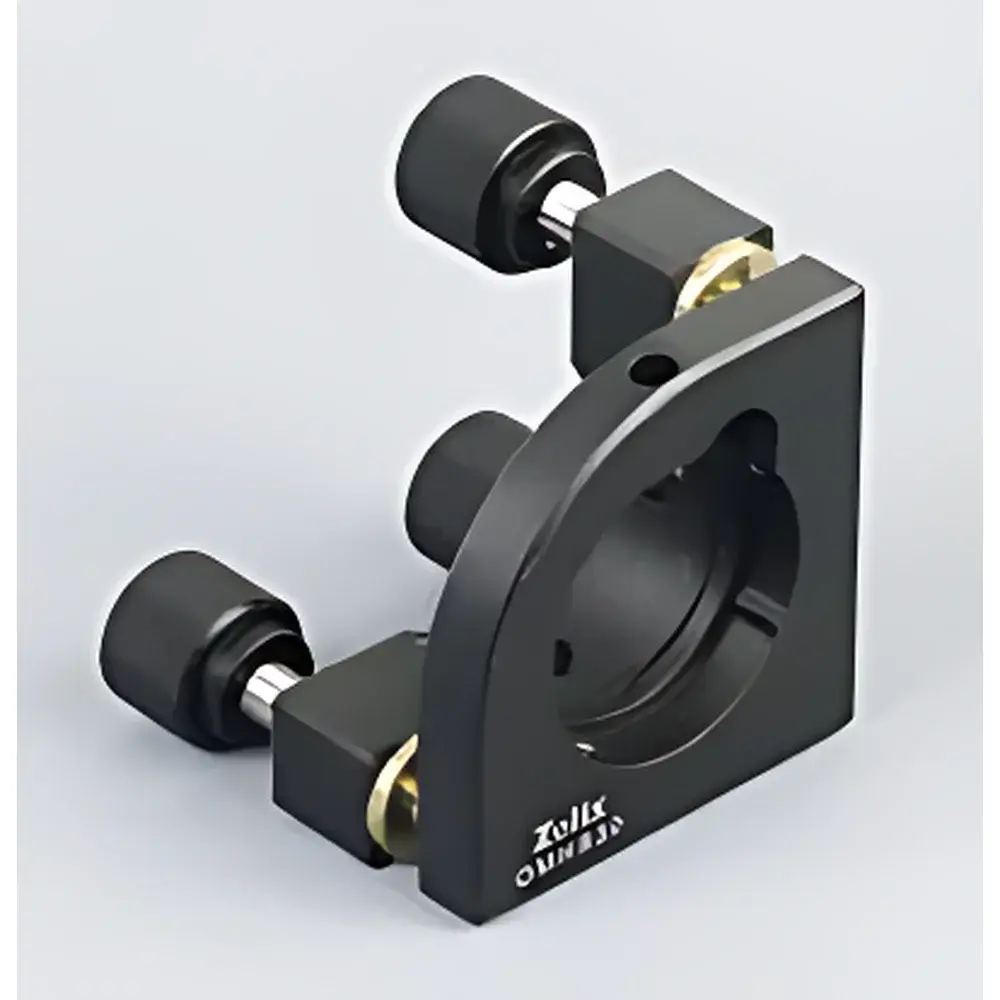
OMHS Series Three-Axis High-Stability Mirror Mount
| Origin | Beijing, China |
|---|---|
| Manufacturer Type | Authorized Distributor |
| Origin Category | Domestic (China) |
| Model | OMHS |
| Pricing | Available Upon Request |
| Mounting Aperture (A) | 20–50.8 mm |
| Clear Aperture (B) | 18–47 mm |
| Tilt Range | ±3° |
| Translation Axis | Axial (Z-axis) Linear Adjustment |
| Clamping Mechanism | Dual Set-Screw with PTFE Liners |
| Mounting Hole Pattern | Dual-Orientation (Horizontal & Vertical) |
Overview
The OMHS Series Three-Axis High-Stability Mirror Mount is an engineered optical positioning solution designed for precision alignment and long-term beam path stability in research-grade optical laboratories, laser systems, interferometry setups, and metrology applications. Unlike conventional two-axis kinematic mounts that provide only pitch and yaw adjustment, the OMHS integrates a third degree of freedom—axial (Z-axis) translation—enabling fine focus tuning without disturbing angular alignment. This mechanical decoupling between tilt and axial position is achieved through a proprietary coaxial micrometer-driven translation stage combined with orthogonal differential screw mechanisms for tip/tilt control. The mount operates on a rigid monolithic base architecture fabricated from stress-relieved aluminum alloy (6061-T6), ensuring thermal dimensional stability and minimal hysteresis during repeated adjustments. All critical motion interfaces employ low-backlash, hardened stainless steel screws with precisely lapped contact surfaces to maintain repeatability better than ±5 arcsec over 10,000 adjustment cycles.
Key Features
- Three independent adjustment axes: pitch, yaw, and axial (Z) translation — enabling full spatial optimization of mirror position without iterative realignment.
- Dual set-screw clamping system with integrated polytetrafluoroethylene (PTFE) liners to prevent surface marring and ensure consistent, non-slip retention of optics up to 50.8 mm diameter.
- Bi-directional mounting hole pattern (standard 1/4″-20 and M6 threads) allows flexible integration into both horizontal and vertical optical benches or breadboards without adapter plates.
- Integrated locking mechanism featuring dual-locking thumbscrews that independently secure tilt and translation axes, eliminating drift under vibration or thermal cycling conditions typical in multi-hour experiments.
- Modular design across seven standardized variants (OMHS20-S through OMHS50.8), each optimized for specific optic diameters and clear apertures while maintaining identical kinematic behavior and torque specifications.
Sample Compatibility & Compliance
The OMHS mount accommodates plano and spherical mirrors with diameters ranging from 20 mm to 50.8 mm (0.79″ to 2.00″), supporting substrates including fused silica, BK7, CaF₂, and metallic-coated optics. Its ±3° tilt range complies with ISO 10110-7 for optical component alignment tolerances in calibration-grade instrumentation. The PTFE interface material meets USP Class VI biocompatibility requirements and is chemically inert per ASTM D149 for high-voltage insulation applications—making it suitable for vacuum-compatible environments when paired with compatible fasteners. While not rated for ultra-high vacuum (UHV), the mount has been validated for use in rough-to-medium vacuum chambers (down to 10⁻³ mbar) following standard outgassing protocols per ESA ECSS-Q-ST-70-02C.
Software & Data Management
The OMHS is a purely mechanical, manually operated mount with no embedded electronics or firmware. As such, it requires no driver installation, calibration software, or data logging interface. However, its deterministic kinematics and repeatable adjustment response make it fully compatible with automated optical alignment workflows when integrated with motorized stages (e.g., Thorlabs K10CR1 or Newport CONEX-AG-PS1) and third-party motion controllers running LabVIEW, MATLAB, or Python-based alignment algorithms. Documentation includes DIN-compliant dimensional drawings (GD&T annotated), RoHS and REACH declarations, and traceable mechanical test reports for angular repeatability and load-bearing capacity (tested per ISO 230-2 Annex B).
Applications
- Laser cavity alignment in CW and pulsed solid-state laser systems (Nd:YAG, Ti:Sapphire, fiber lasers).
- Interferometric reference arm stabilization in Michelson, Mach-Zehnder, and Twyman-Green configurations.
- Beam steering and collimation verification in optical coherence tomography (OCT) and LIDAR receiver paths.
- Alignment of high-NA objectives and relay lenses in microscopy and photolithography prototyping rigs.
- Thermal drift compensation in long-duration spectroscopic measurements where Z-axis re-focusing is required without altering beam angle.
FAQ
Is the OMHS mount compatible with vacuum environments?
Yes — it is suitable for medium vacuum (≤10⁻³ mbar) when assembled with stainless steel hardware and baked per standard outgassing procedures. UHV compatibility requires custom hardware and surface treatment.
What is the maximum recommended optic weight for OMHS50.8?
The mount supports optics weighing up to 180 g at full ±3° tilt without measurable elastic deformation or positional hysteresis.
Can I retrofit my existing OMHS25-S with motorized actuators?
Yes — all OMHS variants feature standardized 4-40 and M3 threaded ports adjacent to each adjustment axis, allowing direct integration with piezoelectric nanopositioners or stepper-motor couplers using off-the-shelf adapters.
Does the PTFE liner affect thermal expansion matching with fused silica optics?
No — the 0.3 mm thick PTFE layer exhibits negligible compressive creep below 60°C and provides sufficient compliance to accommodate differential thermal expansion between aluminum housing and fused silica substrates across ambient lab temperature ranges (15–25°C).




