
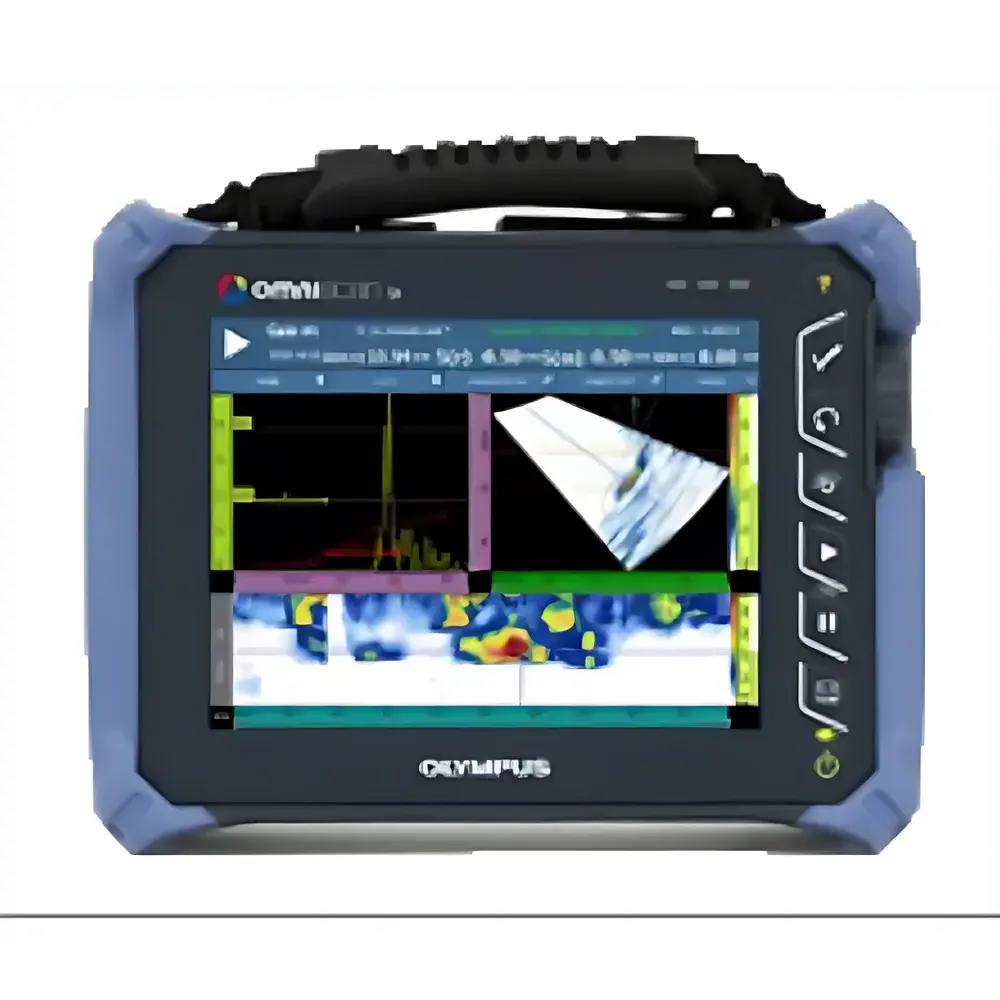
OmniScan SX Phased Array TOFD Flaw Detector by Olympus
| Brand | Olympus |
|---|---|
| Origin | Japan |
| Model | OmniScan SX Phased Array Instrument |
| Portability | Portable |
| Pulse Type | Negative Square Wave Pulse (Adjustable) |
| Application Fields | Aerospace, Oil & Gas, Power Generation, Pipeline & Pressure Vessel Inspection |
| Compliance | ASTM E2700, ISO 13588, ASME BPVC Section V, API RP 2X, EN 1330-4, EN 12668-1/2/3 |
Overview
The OmniScan SX Phased Array TOFD Flaw Detector is a compact, high-performance ultrasonic testing (UT) platform engineered by Olympus (now part of Evident) for field-deployable and workshop-based non-destructive evaluation. Built upon over two decades of phased array ultrasonics (PAUT) innovation, the OmniScan SX implements pulse-echo, pitch-catch, and time-of-flight diffraction (TOFD) modalities using advanced beam steering, dynamic depth focusing, and real-time S-scan synthesis. Its architecture follows the Couette-type beamforming principle—where electronic time delays across transducer elements synthesize steerable, focused acoustic beams without mechanical movement—enabling rapid volumetric inspection of welds, corrosion zones, composite laminates, and critical components. Designed specifically for applications with moderate complexity and throughput requirements, the SX model delivers full PAUT functionality in a streamlined single-channel configuration (16:64PR), eliminating modular expansion overhead while maintaining full compatibility with Olympus’ ecosystem of encoded scanners, wedge assemblies, and calibration standards.
Key Features
- Lightweight, rugged chassis weighing only 3.4 kg (7.5 lb) — 33% lighter and 50% smaller than the OmniScan MX2 — optimized for extended handheld or tripod-mounted operation
- 8.4-inch SVGA TFT-LCD touchscreen (800 × 600 px, 600 cd/m² brightness) with full-screen mode, wide viewing angles (±80° horizontal / ±60° vertical), and 16.7M-color fidelity for high-fidelity A- and S-scan visualization
- Dual UT channels supporting pulse-echo, tandem, and TOFD configurations; one dedicated 16:64 PR phased array interface with automatic probe recognition
- Adjustable negative square-wave pulsers: 40–115 V (PA), 95–340 V (UT); pulse width tunable from 30 ns to 1000 ns (2.5 ns resolution)
- Wideband reception: 0.6–18 MHz (PA), 0.25–28 MHz (UT); up to 120 dB gain range with programmable TCG (16-point curves per focal law)
- IP66-rated enclosure and MIL-STD-810G-compliant drop resistance (Method 516.6) for reliable operation in harsh industrial environments
- Integrated dual-axis encoder input, four TTL digital inputs, three TTL digital outputs (15 mA each), and step-pulse trigger support for synchronized C-scan acquisition
Sample Compatibility & Compliance
The OmniScan SX supports a broad spectrum of industrial materials—including carbon steel, stainless alloys, titanium, aluminum, composites, and austenitic welds—via calibrated delay laws and velocity-based depth correction. It fully complies with international NDT standards governing procedure qualification and personnel certification: ASTM E2700 (PAUT), ISO 13588 (TOFD), ASME BPVC Section V Article 4, API RP 2X (subsea welds), EN 1330-4 (terminology), and EN 12668-1/2/3 (instrument performance verification). Its hardware design and firmware traceability align with GLP/GMP documentation requirements, including audit-ready calibration logs, user-accessible firmware versioning, and timestamped data file metadata. All acquired A-scan waveforms and S-scan images are stored in industry-standard .udx format, ensuring long-term archival integrity and third-party software interoperability.
Software & Data Management
Running Olympus’ latest OmniScan Software v4.1, the SX features an intuitive, context-aware UI designed for single-operator efficiency. The unified operation mode integrates touch, mouse, and remote OmniPC control—eliminating environment-specific learning curves. Key software capabilities include: application-specific setup wizards (e.g., weld mapping, corrosion mapping, TOFD calibration), real-time S-scan update rates up to 60 Hz, configurable gate logic with three independent alarm conditions, and on-device TCG/DAC curve generation. Data management leverages SDHC cards or USB 2.0 mass storage devices (up to 300 MB per session file), with built-in encryption options and export to CSV, PDF, and XML formats. The system supports FDA 21 CFR Part 11-compliant electronic signatures when deployed with validated NDT SetupBuilder workflows and audit-trail-enabled OmniPC post-processing.
Applications
- Weld inspection: Rapid PAUT screening and TOFD characterization of groove welds in piping, pressure vessels, and structural joints per ASME/API acceptance criteria
- Corrosion monitoring: Accurate wall-thickness mapping and pitting assessment in pipelines and storage tanks using zero-degree linear or dual-element probes
- Composite evaluation: Detection of disbonds, delaminations, and porosity in CFRP and GFRP laminates via low-frequency sectorial scanning
- Component integrity verification: Crack detection in turbine blades, landing gear, and airframe structures using angle-beam or immersion techniques
- Manufacturing QA: In-line validation of additive-manufactured parts, castings, and forgings where geometric complexity limits conventional UT access
FAQ
What is the difference between OmniScan SX PA and SX UT models?
The SX PA variant includes a 16:64 PR phased array channel plus one conventional UT channel; the SX UT model omits the PA interface and provides two UT channels only.
Does the OmniScan SX support TOFD acquisition natively?
Yes — both SX PA and SX UT models support TOFD with dedicated filtering, split-beam encoding, and DGS/TCG compensation for accurate defect sizing.
Can I use third-party probes with automatic recognition?
Only Olympus-certified probes with embedded EEPROM chips enable auto-ID; generic probes require manual parameter entry.
Is battery life sufficient for full-shift field operation?
Under typical usage (screen brightness 70%, PRF 2 kHz), the smart Li-ion battery delivers ≥6 hours of continuous operation.
How does the OmniScan SX ensure measurement traceability?
All acquisitions embed instrument ID, firmware version, calibration date, operator ID (if logged), and environmental metadata — enabling full chain-of-custody compliance per ISO/IEC 17025.



