
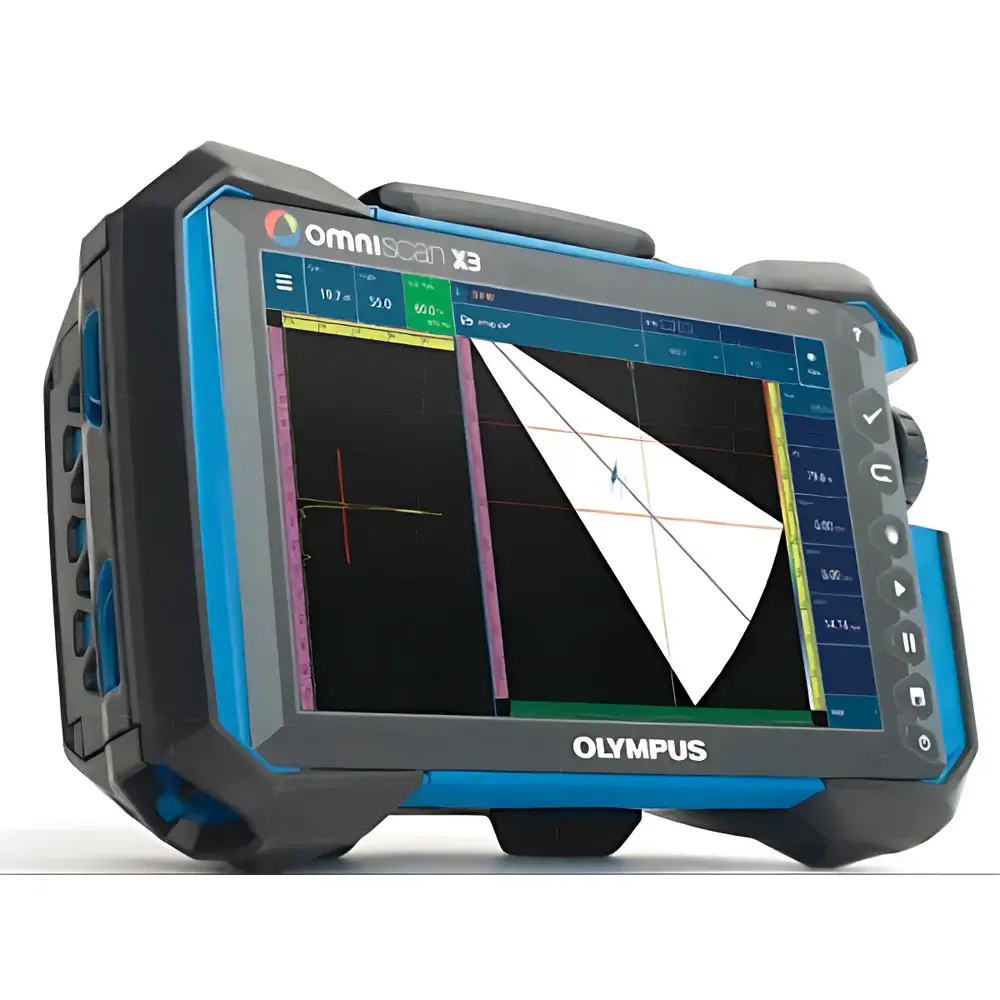
OmniScan X3 Phased Array & TOFD Flaw Detector by Olympus
| Brand | Olympus |
|---|---|
| Origin | Japan |
| Model | OmniScan X3 |
| Portability | Portable |
| Pulse Type | Negative Square Wave Pulse |
| IP Rating | IP65 |
| Compliance | ISO 18563‑1:2015, EN12668‑1:2010 |
| PA Configuration | 16:128PR or 32:128PR |
| TFM Support | Up to 64-element aperture |
| FMC Capacity | Full Matrix Capture enabled |
| Onboard File Capacity | 4 GB |
| Internal Storage | 64 GB SSD |
| Display | 10.6-inch WXGA TFT-LCD (1280 × 768), 16M colors |
| Weight | 5.7 kg (with one battery) |
| Operating Temperature | −10 °C to 45 °C |
| Battery Runtime | 5 hours (dual hot-swappable Li-ion, 93 Wh each) |
| GPS | Integrated |
| Encoders | Dual-axis quadrature or clock/direction |
| UT Channels | 2 independent P/R channels |
| PA Channels | 16 or 32 active elements, 128 receiver channels |
| Max Focusing Laws | 1024 per setup |
| TCG Points | 32 per focusing law |
| System Bandwidth | PA: 0.5–18 MHz |
| UT | 0.25–28 MHz |
| Pulse Width Range | PA: 30–500 ns (2.5 ns step) |
| UT | 30–1000 ns (2.5 ns step) |
| Max PRF | 12 kHz |
| A-scan Height Range | up to 800% |
| Data Acquisition | 16-bit digitization |
| Real-time Averaging | PA: 2/4/8/16 |
| UT | 2/4/8/16/32/64 |
Overview
The OmniScan X3 Phased Array & TOFD Flaw Detector by Olympus is a high-performance, portable ultrasonic testing (UT) platform engineered for precision NDT in demanding industrial environments. Built upon the proven architecture of the OmniScan series, the X3 integrates advanced phased array (PA) beamforming with time-of-flight diffraction (TOFD) and full matrix capture (FMC)-driven total focusing method (TFM) imaging. Its measurement principle relies on controlled electronic steering and dynamic focusing of ultrasonic beams across multi-element arrays—enabling volumetric inspection of welds, pipelines, pressure vessels, composites, and aerospace structures without mechanical scanning. The instrument operates under pulse-echo, pitch-catch, and through-transmission modes, with dual independent UT channels supporting conventional pulse-echo and TOFD configurations. All signal generation and acquisition adhere to the physical constraints defined in ISO 18563‑1:2015 (characterization of PA equipment) and EN12668‑1:2010 (instrument performance verification), ensuring traceable compliance for regulated sectors including ASME BPVC Section V, ASTM E2700, and aerospace OEM specifications.
Key Features
- Integrated PA/TOFD functionality with simultaneous dual-mode operation and real-time TFM reconstruction using FMC data from apertures up to 64 elements
- Ruggedized enclosure certified to IP65 (dust-tight, water-jet resistant) and validated per MIL-STD-810G for 1.2 m drop survivability
- 10.6-inch WXGA resistive touchscreen display (1280 × 768, 16M colors) optimized for glove use, high ambient light, and coupling-agent-covered operation
- Thermally managed design with field-replaceable cooling fan maintaining stable operation between −10 °C and 45 °C while preserving IP65 integrity
- Dual hot-swappable lithium-ion batteries (93 Wh each) enabling continuous 5-hour operation with seamless power transition
- Onboard 64 GB SSD storage and 8 GB DDR RAM, supporting single-scan files up to 4 GB—eliminating segmentation during large-area inspections
- Advanced software architecture reducing keystrokes by >40% versus prior generations via context-aware workflow navigation and unified scan-plan authoring
- Embedded GPS module for geotagging inspection locations—critical for pipeline integrity management and regulatory reporting
Sample Compatibility & Compliance
The OmniScan X3 supports a broad range of industrial test specimens—including carbon steel, stainless alloys, titanium, aluminum, composites, and duplex materials—across thicknesses from 3 mm to 300 mm depending on probe frequency and configuration. It natively interfaces with Olympus-compatible encoded scanners (e.g., COBRA, GLIDER, R-SCAN), dual-linear, matrix, and dual-matrix array probes, as well as standard single-element and bi-element transducers. Calibration verification tools include automated wedge validation, single-sweep TCG calibration, and multi-point sensitivity checks aligned with ASME Section V Article 4 requirements. The system meets electromagnetic compatibility standards per IEC 61326-1 and safety requirements per IEC 61010-1. Its firmware architecture supports audit-trail logging for GLP/GMP environments, and optional integration with Olympus Scientific Cloud (OSC) enables secure, role-based data access compliant with ISO/IEC 27001 information security frameworks.
Software & Data Management
OmniScan X3 runs on Olympus’ proprietary NDT software suite, featuring a streamlined user interface built around task-oriented workflows rather than hierarchical menus. Scan planning occurs entirely onboard: users define geometry, probe layout, beam sets (up to 8 per setup), and TFM regions within a single guided sequence—visualized in real time via synthetic S-scan previews before acquisition begins. Data processing includes 16-bit A-scan digitization, interpolation-enhanced PA imaging, volume-rendered top/side views with geometric correction, and automatic −6 dB cursor placement for rapid defect sizing. Export options include industry-standard formats (ASAM MDF4, Universal Format UF, ASCII CSV) via SDHC/SDXC cards, USB 2.0/3.0 ports, HDMI video output, and wireless OSC upload. Third-party analysis tools (e.g., CIVA, PISCES, GAGE) can directly ingest FMC datasets through OSC’s RESTful API. Firmware updates are delivered over-the-air via OSC, maintaining alignment with evolving regulatory expectations such as FDA 21 CFR Part 11 for electronic records and signatures.
Applications
- Weld Inspection: Multi-beam coverage of complex joint geometries with amplitude extension to 800% for saturation analysis of lack-of-fusion indications; weld gate filtering to suppress root pass reflections
- Pipeline & Vessel Corrosion Mapping: High-speed scanning at 12 kHz PRF with dual-crystal linear arrays for enhanced near-surface resolution; compatibility with Olympus corrosion scanners (e.g., MX2, MXU)
- Aerospace Composite Evaluation: Wide dynamic range (65 dB TCG, 16-bit ADC) and low-frequency pulse control for attenuative carbon fiber laminates; TFM volumetric rendering to resolve delamination morphology
- Power Generation Component Assessment: In-service inspection of turbine disks, nozzles, and steam generator tubes using dynamic depth focusing and encoder-synchronized C-scan stitching
- Manufacturing QA/QC: Automated setup validation and repeatability checks per ISO 2400:2012; support for multi-probe configurations to cover wide inspection zones in single passes
FAQ
Does the OmniScan X3 support both PA and TOFD in the same inspection sequence?
Yes. The instrument provides concurrent PA and TOFD acquisition using its two independent UT channels, allowing synchronized data collection for complementary defect characterization—particularly valuable in weld assessment where PA identifies orientation and TOFD quantifies height.
What TFM reconstruction modes are available, and what is the maximum supported aperture size?
The OmniScan X3 supports LL, LLL, LLLL, TT, TTT, TTTT, LTT, TLT, and TLL parallel multi-mode TFM. FMC data from apertures up to 64 elements can be acquired and reconstructed onboard, delivering volumetric images with up to 1024 × 1024 pixel resolution.
Is the device suitable for outdoor use in extreme temperatures or wet conditions?
Yes. It is rated IP65 for dust and water resistance and has passed MIL-STD-810G drop testing. Operational temperature range is −10 °C to 45 °C, with an integrated replaceable cooling fan sustaining thermal stability without compromising ingress protection.
How does the OmniScan X3 ensure data integrity and regulatory compliance in audited environments?
It maintains full audit trails for calibration events, setup changes, and report generation. When paired with Olympus Scientific Cloud, it supports electronic signature workflows, version-controlled configuration templates, and encrypted data synchronization—aligning with 21 CFR Part 11, ISO 17025, and ASNT SNT-TC-1A documentation requirements.
Can third-party analysis software interface directly with OmniScan X3 raw data?
Yes. FMC datasets are stored in open binary format and accessible via OSC’s API. Users may export .uf, .mdf4, or .csv files for offline analysis in CIVA, PISCES, or custom MATLAB/Python toolchains without proprietary lock-in.



