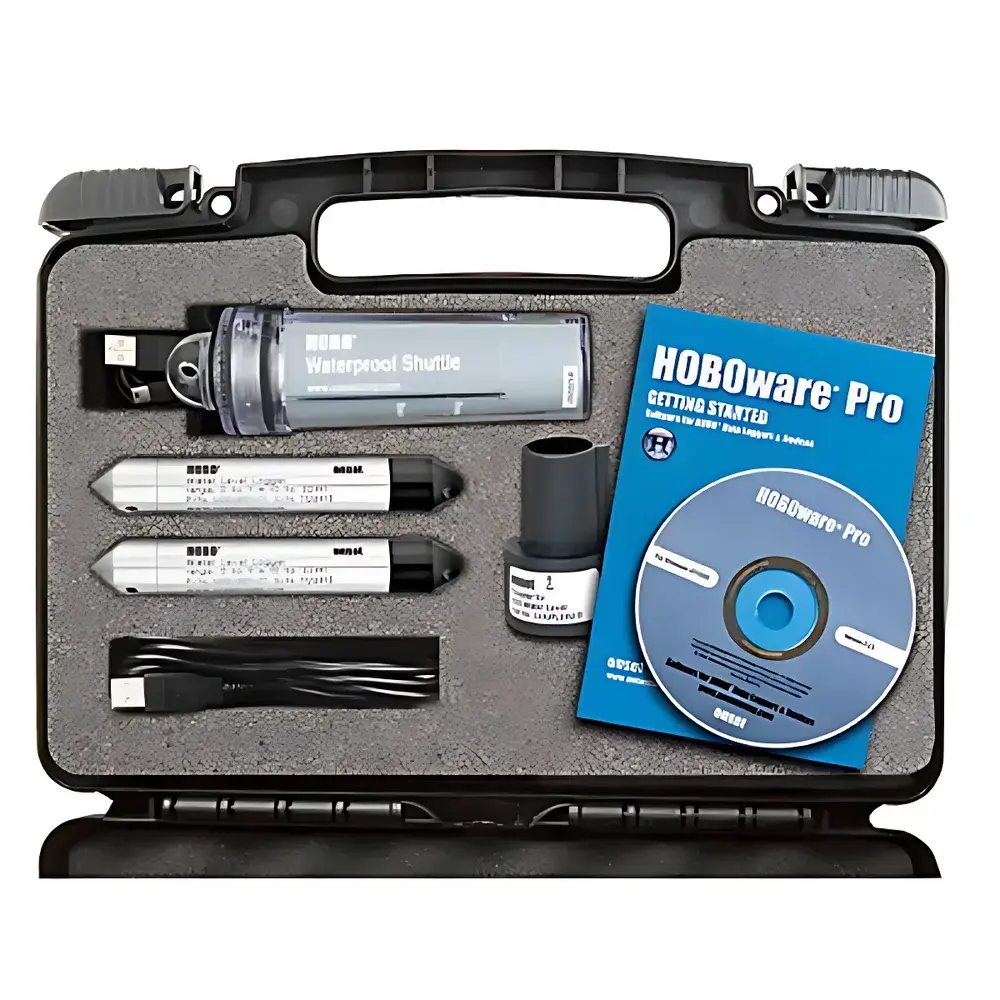
Onset HOBO U20 Series Submersible Water Level and Temperature Sensor
| Brand | Onset HOBO |
|---|---|
| Origin | USA |
| Model | U20-001-01 / U20-001-02 / U20-001-03 / U20-001-04 |
| Measurement Principle | Absolute pressure-based hydrostatic water level sensing with integrated temperature compensation |
| Temperature Range | -20 to 50 °C |
| Temp Accuracy | ±0.37 °C @ 20 °C, ±0.5 °C outside -5 to 40 °C |
| Temp Resolution | 0.1 °C @ 20 °C |
| Water Level Ranges | 0–4 m (U20-001-04), 0–9 m (U20-001-01), 0–30 m (U20-001-02), 0–76 m (U20-001-03) |
| Water Level Accuracy | ±0.3 cm (U20-001-04), ±0.5 cm (U20-001-01), ±1.5 cm (U20-001-02), ±3.8 cm (U20-001-03) |
| Water Level Resolution | 0.14–0.87 cm (model-dependent) |
| Dimensions | 150 mm × 24.6 mm |
| Weight | 7 g |
| Memory Capacity | 21,000 measurements |
Overview
The Onset HOBO U20 Series is a compact, submersible water level and temperature sensor engineered for long-term, unattended monitoring in natural and engineered hydrological environments. Unlike radar- or ultrasonic-based water level instruments — which the product classification incorrectly cites — the U20 operates on the principle of absolute pressure transduction. It measures the hydrostatic pressure exerted by the water column above the sensor diaphragm and converts this pressure into depth using the known specific weight of water and local gravitational acceleration. An integrated thermistor simultaneously records temperature to support thermal drift correction of the pressure transducer and enable density-compensated depth calculations where high accuracy is required. Designed for deployment in streams, lakes, wetlands, tidal zones, and shallow groundwater wells, the U20 delivers reliable, low-power, high-reproducibility data under variable environmental conditions.
Key Features
- Submersible stainless steel housing rated to full operational depth (IP68); chemically resistant and corrosion-inhibiting for prolonged exposure in freshwater, brackish, and mildly saline environments
- Low-power consumption enabling multi-year battery life when paired with HOBO UX120 or RX3000 data loggers (typical interval: 15-min logging over 2+ years)
- Integrated dual-sensor capability: simultaneous measurement of water level (via absolute pressure) and temperature (via precision thermistor) within a single 150 mm × 24.6 mm cylindrical form factor
- Four calibrated pressure ranges to match site-specific hydraulic head requirements: 0–4 m, 0–9 m, 0–30 m, and 0–76 m full scale
- Factory-calibrated pressure transducer with NIST-traceable documentation; temperature compensation applied in real time during data acquisition
- No external vent tube required — unlike differential-pressure sensors — eliminating maintenance-intensive barometric reference lines
Sample Compatibility & Compliance
The U20 sensor is compatible with a wide range of hydrological media, including freshwater, estuarine mixtures (up to ~15 ppt salinity), and aerated or sediment-laden surface waters. Its solid-state design avoids mechanical clogging issues common in float- or bubbler-type systems. While not certified for explosive atmospheres or potable water contact per NSF/ANSI 61, it meets general environmental monitoring requirements under ASTM D4044 (Standard Test Method for Determining the Integrity of Wells) and supports data collection workflows aligned with USGS NWIS and EPA STORET metadata standards. The sensor’s passive analog output (0–3 VDC) and compatibility with HOBOware Pro ensure seamless integration into GLP-compliant field data acquisition protocols, including audit-trail-enabled configuration logging and timestamped raw value export.
Software & Data Management
Data from the U20 is acquired via Onset’s HOBOware Pro software (Windows/macOS) or the cloud-based HOBOlink platform. HOBOware Pro provides calibration file import, linear and polynomial pressure-to-depth conversion tools, temperature-corrected density lookup tables (based on UNESCO 1983 EOS-80), and batch processing for multi-sensor deployments. All logged values include embedded UTC timestamps, sensor serial ID, and firmware version. Export formats include CSV, Excel (.xlsx), and XML, supporting direct ingestion into GIS platforms (e.g., ArcGIS, QGIS) and statistical analysis suites (R, Python pandas). For regulated environments, HOBOlink supports 21 CFR Part 11-compliant user roles, electronic signatures, and immutable audit logs — critical for QA/QC validation in watershed management and regulatory reporting.
Applications
- Continuous stage monitoring in small watersheds and ephemeral streams for flood forecasting and baseflow separation analysis
- Groundwater level tracking in unconfined aquifers and monitoring wells (depth-to-water measurements)
- Tidal elevation profiling across intertidal zones, marsh platforms, and coastal embayments
- Wetland hydroperiod quantification for ecological restoration assessment and habitat modeling
- Calibration reference for larger-scale radar or ultrasonic gauges in multi-sensor validation networks
- Long-term climate-driven hydrological trend analysis (e.g., decadal changes in lake level or aquifer response)
FAQ
Is the U20 sensor suitable for saltwater applications?
It is rated for short-term exposure in brackish water (<15 ppt). Prolonged immersion in full-strength seawater (>35 ppt) may accelerate corrosion of the stainless steel housing and affect long-term stability; for marine applications, Onset recommends the U20-Lite with enhanced passivation or the separate U20-Tilt series.
How is barometric pressure compensated?
The U20 is an absolute pressure sensor and does not inherently compensate for atmospheric variation. Accurate water level calculation requires concurrent barometric pressure measurement — typically achieved by co-deploying a second U20 (or HOBO U12-012) in open air as a reference sensor. HOBOware Pro automatically applies differential correction during post-processing.
Can the U20 be used in frozen conditions?
Operation below -20 °C is not specified. Ice formation around the sensor port may impede pressure transmission; for winter deployments, users should ensure the sensor remains submerged below the freeze line or employ insulated well casings.
What is the maximum sampling interval supported?
The internal memory stores up to 21,000 measurements. At 1-minute intervals, this supports ~14.6 days of continuous logging; at 15-minute intervals, >2 years. External logging via RX3000 extends capacity indefinitely via SD card or cellular upload.
Does the U20 require recalibration after field deployment?
No routine recalibration is required. The sensor’s solid-state MEMS pressure transducer exhibits excellent long-term zero stability (<0.1 cm/year drift typical). However, annual verification against a traceable pressure standard is recommended for regulatory-grade monitoring programs.