
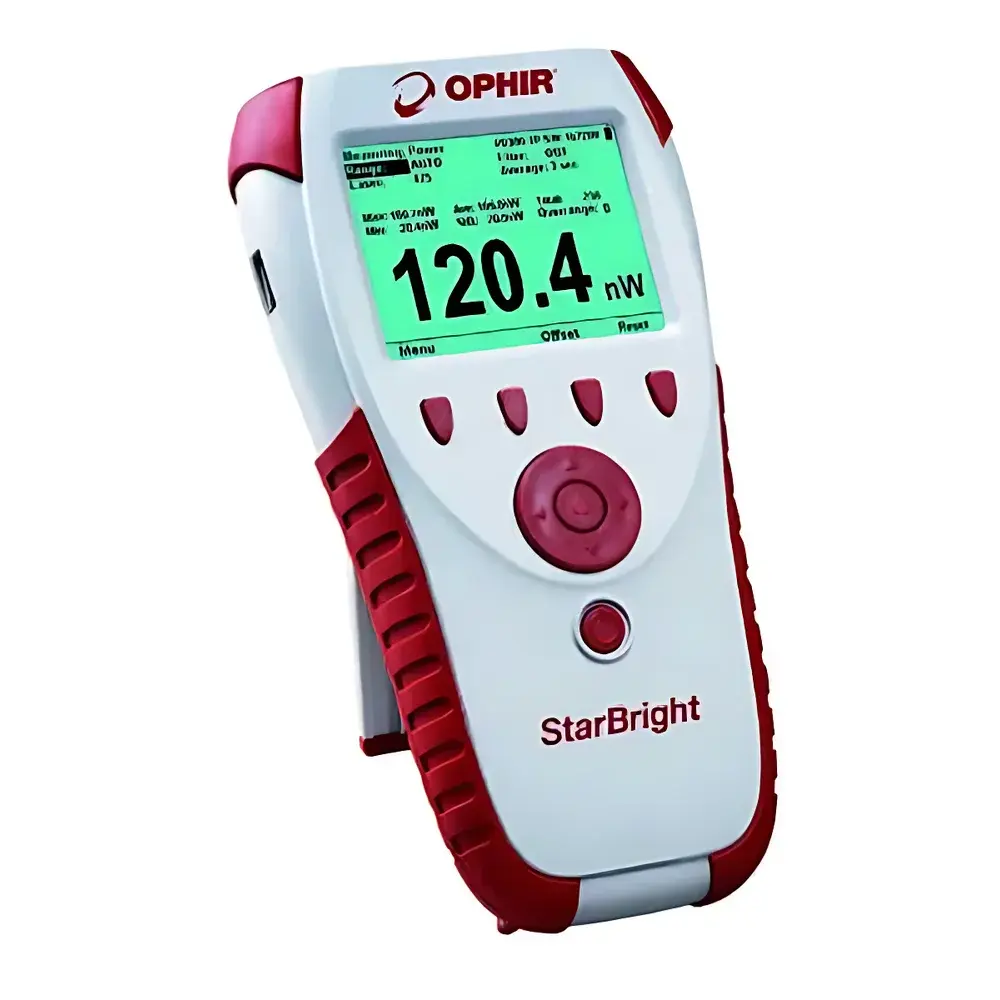
Ophir StarBright Universal Laser Power and Energy Meter
| Brand | Ophir |
|---|---|
| Origin | France |
| Model | StarBright |
| Sensor Compatibility | Thermopile, BeamTrack, Pyroelectric (PE-C series), Photodiode |
| Display | 320×240 color TFT LCD |
| Measurement Modes | Digital bar graph, analog needle, real-time line plot (for laser tuning), pulse waveform, Pass/Fail, beam position, stability index, live statistics |
| Sampling Rate | Up to 5 kHz (with pyroelectric sensors) |
| Data Processing | Baseline normalization, density scaling, ratio functions, composite mathematical operations |
| Data Storage | USB flash drive support (unlimited capacity) |
| Interfaces | USB 2.0, RS-232 |
| Software | StarLab PC application, scriptable command files |
| Instrument Drivers | LabVIEW VIs, COM object API |
| Advanced Capabilities | Pulse power measurement (thermopile), exposure energy integration (photodiode) |
Overview
The Ophir StarBright Universal Laser Power and Energy Meter is a high-fidelity, multi-sensor interface instrument engineered for precision quantification of continuous-wave (CW) and pulsed laser radiation across industrial, research, and quality assurance environments. Unlike single-purpose meters, the StarBright serves as a universal readout platform that natively supports Ophir’s full family of calibrated sensors—including thermopile, BeamTrack, pyroelectric (PE-C series), and photodiode detectors—enabling seamless transition between power (W), energy (J), beam position (mm), centroid stability (µm RMS), and temporal pulse profile analysis. Its architecture implements low-noise analog front-end circuitry with 16-bit ADC resolution and real-time digital signal processing, ensuring traceable measurements compliant with ISO/IEC 17025-accredited calibration practices. The device operates on the principle of sensor-specific signal conditioning: thermopiles deliver voltage proportional to absorbed thermal flux; pyroelectrics generate charge in response to rapid irradiance changes; photodiodes provide fast current output for high-repetition-rate pulse integration; and BeamTrack sensors simultaneously resolve power, position, and beam diameter via quadrant photodiode arrays.
Key Features
- Universal sensor interface supporting all Ophir thermopile, BeamTrack, PE-C pyroelectric, and photodiode sensors without hardware modification
- 320×240 high-contrast color TFT display with configurable visualization modes: digital bar graph, analog-style needle meter, real-time line plot (ideal for wavelength tuning or cavity alignment), pulse waveform view, Pass/Fail status indicator, beam position overlay, stability trend chart, and live statistical summary (mean, std dev, min/max, pulse-to-pulse variation)
- High-speed data acquisition up to 5 kHz sampling rate when paired with compatible pyroelectric sensors—enabling per-pulse energy capture in Q-switched and mode-locked systems
- Onboard mathematical engine supporting baseline subtraction, linear scaling, density normalization, ratio computation (e.g., Pref/Ptest), and cascaded function composition with graphical output and timestamped logging
- USB flash drive port enabling persistent, high-capacity storage of raw time-series data, processed results, configuration profiles, and firmware updates—eliminating reliance on host PC memory or internal non-volatile storage limits
- Dual communication interfaces: USB 2.0 (CDC class, plug-and-play) and RS-232 (9600–115200 bps), both supporting SCPI-compatible command syntax for automated test sequences
- Native integration with StarLab PC software for advanced analysis, report generation (PDF/CSV), multi-channel synchronization, and compliance documentation (including audit trail export for GLP/GMP workflows)
Sample Compatibility & Compliance
The StarBright accepts input from any Ophir-calibrated sensor with standard SMB or LEMO connectors, covering wavelengths from 190 nm to 11 µm and power ranges from 100 nW to 12 kW (dependent on sensor selection). It complies with IEC 61000-6-3 (EMC emissions) and IEC 61000-6-2 (immunity), and its firmware supports NIST-traceable calibration certificate import. When used with ISO 11554-compliant sensors and StarLab’s calibration management module, the system meets requirements for laser safety auditing (ANSI Z136.1), medical laser verification (IEC 60825-1), and pharmaceutical process validation under FDA 21 CFR Part 11 (with electronic signature and audit trail enabled).
Software & Data Management
StarLab v3.x is a Windows-based application offering synchronized multi-meter control, customizable dashboards, automated pass/fail evaluation against user-defined thresholds, and batch report generation compliant with ISO/IEC 17025 documentation standards. The software includes built-in tools for FFT spectral analysis of pulse trains, Gaussian fit to beam profiles (when used with BeamTrack), and exposure dose accumulation (J/cm²) with area-normalized integration. LabVIEW drivers (32/64-bit) and COM object interfaces allow direct integration into custom test benches, PLC-controlled manufacturing lines, and MATLAB-based optical modeling pipelines. All data exports include embedded metadata: sensor serial number, calibration date, wavelength setting, aperture configuration, and environmental conditions (if logged via optional external sensors).
Applications
- Laser diode production line testing: CW power stability monitoring, turn-on transient characterization, and pulse shape fidelity assessment
- Ultrafast laser lab diagnostics: Single-shot energy measurement at 1 kHz–5 kHz repetition rates using PE-C sensors; simultaneous peak power and fluence calculation
- Medical laser system commissioning: Output verification per IEC 60601-2-22, including exposure time gating, dose accuracy, and interlock response latency
- Materials processing R&D: Real-time feedback during laser welding, ablation, or annealing—correlating power fluctuations with surface morphology changes
- Optical component qualification: Coating damage threshold testing via energy-per-pulse ramping with statistical failure analysis
- Academic teaching labs: Visual demonstration of laser parameter interdependence—e.g., how M² affects focal spot intensity distribution and measured power density
FAQ
Does the StarBright require separate calibration for each connected sensor?
No. Calibration coefficients are stored within each Ophir sensor’s EEPROM and automatically loaded upon connection.
Can the StarBright measure both average power and single-pulse energy simultaneously?
Yes—when configured with a dual-mode sensor (e.g., PE-C with integrated thermopile), it can log both parameters synchronously with shared time stamps.
Is StarLab software validated for use in regulated environments?
StarLab v3.5+ includes 21 CFR Part 11-compliant features: role-based access control, electronic signatures, immutable audit trails, and change history for all measurement configurations.
What is the maximum sampling duration for continuous recording to USB drive?
Limited only by available flash drive capacity; typical 64 GB drives support >10 million data points at 1 kHz sampling over 2.8 hours.
Does the device support triggering from external TTL signals?
Yes—via optional BNC sync input for gated acquisition aligned to laser Q-switch or chopper signals.



