
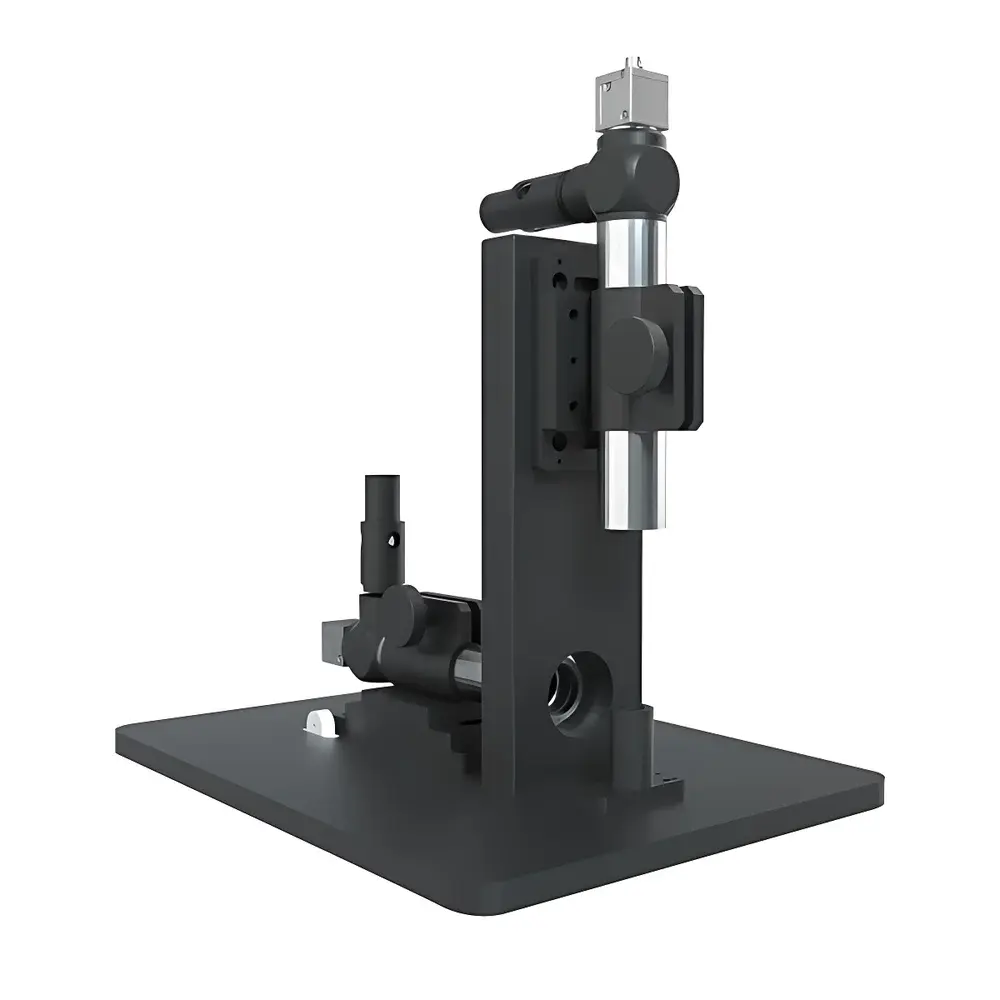
Optec Custom Prism Beam Deviation Angle Measurement System
| Brand | Optec |
|---|---|
| Origin | Beijing, China |
| Manufacturer Type | Authorized Distributor |
| Country of Origin | China |
| Model | Custom |
| Price Range | USD 42,000 – 70,000 |
| Mounting Options | Vertical & Horizontal Adjustable Head Stand |
| Adjustment Axes | 2-Axis Precision Kinematic Mount |
| Support Fixture | V-Groove Alignment Slot |
| Angular Resolution | ≤1 arcsecond |
| Output | Real-Time Image + Numeric Readout |
| Software Features | Pass/Fail Thresholding, Exportable Measurement Reports |
| Compliance | Designed for ISO 10110-3 and ISO 11146 alignment verification workflows |
Overview
The Optec Custom Prism Beam Deviation Angle Measurement System is a precision optical metrology platform engineered for quantitative evaluation of angular deviation introduced by small-format prisms—particularly right-angle, penta, roof, and wedge prisms used in laser steering, interferometry, and compact optomechanical assemblies. Operating on the principle of collimated beam displacement analysis, the system captures the spatial shift between incident and emergent beams using high-resolution CMOS imaging coupled with sub-pixel centroid detection algorithms. By referencing a calibrated fiducial plane and leveraging geometric ray-trace modeling, it computes the actual apex-induced deviation angle (δ) with traceability to NIST-traceable angular standards. This system is not a generic goniometer; rather, it is purpose-built for micro-prism geometries (<25 mm base dimension), where conventional autocollimators or theodolites lack sufficient resolution, repeatability, or ease of integration into production test benches.
Key Features
- Precision kinematic mounting architecture supporting both vertical and horizontal orientation modes—enabling alignment against optical tables, breadboards, or OEM assembly fixtures.
- Two-axis fine-adjustment stage (±5° tilt, 0.5 arcsec resolution) integrated with a V-groove support slot for repeatable, stress-free prism seating without adhesive or clamping-induced distortion.
- Real-time imaging engine delivering 12-bit dynamic range at 60 fps, synchronized with angular computation to visualize beam walk-off and quantify δ within ±0.5 arcseconds (1σ, under controlled thermal and vibration conditions).
- Dedicated measurement software providing dual-output visualization: overlayed beam profiles with vector deviation indicators and tabular numeric readouts updated at 10 Hz.
- User-configurable pass/fail logic based on programmable angular tolerance bands—supporting bilateral, unilateral, or asymmetric limits per specification sheet (e.g., δ = 90.000° ± 3 arcsec).
- Export functionality compliant with ASTM E2918-22 data formatting conventions: CSV reports include timestamp, operator ID, environmental conditions (optional ambient sensor input), raw pixel coordinates, calculated δ, and conformance status.
Sample Compatibility & Compliance
The system accommodates prisms fabricated from BK7, fused silica, CaF₂, SF10, and other common optical glasses, with surface quality up to 10-5 scratch-dig and coating types including AR, HR, and metallic dielectric stacks. It supports prisms with clear apertures as small as 3 mm and apex angles ranging from 30° to 120°. Mechanical interface design conforms to ISO 8015 geometric product specifications and supports verification per ISO 10110-3 (surface form tolerances) and ISO 11146-2 (laser beam parameter measurements). While not certified as a medical device or safety-critical instrument, its measurement uncertainty budget is documented per ISO/IEC 17025 guidelines and suitable for internal QC/QA processes in ISO 9001-certified facilities.
Software & Data Management
The proprietary Optec PrismDev Suite runs on Windows 10/11 (64-bit) and requires no third-party runtime licenses. It implements audit-trail logging per FDA 21 CFR Part 11 requirements—including user authentication, electronic signatures, and immutable record retention—for regulated environments. All measurement sessions generate hashed metadata files (.prismdev) containing image thumbnails, calibration checksums, and full processing history. Data export options include CSV (for SPC charting in Minitab or JMP), XML (for MES integration), and PDF reports with embedded digital signatures. Software updates are delivered via secure HTTPS channel with SHA-256 integrity verification.
Applications
- Final inspection of micro-prisms in fiber-optic transceiver modules and LiDAR scanning assemblies.
- Process validation for prism bonding and epoxy-curing steps where thermal drift affects angular stability.
- Root-cause analysis of beam pointing instability in ultrafast amplifier chains requiring <10 µrad long-term repeatability.
- Calibration reference for in-house autocollimator systems using transfer-standard methodology.
- Education and R&D labs performing comparative studies of dispersion-induced angular error across wavelength bands (400–1064 nm).
FAQ
What is the minimum measurable deviation angle?
The system resolves deviations down to ±0.3 arcseconds under optimal conditions (vibration-isolated bench, stabilized temperature, collimated HeNe source). Practical lower limit depends on prism surface quality and illumination uniformity.
Can the system measure prisms with anti-reflection coatings?
Yes—software includes automatic glare suppression and contrast-enhanced edge detection optimized for coated surfaces. No hardware modification is required.
Is calibration traceable to national standards?
Each unit ships with a factory calibration certificate referencing NIST-traceable angular artifacts. Optional annual recalibration service includes uncertainty budget documentation per ISO/IEC 17025.
Does the system support automated integration with robotic handlers?
Yes—TCP/IP and RS-232 interfaces enable handshake protocols for trigger synchronization and result polling in high-throughput AOI stations.
What environmental conditions are recommended for operation?
Ambient temperature: 20 ± 2°C; humidity: 30–60% RH non-condensing; acoustic noise <45 dB(A); floor vibration <2.5 µm RMS below 10 Hz.




