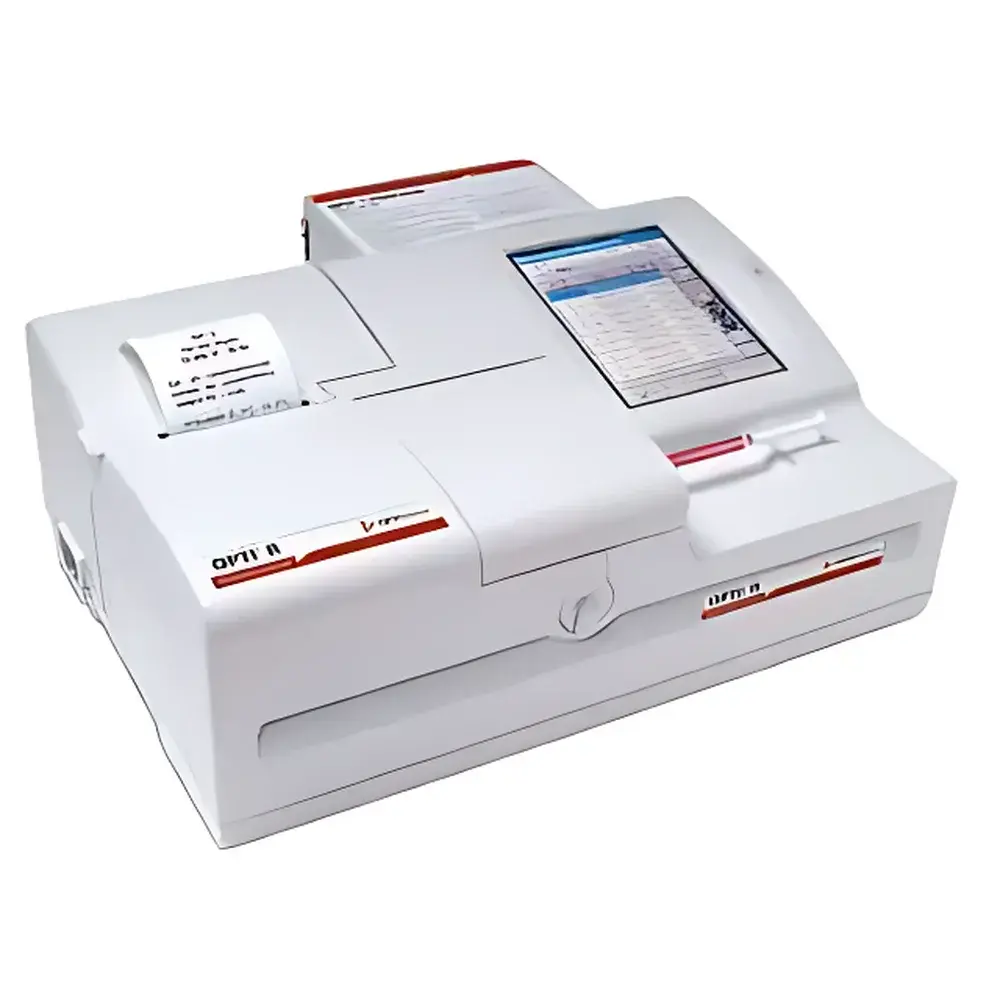
OPTI R Desktop Dry-chemistry Blood Gas and Electrolyte Analyzer
| Brand | OPTI |
|---|---|
| Origin | USA |
| Model | OPTI R |
| Measurement Principles | Optical Fluorescence (pO₂), Severinghaus-type CO₂ Sensor (pCO₂), Potentiometric Ion-Selective Electrodes (pH, Na⁺, K⁺, Ca²⁺), Spectrophotometric Hemoglobin Detection (tHb, SO₂) |
| Sample Type | Whole blood (arterial, venous, capillary), heparinized |
| Test Time | ≤ 60 seconds per sample |
| Cartridge Capacity | 50 tests per single-use disposable cartridge |
| Onboard QC | Three-level automated quality control with integrated calibrators |
| Data Storage | 300 patient results + 60 days of QC records (3 levels) |
| Interface | Built-in barcode scanner, RS232/USB, LIS/HIS-compatible software |
| Display | 7-inch color touchscreen with intuitive graphical UI |
| Regulatory Compliance | FDA 510(k) cleared, CE IVD, ISO 13485 certified |
Overview
The OPTI R Desktop Dry-chemistry Blood Gas and Electrolyte Analyzer is a fully integrated, point-of-care–capable clinical instrument engineered for rapid, precise, and operator-independent analysis of critical blood parameters. Unlike conventional wet-chemistry or electrode-based analyzers, the OPTI R employs a hybrid sensing architecture: optical fluorescence detection for pO₂, a miniaturized Severinghaus-type CO₂ sensor for pCO₂, solid-state potentiometric ion-selective electrodes (ISEs) for pH, sodium, potassium, and ionized calcium, and dual-wavelength spectrophotometry for total hemoglobin (tHb) and oxygen saturation (SO₂). This multi-modal approach eliminates liquid electrolyte refills, electrode polarization delays, and frequent recalibration—enabling stable baseline performance across shifts and ambient temperature fluctuations (15–30 °C). Designed for high-utilization environments—including central laboratories, intensive care units (ICUs), cardiac care units (CCUs), operating rooms, and emergency departments—the OPTI R delivers full-parameter results in under 60 seconds using only 95 µL of heparinized whole blood. Its dry-cartridge format ensures reagent stability at room temperature, eliminating cold-chain logistics and refrigerated storage requirements.
Key Features
- Optical fluorescence pO₂ sensing with <1% coefficient of variation (CV) across physiological range (0–300 mmHg)
- Integrated barometric pressure compensation for accurate altitude-adjusted pO₂ and pCO₂ reporting
- Single-use, factory-calibrated cartridges—each supporting up to 50 consecutive tests without recalibration or maintenance
- 7-inch capacitive touchscreen with context-sensitive graphical prompts and multilingual UI (English, Spanish, French, Chinese)
- Built-in barcode reader for automatic test selection, lot tracking, and expiration validation
- Automated three-level quality control system with onboard calibrator vials; configurable QC schedules per CLIA and ISO 15189 requirements
- On-device data management: stores 300 patient results with timestamps, operator IDs, and cartridge lot numbers; retains 60 days of QC summary statistics (mean, SD, CV, Levey-Jennings plots)
- Robust mechanical architecture rated for continuous operation in environments with ambient humidity up to 80% RH (non-condensing)
Sample Compatibility & Compliance
The OPTI R accepts lithium heparin–anticoagulated whole blood specimens collected via arterial, venous, or capillary puncture. Capillary samples require manual mixing prior to loading. The analyzer is validated for use with standard 1-mL syringes and microtubes (0.5–2.0 mL). It complies with international regulatory frameworks including FDA 21 CFR Part 820 (Quality System Regulation), ISO 13485:2016, and EU In Vitro Diagnostic Regulation (IVDR) Annex II Class B requirements. All measurement algorithms adhere to CLSI EP9-A3 and EP15-A3 protocols for method comparison and precision evaluation. Traceability is maintained to NIST-traceable reference materials for pH, pO₂, and pCO₂. The device supports GLP/GMP-compliant audit trails when connected to validated LIS/HIS middleware.
Software & Data Management
The OPTI R operates with embedded firmware v3.2+ featuring secure, role-based user access (administrator, technician, clinician). Data export is supported via HL7 v2.5.1 messaging over TCP/IP or serial RS232, enabling seamless integration with major laboratory information systems (e.g., Epic, Cerner, Sunquest) and hospital information systems. Optional OPTI Connect desktop software provides advanced QC trending, Westgard rule application, inter-laboratory comparison reports, and FDA 21 CFR Part 11–compliant electronic signatures. All stored results include metadata such as environmental temperature, barometric pressure, cartridge ID, and operator login—ensuring full traceability for CAP inspections and internal QA audits.
Applications
Clinically, the OPTI R supports real-time decision-making in acute respiratory failure assessment (ABG interpretation), metabolic acidosis/alkalosis evaluation (electrolyte panel + pH), perioperative hemodynamic monitoring (ionized calcium, tHb), and sepsis triage (lactate-ready platforms via optional add-on modules). Its rapid turnaround time reduces pre-analytical delays common in centralized lab workflows—particularly valuable during surge events or transport-limited scenarios. In resource-constrained settings, the absence of gas tanks, calibration gases, or liquid reagents significantly lowers total cost of ownership compared to traditional benchtop analyzers.
FAQ
Does the OPTI R require daily calibration or electrode conditioning?
No. Each disposable cartridge contains factory-applied calibration curves and reference layers. No user-performed calibration is required between cartridges.
Can the OPTI R interface with our existing LIS without custom development?
Yes. Standard HL7 ADT/Ack and ORU messages are preconfigured. Site-specific mapping is performed during installation by certified field service engineers.
What is the shelf life of unopened cartridges?
24 months from manufacture date when stored at 15–30 °C. No refrigeration is needed.
Is barometric pressure measured internally or entered manually?
The unit includes an integrated digital barometer; no manual entry is required for automatic correction.
How is traceability ensured for regulatory audits?
All measurements generate immutable audit logs containing timestamp, operator ID, cartridge serial number, environmental conditions, and QC status—exportable in CSV or PDF formats per ISO 15189 clause 5.9.2.